
TL;DR:
- Personalized health programs tailor care based on individual genetics, biomarkers, and lifestyle data.
- These programs improve outcomes like A1C levels, quality of life, and reduce healthcare costs.
- Engagement, consistent coaching, and human oversight are key to maximizing their benefits.
Most health advice you've heard treats everyone the same. Eat less, move more, manage your stress. But if you're living with diabetes, heart disease, or another chronic condition in North Bergen or Secaucus, you already know generic tips often fall short. Personalized health programs use your individual data, including genetics, biomarkers, and lifestyle factors, to build a care strategy that actually fits your life. This guide walks you through how these programs work, what results you can realistically expect, and how to find the right options right here in your community.
Table of Contents
- What are personalized health programs?
- How personalized health programs work: Steps and tools
- Benefits and evidence: What outcomes to expect
- Caveats and controversy: What most articles don't tell you
- How to apply personalized health programs locally
- A clear-eyed perspective: Personalization is a tool, not a magic bullet
- Explore local personalized health solutions
- Frequently asked questions
Key Takeaways
| Point | Details |
|---|---|
| Tailored to you | Personalized health programs use your individual data to create a unique plan for better health. |
| Real results for chronic care | They’re especially effective for diabetes or heart disease when you’re actively engaged in your care. |
| Not just about DNA | Most benefits come from ongoing coaching and behavior changes, not just genetic testing. |
| Choose local support | Combining evidence-based programs with trusted local care leads to better long-term outcomes. |
What are personalized health programs?
With a sense of why personalization matters, let's clarify exactly what these programs involve.
A personalized health program is a structured plan built around your specific health data rather than general population guidelines. Instead of following the same advice given to everyone, you receive recommendations shaped by your body, your history, and your goals. That shift sounds simple, but it changes everything about how care is delivered.
Personalized programs are built around genetics, real-time biometrics, and lifestyle and environmental factors. In practice, this means your provider looks at things like your blood sugar trends, cholesterol readings, sleep patterns, physical activity levels, and even stress responses before recommending a plan. The goal is to identify what your body actually needs, not what the average person needs.
These programs typically cover several key areas:
- Nutrition guidance based on your metabolic responses and health goals
- Exercise recommendations matched to your fitness level and any physical limitations
- Behavioral coaching to support habit change and long-term motivation
- Medication review or adjustments when appropriate, in collaboration with your physician
- Ongoing monitoring so the plan can be updated as your health changes
This is very different from a one-time checkup or a printed handout. Chronic care management programs, for example, involve regular touchpoints and evolving care plans that respond to your progress. If your A1C improves, your plan changes. If you hit a plateau, your coach adjusts your approach.
The evidence on chronic disease management shows that this adaptive, data-driven model consistently outperforms static advice. And the personalized care evidence from the National Institute of Diabetes and Digestive and Kidney Diseases supports building individual plans based on real health assessments.
| Data type | Examples used in personalized programs |
|---|---|
| Genetic markers | Predisposition to conditions like diabetes or heart disease |
| Biometrics | Blood sugar, cholesterol, blood pressure, BMI |
| Lifestyle factors | Diet habits, physical activity, sleep, stress levels |
| Environmental factors | Work schedule, home environment, social support |
Pro Tip: Before your first appointment, write down your last three lab results and any health goals you have. Bringing this information helps your provider build a more accurate starting point for your personalized plan.
How personalized health programs work: Steps and tools
Now that you know the basics, let's look at how these programs play out step by step.
The process usually begins with a thorough health assessment. Your provider collects baseline data through lab tests, health history reviews, and sometimes wearable devices that track real-time activity, heart rate, or glucose levels. This initial data collection is what separates a personalized program from a standard wellness visit.
Here's a typical sequence of steps:
- Initial assessment — Lab work, health history, and lifestyle questionnaires are completed.
- Goal setting — You and your care team identify specific, realistic health targets together.
- Plan creation — A customized plan is developed covering nutrition, activity, and any clinical needs.
- Regular check-ins — Sessions happen by phone, app, or in-person, with a median of around 12 sessions over the program period.
- Plan adjustment — Based on your results and engagement, the plan is updated regularly.
- Long-term monitoring — Ongoing tracking ensures you stay on course and catch issues early.
Mechanics include genetic testing, health coaching, AI-powered feedback, and real-time wearable tracking. The technology side is growing fast. AI-supported health research from Cleveland Clinic shows that AI tools can analyze your data continuously and flag when your plan needs updating, something no human coach could do alone at scale.

| Program type | Primary tools used | Typical contact frequency |
|---|---|---|
| Digital-only | App, wearables, AI feedback | Daily automated, weekly check-in |
| Hybrid | App plus phone coaching | Biweekly calls, monthly in-person |
| In-person | Lab tests, face-to-face visits | Monthly or more frequent visits |
You can explore the full range of program options available locally to see which format fits your schedule and needs. For those already managing a condition, reading tips for managing chronic conditions can help you prepare the right questions before your first session.
Pro Tip: If you use a smartwatch or fitness tracker, ask your provider if your data can be shared directly with your care team. Many programs now accept data exports from common devices, which saves time and improves accuracy.
Benefits and evidence: What outcomes to expect
Understanding the mechanics is key, but what actually happens when you enroll? Let's review the outcomes and evidence.
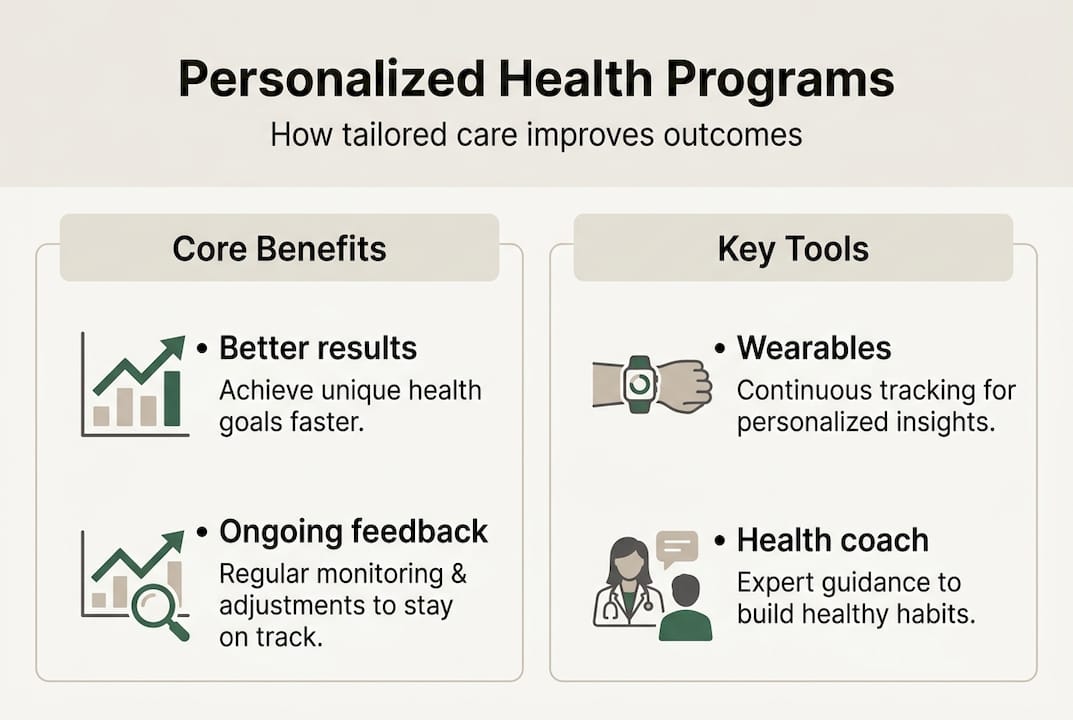
The results from well-designed personalized health programs are genuinely encouraging, especially for people managing chronic conditions like type 2 diabetes. 71% of participants achieved an A1C below 6.5%, and 81% reported improved quality of life in Cleveland Clinic-led research on AI-supported precision health programs. Those are significant numbers.
Health coaching improves self-efficacy, reduces BMI and HbA1c, and increases physical activity levels. This matters because motivation and self-confidence are often the hardest parts of managing a chronic condition long-term. A good coaching relationship addresses those barriers directly.
Here's a summary of common outcomes reported across programs:
- Reduced A1C levels in people with prediabetes and type 2 diabetes
- Lower blood pressure and improved cholesterol readings
- Increased physical activity and better sleep quality
- Reduced healthcare costs, with typical savings around $139 per month
- Stronger self-management skills and long-term behavior change
"Programs that combine personalized data with consistent coaching produce the most sustained improvements in both clinical markers and patient-reported quality of life."
A coaching program case study from the Commonwealth Fund found that health plan-led programs led to measurable improvements in outcomes and reduced overall care costs over time. These aren't just short-term wins.
The benefits of joining health programs extend beyond clinical numbers. Many participants report feeling more in control of their health, which itself leads to better follow-through on medical recommendations. For those with diabetes specifically, the diabetes prevention program at Garden State Medical Group is designed around this kind of evidence-based, individualized approach.
| Outcome | Typical improvement reported |
|---|---|
| A1C levels | Reduction toward or below 6.5% in high-risk groups |
| Quality of life | 81% of participants report improvement |
| Monthly healthcare costs | Average savings of approximately $139 |
| Physical activity | Measurable increase in weekly activity levels |
Caveats and controversy: What most articles don't tell you
Before you get started, it's important to know what limitations exist and what most program descriptions leave out.
Personalized health programs are not a guaranteed fix. The research is promising, but it comes with real caveats that are worth understanding before you commit time and money.
First, genetics matter less than many people assume. There are concerns about variable effectiveness, data privacy, cost, accessibility, and the limited predictive value of genetics in personalized nutrition and health programs. Your DNA provides some useful clues, but lifestyle and behavior still explain far more of your health outcomes than your genetic code alone.
Second, adherence is a persistent challenge. Many people start strong but struggle to maintain engagement over months or years. Programs that rely heavily on self-reporting or app check-ins see higher dropout rates than those with regular human contact.
Third, not all programs are equal:
- Some programs are more marketing than medicine, with little clinical oversight
- Cost can be a real barrier, especially for programs not covered by insurance
- Data privacy is a legitimate concern when sharing sensitive health information with third-party apps
- Access to high-quality programs varies significantly by location and income level
"The most honest summary is this: personalized programs work best for people who are already motivated and at high risk. For lower-risk individuals, the gains over standard care are often modest."
This doesn't mean you should avoid these programs. It means you should choose carefully. Improving preventive care starts with finding providers who combine clinical evidence with genuine accountability. Reading independent health coaching research can help you ask better questions when evaluating any program.
How to apply personalized health programs locally
Equipped with the full picture, here's how you can confidently act on this information in North Bergen or Secaucus.
The good news is that you don't need to travel far or spend a fortune to access quality personalized care. Local primary care and family medicine providers are often the best starting point, especially for managing ongoing conditions.
Here are practical steps to get started:
- Schedule a baseline visit — Request a full health panel including blood sugar, cholesterol, blood pressure, and BMI. This gives you the data foundation any good program needs.
- Ask about specific programs — Inquire about diabetes management, lung health, or weight management programs your provider offers.
- Add a digital layer — Use a wearable or health app to track daily activity, sleep, and diet between appointments. Share that data with your care team.
- Set measurable goals — Work with your provider to define specific targets, like reducing A1C by a certain amount or walking 30 minutes five days a week.
- Review and reset regularly — At each visit, revisit your goals and adjust your plan based on what the data shows.
AI-supported precision health improves outcomes most when paired with consistent human oversight, which is exactly what local primary care provides. The medical services guide for North Bergen and Secaucus is a useful resource for understanding what's available near you. You can also review primary care options to find the right fit for your family's needs.
Pro Tip: Ask your primary care provider directly: "Do you offer personalized health programs or can you refer me to one?" Many providers have resources they don't routinely mention unless a patient asks.
For additional guidance on building your plan, the evidence-based steps from NIDDK offer a solid clinical framework.
A clear-eyed perspective: Personalization is a tool, not a magic bullet
After reviewing all the research and real-world outcomes, one thing stands out clearly. The technology behind personalized health programs is impressive, but it rarely does the heavy lifting on its own. The people who see the best results are those who stay engaged, show up consistently, and build a trusting relationship with their care team.
Many patients gain less from cutting-edge DNA analysis and more from a coach who knows their name, remembers their challenges, and checks in regularly. That human element is hard to quantify but easy to feel.
The value of health program engagement comes down to consistency over time, not the sophistication of the tool. Small, sustainable changes, like walking after dinner or tracking your meals three days a week, often produce more lasting results than a complex protocol you can't maintain.
Choose programs and providers you trust, stay curious about your own data, and remember that personalization is meant to simplify your path forward, not bury you in numbers.
Explore local personalized health solutions
If you're ready to apply what you've learned, here's how to get started locally.
Garden State Medical Group serves North Bergen and Secaucus residents with a full range of evidence-based health programs designed around your individual needs. Whether you're managing a chronic condition or focused on prevention, their team brings together primary care, specialized programs, and ongoing support under one roof.
You can explore all available personalized program options to find the right fit, or connect directly with their primary care services team to start with a baseline assessment. If diabetes management is your priority, the diabetes program offers structured, locally delivered care built on the latest clinical evidence. Reach out today to take the first step toward a plan that's actually built for you.
Frequently asked questions
What's the difference between a personalized health program and basic wellness advice?
Personalized programs use individual data to tailor care strategies, while basic wellness advice applies the same general recommendations to everyone regardless of their health status or history.
What are examples of data points used in these programs?
Programs typically use genetics, real-time glucose and activity readings, cholesterol levels, and lifestyle surveys. These programs are built around biometrics and environmental factors specific to each individual.
Do I need DNA or expensive lab tests to benefit?
No. Many meaningful benefits come from personalized coaching and behavior tracking alone. Genetics explain limited variance in most health outcomes, so lifestyle-focused programs can deliver real results without advanced genetic testing.
What local providers offer personalized health programs in North Bergen or Secaucus?
Garden State Medical Group offers several evidence-based personalized health programs in both North Bergen and Secaucus, including options for chronic disease management, diabetes, and preventive wellness.
Are personalized health programs covered by insurance?
Some insurance plans cover chronic disease programs and health coaching. Programs can lead to cost savings and are sometimes supported by health plans, so it's worth checking with your insurer before enrolling.