
TL;DR:
- Care coordination connects healthcare providers to share information and improve chronic disease management.
- It reduces hospital readmissions, lowers costs, and enhances patient quality of life.
- Patients should actively participate by keeping records and communicating clear concerns.
Managing multiple chronic conditions while seeing different doctors in North Bergen or Secaucus can feel overwhelming, especially when your records seem to disappear between appointments. Many people assume that visiting more specialists automatically leads to better care. But without organized communication between providers, critical details get lost, tests get repeated, and small health problems grow into serious ones. Care coordination improves health outcomes for chronic disease patients by reducing hospital readmissions and emergency visits. This guide explains what care coordination actually is, why it matters for people managing ongoing health conditions, and practical steps you can take right now to benefit from it.
Table of Contents
- What is care coordination and why does it matter?
- Key benefits of care coordination for chronic condition management
- How care coordination actually works: steps, roles, and your part
- Common challenges and how to overcome them
- What most people get wrong about care coordination
- Connect your care with expert coordination in North Bergen and Secaucus
- Frequently asked questions
Key Takeaways
| Point | Details |
|---|---|
| Better chronic care | Care coordination lowers ER visits, repeat hospital stays, and helps manage ongoing conditions more smoothly. |
| Lower healthcare costs | Organized care teams can save thousands of dollars per patient through efficiency and prevention. |
| Active patient role | Bringing your records, asking questions, and joining in decisions boost the impact of coordinated care. |
| Local options available | North Bergen and Secaucus residents have access to integrated care programs to improve their daily health management. |
What is care coordination and why does it matter?
Care coordination is the organized effort to connect all of your healthcare providers so they share the right information at the right time. It means your primary care doctor, cardiologist, endocrinologist, and pharmacist all know what the others are doing. There is no chasing down records and no repeating the same medical history at every new office.
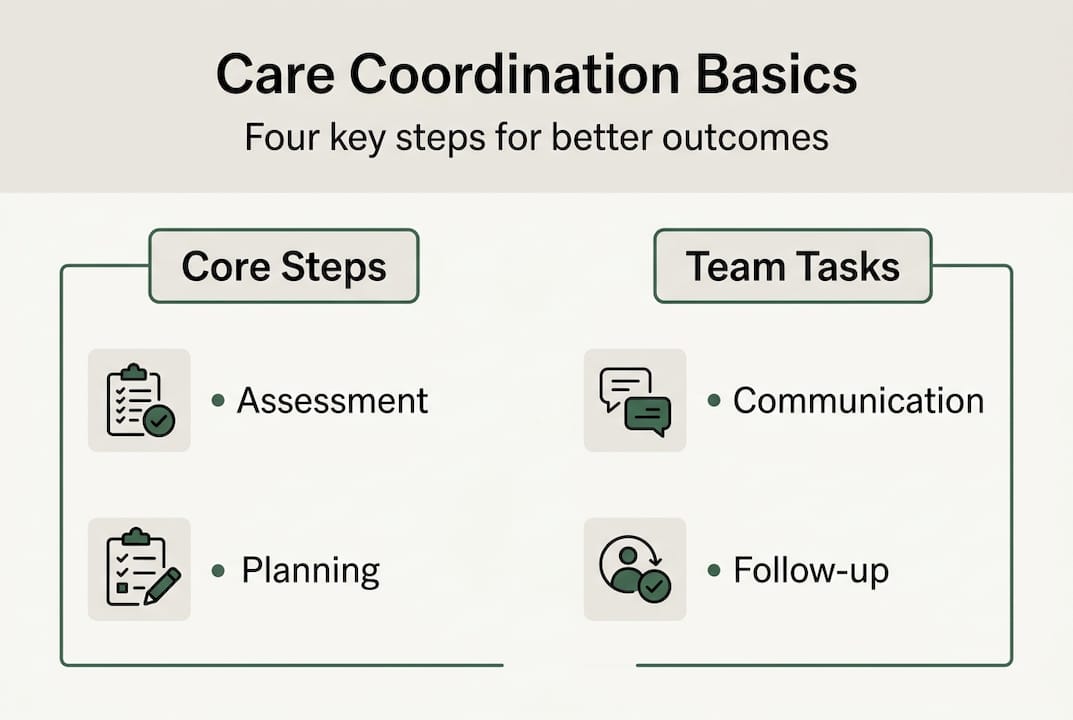
At its core, care coordination involves four basic components. First, a thorough assessment of your current health status and needs. Second, building a care plan that lists your conditions, medications, goals, and next steps. Third, active communication between all members of your healthcare team. Fourth, follow-up monitoring to check whether the plan is working and to adjust it when your needs change.
This matters enormously in communities like North Bergen and Secaucus, where residents often manage several health issues at once. Nationally, 60% of US adults have at least one chronic condition, and 40% have multiple. That means the majority of adults are navigating complex care needs, and most of them are doing it without a clear plan connecting all of their providers.
Consider a real scenario. A local resident with type 2 diabetes visits her primary care doctor, an endocrinologist, and a cardiologist. Without coordination, each provider may order their own bloodwork, adjust medications independently, and miss conflicting prescriptions. With coordination in place, one shared care plan guides every decision. Her blood sugar and heart health are managed together, reducing the risk of an ER visit that could have been avoided.
Supporting your own chronic care management between appointments is easier when you take an active role in the process.
Pro Tip: Keep a personal health folder, whether digital or paper, that holds your current medication list, recent lab results, a list of your providers and their contact information, and notes from recent appointments. Bring it to every visit. This simple habit makes you a more informed participant in your own care.
Key benefits of care coordination for chronic condition management
Understanding what care coordination means, let's look at how it tangibly improves outcomes for people managing chronic conditions.
The financial impact alone is striking. Coordinated care saves up to $8,568 per patient in complex cases. Those savings come from avoiding duplicate tests, preventing unnecessary hospitalizations, and catching complications before they escalate.
| Benefit | What the evidence shows |
|---|---|
| Reduced hospital stays | Fewer readmissions when follow-up is coordinated |
| Lower healthcare costs | Up to $8,568 per patient in complex cases |
| Better health status | Statistically significant improvements after 6 months of coordinated care |
| Improved quality of life | Patients report better daily function and confidence |
| Fewer repeated tests | Shared records eliminate duplicate diagnostics |
One standout example comes from a program using relationship-based case management. That approach saved $248,121 net annually while also improving patient quality of life. That is not a small number. It reflects what happens when patients have a consistent care manager who knows their full history and keeps everything connected.
Beyond the numbers, the lived experience changes too. People who receive coordinated care report fewer ER visits, less confusion about their medications, and a stronger sense of control over their health. You can learn more about how these results translate to local patients by reviewing how to improve chronic health outcomes through structured programs.

For residents in North Bergen and Secaucus, there is an added practical benefit. When your care team works together and your records are centralized, you spend less time traveling between offices for repeat appointments or redundant testing. That means more time for the things that matter in your daily life. If you have specific questions about what these programs include, chronic care FAQs can help clarify what to expect.
How care coordination actually works: steps, roles, and your part
You've seen the benefits, but how does care coordination unfold in real life? Let's walk through the steps.
Step 1: Assessment. A care coordinator or primary care provider reviews your full health picture, including all diagnoses, medications, recent hospitalizations, and social factors like transportation or housing.
Step 2: Care planning. Your team builds a written plan that documents your goals, lists your conditions and treatments, and outlines who is responsible for each part of your care.
Step 3: Communication facilitation. Your providers share updates with each other, particularly when something changes. This is especially important after a hospital discharge or a new diagnosis.
Step 4: Monitoring and follow-up. Your care coordinator checks in regularly to see how you are doing, whether your medications are working, and whether any part of the plan needs to change.
Risk stratification and interdisciplinary teams with patient-centered plans are essential components of effective coordination, particularly for high-risk seniors and those with multiple conditions.
Each member of the team plays a specific role. Your primary care doctor oversees the overall plan. Specialists focus on specific conditions. A care coordinator, often a nurse or social worker, handles communication and logistics. You and your family contribute by sharing accurate information and following through on the plan.
Review these primary care tips to understand how your primary care relationship anchors the whole process. Understanding how to streamline your preventive care visits also makes coordination smoother.
Transitions in care, such as leaving the hospital after a procedure or starting with a new specialist, are the moments when coordination matters most. This is also when medication errors are most common. Assessment, care planning, and follow-up monitoring are especially critical during these transitions.
Pro Tip: After any major appointment or hospital stay, ask your provider for a written care summary. This document should list your current diagnoses, medications, and next steps. Keeping it updated helps every provider you see stay on the same page.
Knowing how to communicate with your doctor clearly is one of the most valuable skills you can develop as a patient.
Common challenges and how to overcome them
While the process works well, there are pitfalls, especially in complex or fragmented systems. Here's what to watch for and how to navigate.
The most common barriers people in North Bergen and Secaucus face include:
- Disconnected records: When providers use different electronic health systems that do not share data, important information falls through the cracks.
- Communication gaps: Specialists may not send notes to your primary care doctor promptly, leaving your team working with incomplete information.
- Coverage confusion: Some patients are unsure whether care coordination services are covered by their insurance, so they never ask about them.
- High-risk transitions: People with complex conditions, especially after a hospital discharge, face the greatest risk from fragmented follow-up.
"Not all programs save costs equally. Integrated systems consistently outperform fragmented ones, and emerging tools like causal machine learning are improving how high-risk patients are identified and supported." Source
Practical strategies can make a real difference here. First, always request a written summary after any hospital stay or specialist visit. Second, bring a trusted family member or friend to important appointments so they can help track information. Third, ask your primary care doctor's office whether they have a care manager or care navigator you can work with directly.
If you're evaluating your options, start by understanding primary care and what role it plays in keeping your full care team aligned. You can also explore specialty care coordination to see how integrated services work in practice.
When evaluating any care team, ask specifically: Do your providers share records with each other? Is there a dedicated person who can help me navigate my care? What happens if I'm discharged from the hospital on a weekend? The answers will tell you a lot about how well-coordinated that system actually is.
What most people get wrong about care coordination
Here's the truth most articles miss. Many people assume that being seen by a reputable hospital system or a well-known specialist means their care is automatically coordinated. It is not. Even in high-quality systems, information silos exist. A cardiologist may not know what your endocrinologist prescribed last month unless someone actively ensures that communication happens.
Over the years, we've seen cases where patients were managing three or four chronic conditions, visiting respected providers, and still experiencing preventable setbacks. The common thread was not poor clinical skill. It was silent information gaps. Nobody had claimed responsibility for connecting the whole picture.
The pattern that leads to the best outcomes is clear: care teams and patients communicate openly, share records proactively, and treat the patient as a partner rather than a passive recipient. Your engagement is not optional. It is a clinical variable. When you arrive at appointments prepared, ask questions, and follow up on your plan, you change your outcomes.
Mastering doctor-patient communication is one of the most practical steps you can take toward genuinely coordinated care.
Connect your care with expert coordination in North Bergen and Secaucus
If you're ready to move from fragmented care to a coordinated strategy, here's how our team can help.
At Garden State Medical Group, we serve residents of North Bergen and Secaucus through an integrated, multidisciplinary approach to care. Our team brings together primary care, specialty services, and dedicated chronic care management programs designed specifically for people managing ongoing health conditions.
Whether you are navigating diabetes, heart disease, lung conditions, or multiple diagnoses at once, we work to make sure every provider on your team is informed and aligned. You can explore all of our chronic care programs or reach out to schedule an appointment and ask about starting a coordinated care plan tailored to your needs. You deserve care that works as a whole system, not a series of disconnected visits.
Frequently asked questions
How does care coordination reduce hospital stays?
Care coordination organizes follow-up and communication so that complications are spotted early, which helps prevent many readmissions. Coleman's intervention reduced 30-day readmissions by 30%.
Is care coordination only for people with multiple conditions?
No, it benefits anyone with ongoing health needs, but it is especially valuable for those managing several chronic illnesses. Nationally, 40% of adults have more than one chronic condition and stand to gain the most.
Who is part of the care coordination team?
Your team typically includes your primary care doctor, relevant specialists, nurses, a care coordinator, and often a family member or caregiver. Assessment, care planning, and follow-up are shared responsibilities across all of them.
Does coordinated care cost extra for patients?
Most coordinated care services are covered by insurance without additional out-of-pocket charges, and the evidence consistently shows it saves money overall, including up to $8,568 per patient in complex cases.