
Managing two or more chronic conditions at once is genuinely hard. Between tracking medications, keeping up with specialist appointments, and trying to stay out of the emergency room, it can feel like a full-time job. The good news is that chronic care management reduces hospitalizations and improves health outcomes for people just like you. Chronic care management, or CCM, is a structured Medicare program designed to give you consistent, coordinated support between office visits. This guide will walk you through eligibility, enrollment, what to expect each month, and how to find trusted CCM providers right here in North Bergen and Secaucus.
Table of Contents
-
Local chronic care management resources in North Bergen and Secaucus
-
The real impact of chronic care management: What experts and patients experience
Key Takeaways
| Point | Details |
|---|---|
| Eligibility basics | Adults with multiple chronic conditions, usually covered by Medicare, qualify for CCM. |
| Monthly care coordination | CCM provides regular, team-based management to supplement standard office visits. |
| Local provider access | Residents of North Bergen/Secaucus can use FQHCs and primary care programs for CCM services. |
| Documented benefits | CCM leads to lower hospital visits, better outcomes, and significant yearly cost savings. |
| Easy enrollment steps | Starting CCM requires a doctor visit, consent, and an electronic care plan shared with you. |
Understanding chronic care management and eligibility
CCM stands for chronic care management. It is a Medicare-covered program that connects you with a care team between your regular doctor visits. Instead of waiting until something goes wrong, your team checks in with you regularly, updates your care plan, and coordinates with your specialists. The goal is to keep your conditions stable and catch problems early.
According to Medicare guidelines, CCM covers adults with two or more chronic conditions expected to last at least 12 months or until death. These conditions must place you at significant risk of decline, acute episodes, or death. That is a broad definition, and it covers a wide range of diagnoses.
Conditions that commonly qualify for CCM include:
-
Diabetes
-
Heart disease or heart failure
-
Chronic obstructive pulmonary disease (COPD)
-
Hypertension (high blood pressure)
-
Arthritis
-
Depression or anxiety disorders
-
Alzheimer’s disease or dementia
-
Chronic kidney disease
You need at least two of these, or similar long-term diagnoses, to be eligible. If you are not sure whether your conditions qualify, reviewing the CCM eligibility FAQs can help clarify things quickly.
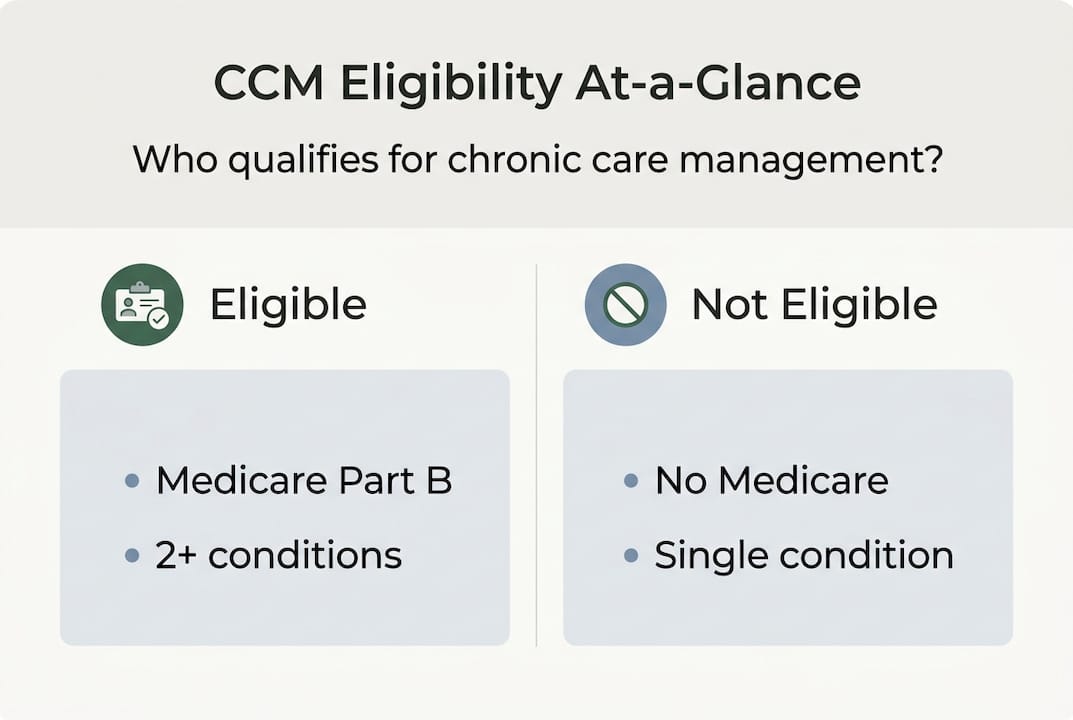
Here is a simple breakdown of who qualifies versus who does not:
| Eligible | Not eligible |
|---|---|
| Medicare Part B beneficiaries | Patients without Medicare |
| Two or more qualifying chronic conditions | Only one chronic condition |
| Conditions lasting 12+ months | Short-term or acute conditions only |
| Willing to provide written consent | Refused to provide consent |
If you are a local resident in North Bergen or Secaucus, you can explore the local CCM program at Garden State Medical Group to see if you qualify. The team there can review your medical history and walk you through your options in plain language.
Preparing for chronic care management: What you need
Once you know you are eligible, the next step is getting ready to enroll. CCM is not something that starts automatically. You need to take a few deliberate steps before your care coordination begins.
The Medicare CCM enrollment process requires three key elements: an initiating face-to-face visit with your doctor, written patient consent, and a comprehensive electronic care plan. Each of these plays a specific role in making sure your care is properly documented and coordinated.
Here is what the enrollment process looks like in order:
-
Schedule an initiating visit. This is an in-person appointment where your doctor reviews your conditions, medications, and health goals. It sets the foundation for everything that follows.
-
Provide written consent. You must agree in writing to participate in CCM. Your provider will explain what services are included and what your cost-sharing responsibilities may be.
-
Develop your electronic care plan. Your care team creates a detailed digital plan covering your diagnoses, medications, allergies, upcoming appointments, and goals. This plan is shared across your providers.
-
Confirm your care team contacts. You will be given a point of contact for after-hours questions and urgent concerns.
-
Review your plan and ask questions. Before leaving, make sure you understand what happens next and how to reach your care coordinator.
To make your initiating visit as productive as possible, review our guide on preparing for your doctor visit before you go.
Bring the following to your first appointment:
-
A complete list of all medications, including dosages
-
Names and contact information for all specialists you see
-
Your Medicare card and any supplemental insurance cards
-
A written summary of your symptoms or recent health changes
Pro Tip: Write down your top three health concerns before your initiating visit. Doctors can cover more ground when patients come prepared with specific questions.
You can review the full chronic care program steps on the Garden State Medical Group website before your appointment so you know exactly what to expect.
How chronic care management works: Step-by-step process
After enrollment, CCM becomes a monthly rhythm of care coordination. Understanding what happens each month helps you stay engaged and get the most out of the program.

The core requirement is that CCM provides at least 20 minutes monthly of care coordination by clinical staff under physician supervision. That time is documented carefully and tied to specific billing codes. The most common ones are 99490 for standard CCM (about $60) and 99487 for complex CCM (about $130). FQHCs, which stands for Federally Qualified Health Centers, use a different code called G0511.
Here is what a typical month in CCM looks like:
-
Your care coordinator contacts you. This may be a nurse, medical assistant, or licensed clinical staff member. They check in on your symptoms, medications, and any recent health events.
-
Your care plan is reviewed and updated. If anything has changed, your plan is adjusted. This keeps all your providers on the same page.
-
Specialist communication happens behind the scenes. Your care team reaches out to your cardiologist, pulmonologist, or other specialists as needed to share updates and prevent gaps in care.
-
Medication management is reviewed. Your coordinator checks for interactions, refill needs, and whether you are taking medications as prescribed.
-
Time is documented. Every minute of care coordination is logged. This is important for billing and for making sure you receive the full benefit of the program.
“Staying engaged with your CCM coordinator each month is one of the most effective things you can do to avoid a preventable hospitalization.”
One of the most common mistakes patients make is missing their monthly check-in calls. If you are managing a condition like COPD, consistent contact matters. Our managing COPD tips page explains why regular monitoring makes such a measurable difference.
Pro Tip: Keep a simple health journal between check-ins. Note any new symptoms, medication side effects, or questions. Sharing this with your coordinator saves time and leads to better care adjustments.
If you are unsure whether your current provider has the right experience to lead your CCM, reading about primary care expertise and choosing the right care team can help you make a more informed decision.
Local chronic care management resources in North Bergen and Secaucus
Knowing how CCM works is one thing. Finding a trusted provider close to home is another. Fortunately, residents of North Bergen and Secaucus have solid options available.
According to the Hudson and Bergen County CCM resource guide, local options include North Hudson Community Action Corp, an FQHC serving North Bergen, Hackensack Meridian primary care practices, and HRH Medical Group in Secaucus. These providers accept Medicare and can initiate CCM services directly.
Here are practical tips for accessing CCM in your area:
-
Call your primary care office first. Ask directly whether they offer CCM under Medicare. Not all practices advertise it, but many are enrolled.
-
Ask about FQHC options. FQHCs often serve patients regardless of insurance status and use the G0511 billing code, which can reduce your out-of-pocket costs.
-
Confirm your Medicare coverage. Most CCM services are covered under Medicare Part B, though a copay may apply unless you have a supplemental plan.
-
Request a care coordinator by name. Having a consistent point of contact improves your experience and outcomes significantly.
-
Check telehealth availability. Many CCM check-ins can now happen by phone or video, which is especially helpful if transportation is a barrier.
Garden State Medical Group also offers a range of local health programs designed for residents managing complex or multiple conditions. If memory or cognition is a concern alongside your other diagnoses, the memory and cognition care program may also be relevant for you or a family member.
One important statistic worth knowing: Medicare beneficiaries enrolled in CCM have been shown to experience fewer emergency department visits and lower overall healthcare costs compared to those not enrolled. That is a meaningful difference for anyone managing conditions long-term.
The real impact of chronic care management: What experts and patients experience
Here is something most articles about CCM do not tell you. The program is significantly underused. Despite strong evidence of its benefits, CCM delivers $74 to $8,568 in savings per patient annually, yet 23% of claims still lack proper diagnoses. That means many patients are enrolled but not receiving the full value of the program because documentation is incomplete.
From our experience working with patients in North Bergen and Secaucus, the biggest barrier is not eligibility. It is follow-through. Patients who treat CCM like a passive service, waiting for their care team to do everything, tend to see fewer benefits. Patients who stay engaged, ask questions, and communicate changes between visits see real improvements in stability and quality of life.
The expert outcomes data consistently points to one thing: relationship-based care outperforms transactional care. When you know your coordinator by name and they know your history, the quality of every interaction goes up. That is not a soft benefit. It translates directly into fewer hospitalizations and better medication adherence.
If you want to experience what CCM can genuinely offer, explore our chronic care management program and come in ready to be an active participant.
Connect with local chronic care management experts
You now have a clear picture of what CCM is, how to enroll, and what to expect. The next step is connecting with a provider who can put this into practice for you.
At Garden State Medical Group, our chronic care management program is built around consistent, relationship-based care for adults managing multiple chronic conditions in North Bergen and Secaucus. Our primary care team works alongside specialists to coordinate your care, update your plan monthly, and keep you out of the emergency room. You can also browse our full range of health programs to find additional support that fits your needs. Call us or schedule online today to get started.
Frequently asked questions
Who qualifies for chronic care management in North Bergen or Secaucus?
Adults covered by Medicare who have two or more chronic conditions lasting at least 12 months are eligible for CCM. Your primary care provider can confirm whether your specific diagnoses qualify.
How do I start chronic care management with my doctor?
You begin with an in-person initiating visit, provide written consent, and work with your doctor to build an electronic care plan. From there, monthly coordination begins with a designated clinical staff member.
How much does chronic care management cost under Medicare?
Medicare Part B covers CCM, but a copay may apply. Billing codes range from about $60 for standard CCM to $130 for complex cases. Ask your provider about your specific cost-sharing responsibility.
What outcomes can I expect from CCM?
CCM consistently reduces hospitalizations and ED visits, with some studies showing $243 in monthly savings after seven months of enrollment. Consistent engagement with your care coordinator is the strongest predictor of positive results.
Are there programs near me for CCM?
Yes. Local providers in North Bergen and Secaucus include North Hudson Community Action Corp, Hackensack Meridian primary care, HRH Medical Group, and Garden State Medical Group, all of which offer CCM under Medicare.