
TL;DR:
- Medicare has four parts with different coverage, and some services like dental and vision are excluded.
- Understanding plan differences helps manage costs and avoid surprises; Medicare Advantage often includes extra benefits.
- State programs like PAAD and Senior Gold assist low- and moderate-income seniors with prescription costs and premiums.
Many New Jersey seniors assume Medicare covers everything from doctor visits to dental cleanings, prescriptions to nursing home stays. That assumption can lead to real financial surprises. Medicare has parts with different coverage scopes, and some services are excluded entirely. Understanding what you actually have, what you're missing, and what local programs can fill those gaps is the difference between struggling with medical bills and managing your health with confidence. This article breaks down each Medicare part, compares your coverage options, and points you toward New Jersey programs that can make a meaningful difference in your costs and care.
Table of Contents
- What is Medicare coverage? Parts A, B, C, D explained
- Medicare Advantage vs. Original Medicare: Comparing coverage and limitations
- Prescription drug coverage and out-of-pocket costs: Part D and local programs
- Financial help for Medicare: QMB, SLMB, QI-1, PAAD, and Senior Gold in New Jersey
- Our perspective: What most New Jersey seniors miss about Medicare coverage
- Connect with expert care and support
- Frequently asked questions
Key Takeaways
| Point | Details |
|---|---|
| Coverage varies by part | Medicare coverage depends on whether you have Parts A, B, C, and D, with each covering different services. |
| NJ programs help with costs | State programs like PAAD and Senior Gold help lower-income New Jersey seniors pay for premiums, drugs, and copays. |
| Review plans annually | Medicare Advantage and Part D plans can change—review and update during open enrollment every year. |
| Assistance is available | Free counseling and application help from NJ SHIP and NJ Save simplifies Medicare decision-making. |
What is Medicare coverage? Parts A, B, C, D explained
Now that you know Medicare isn't one-size-fits-all, let's break down what's actually covered. Medicare is a federal health insurance program primarily for people 65 and older. It's divided into four parts, and each one works differently.
Part A is your hospital insurance. It covers inpatient hospital stays, skilled nursing facility care, hospice care, and some home health care. Most people don't pay a monthly premium for Part A if they or their spouse worked and paid Medicare taxes for at least 10 years. However, there are deductibles and coinsurance costs that apply.
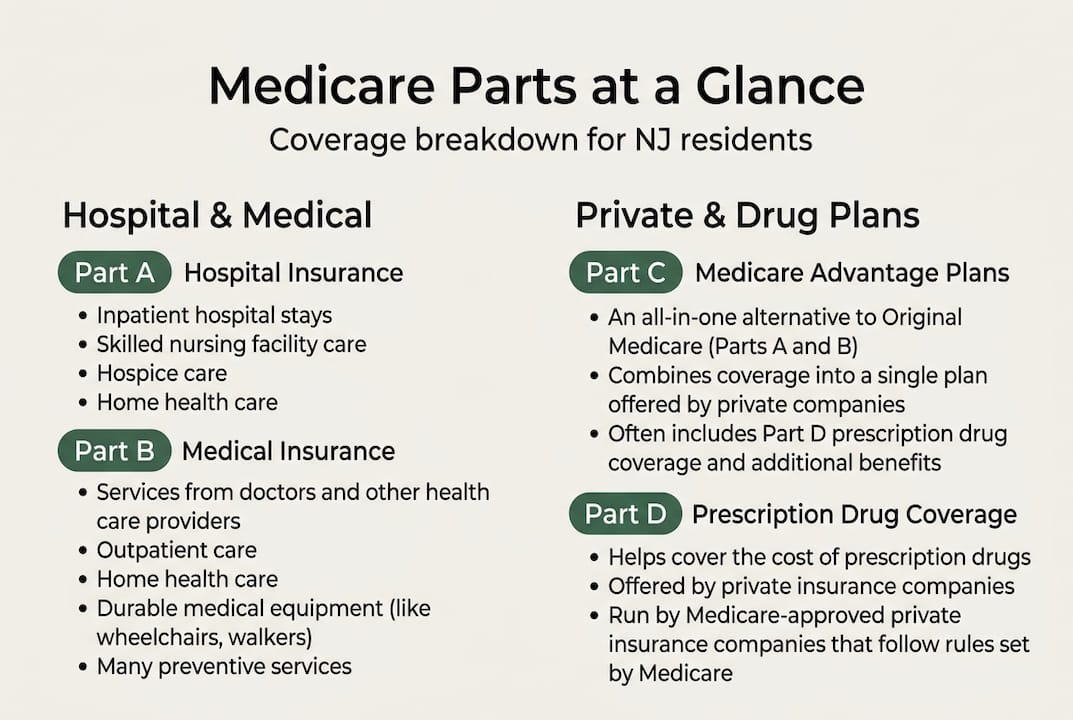
Part B is your medical insurance. It covers outpatient care, doctor services, preventive services, durable medical equipment, and home health care. In 2026, the standard Part B premium is $185 per month. Part B also has an annual deductible and covers 80% of approved costs after you meet it, leaving you responsible for the remaining 20%.
Part C, also called Medicare Advantage, is an alternative to Original Medicare. Private insurance companies approved by Medicare offer these plans. They must cover everything Original Medicare covers, but many add extra benefits. Part D covers prescription drugs and is offered through private plans that work alongside Original Medicare.
Here's a quick comparison of what each part covers:
| Medicare part | What it covers | Monthly cost (2026) |
|---|---|---|
| Part A | Hospital, skilled nursing, hospice | $0 for most people |
| Part B | Outpatient, doctor visits, preventive | $185 (standard) |
| Part C | All of A and B, often more | Varies by plan |
| Part D | Prescription drugs | Varies by plan |
What Medicare does not cover is just as important. Routine dental care, vision exams, hearing aids, and long-term custodial care are generally not included under Original Medicare. These gaps surprise many people after they enroll.
New Jersey is also part of the CMS WISeR pilot launching in 2026, which adds prior authorization requirements for certain services. This means your doctor may need to get approval before some procedures are covered. Staying informed about your insurance options can help you prepare for these changes.
Pro Tip: Avoid late enrollment penalties by signing up during your Initial Enrollment Period, which begins three months before you turn 65. Late enrollment penalties for Medicare are permanent and can follow you for years. For more general health tips for seniors, staying proactive about enrollment is one of the smartest moves you can make.
Medicare Advantage vs. Original Medicare: Comparing coverage and limitations
With the main Medicare parts explained, it's helpful to examine the two main coverage pathways side by side. Original Medicare (Parts A and B) gives you broad access to providers nationwide. You can see any doctor or specialist who accepts Medicare, which is a major advantage if you travel or want flexibility. However, it doesn't cap your out-of-pocket spending unless you add a Medigap supplemental policy.

Medicare Advantage plans bundle Parts A, B, and usually D into one plan. Many include extras like routine dental, vision, and hearing coverage that Original Medicare lacks. These plans often have lower premiums, but they typically require you to use a network of providers.
| Feature | Original Medicare | Medicare Advantage |
|---|---|---|
| Provider access | Any Medicare-accepting provider | Network-based |
| Out-of-pocket cap | None (without Medigap) | Annual cap required |
| Dental/vision/hearing | Not included | Often included |
| Drug coverage | Separate Part D plan needed | Usually bundled |
| Referrals needed | No | Sometimes |
In New Jersey, Medicare Advantage is popular in densely populated areas like Hudson County. But there's a real concern worth knowing: some plans list providers who are no longer accepting new patients or have left the network. These are sometimes called "ghost" providers. Before you enroll, call the doctors you want to see and confirm they're actively accepting that specific plan.
Understanding the difference between routine and urgent care also matters when choosing a plan. Knowing when to use urgent care vs. primary care can affect your costs depending on your plan type.
Pro Tip: Review your Medicare Advantage plan every year during Open Enrollment, which runs October 15 through December 7. Plans can change their networks, premiums, and drug formularies annually. Use the AARP enrollment guide for New Jersey-specific guidance on comparing your options each fall.
Prescription drug coverage and out-of-pocket costs: Part D and local programs
Next, let's address prescription drug coverage, a critical area for many New Jersey seniors. Part D plans are sold by private insurers and each one has its own formulary, which is the list of covered drugs. They also have their own pharmacy networks. A drug that's covered under one plan may not be covered under another, so comparing plans before you enroll matters a great deal.
The good news is that a significant change took effect recently. The donut hole has been eliminated and a new $2,100 out-of-pocket cap for Part D is now in place. This means once you spend $2,100 on covered drugs in a year, your plan pays 100% for the rest of the year. That's a major relief for seniors on multiple medications.
New Jersey also offers two state programs that help fill coverage gaps:
PAAD (Pharmaceutical Assistance to the Aged and Disabled) helps low-income seniors by paying Part D premiums and copays. Senior Gold is another state program that provides drug coverage assistance for those who don't qualify for PAAD but still need help.
Here's how to apply for PAAD or Senior Gold:
- Gather your income documents, Medicare card, and proof of New Jersey residency.
- Visit the NJ Division of Aging Services website or call 1-800-792-9745.
- Complete the application online or by mail.
- Submit any required documentation and wait for a determination letter.
- Once approved, your benefits will coordinate automatically with your Part D plan.
If you're near North Bergen, our North Bergen location can connect you with staff who are familiar with these programs. You can also explore our senior programs for additional support resources.
| Program | Who it helps | Key benefit |
|---|---|---|
| PAAD | Low-income seniors | Pays Part D premium and copays |
| Senior Gold | Moderate-income seniors | Reduces drug costs |
| Extra Help (federal) | Very low-income seniors | Subsidizes Part D costs |
Financial help for Medicare: QMB, SLMB, QI-1, PAAD, and Senior Gold in New Jersey
After understanding coverage and costs, many seniors need help affording Medicare itself. New Jersey participates in federal Medicare Savings Programs (MSPs) that pay for premiums and cost-sharing based on your income and assets.
QMB (Qualified Medicare Beneficiary) is the most generous program. It pays your Part B premium and cost-sharing for singles with income at or below $1,305 per month and assets at or below $9,660. SLMB (Specified Low-Income Medicare Beneficiary) pays only the Part B premium for those with slightly higher income. QI-1 (Qualifying Individual) helps a broader group but funding is limited, so applying early in the year is wise.
Here's a summary of the main programs:
| Program | Income limit (single) | Asset limit | Benefit |
|---|---|---|---|
| QMB | Up to $1,305/mo | $9,660 | Pays Part B premium and cost-sharing |
| SLMB | Slightly above QMB | $9,660 | Pays Part B premium only |
| QI-1 | Higher than SLMB | $9,660 | Pays Part B premium (limited funding) |
| PAAD | NJ-specific thresholds | Varies | Pays Part D premium and copays |
To apply for these programs, follow these steps:
- Visit NJ Save at njsave.org to apply online for PAAD, Senior Gold, and MSPs in one place.
- Gather proof of income, Medicare card, bank statements, and residency documents.
- Submit your application and watch for a confirmation or request for more information.
- Contact NJ SHIP (State Health Insurance Assistance Program) for free help completing your application.
Our Secaucus location can refer you to local SHIP counselors. If you're managing a chronic condition alongside your Medicare coverage, our chronic care management program is designed to support you with coordinated care. You can also read our detailed chronic care management guide to understand how coordinated care works.
Our perspective: What most New Jersey seniors miss about Medicare coverage
We've worked with many seniors in North Bergen and Secaucus who came to us confused about their coverage, and we've noticed a pattern. Most people read their plan brochure once and assume nothing changes. But Medicare plans do change every year, and missing the annual review window can mean staying in a plan that no longer fits your needs or budget.
Another thing people often overlook is the real cost of routine care gaps. Dental and vision expenses add up quickly, and assuming Medicare handles them leads to unpaid bills that could have been avoided with the right plan.
The most practical advice we can offer is this: don't navigate Medicare alone. NJ SHIP provides free counseling from trained advisors who have no financial stake in which plan you choose. They can review your paperwork, catch errors, and help you compare options honestly. Our chronic care support team can also coordinate with your coverage to make sure your medical needs are met without unnecessary gaps.
Pro Tip: NJ Save and SHIP counselors can catch paperwork mistakes that delay or reduce your benefits. Use them before you submit any application.
Connect with expert care and support
If you're ready to make Medicare work for you, here are local resources and programs that can help. Garden State Medical Group serves seniors in North Bergen and Secaucus with a full range of services designed to work alongside your Medicare coverage.
Our primary care services are built to support preventive care and ongoing health management, both of which Medicare Part B covers. If you're managing a chronic condition, our chronic care management program helps coordinate your care so nothing falls through the cracks. Browse our full list of senior health programs to find the right fit for your needs. We're here to help you get the most from your coverage and your health.
Frequently asked questions
Does Medicare cover routine dental, vision, or hearing care?
Original Medicare does not cover routine dental, vision, or hearing services, but some Medicare Advantage plans may include these benefits as part of their coverage.
What is the out-of-pocket cap for prescription drugs under Part D in 2026?
The Part D out-of-pocket cap in 2026 is $2,100, and the donut hole coverage gap has been fully eliminated, meaning your plan covers 100% of drug costs after you reach that limit.
How can New Jersey seniors get free help choosing or applying for Medicare coverage?
NJ SHIP provides free counseling from unbiased advisors, and you can apply for state assistance programs like PAAD and Senior Gold through the NJ Save online portal.
What happens if I enroll late in Medicare?
Missing your initial enrollment window can result in permanent late enrollment penalties added to your monthly premiums, which stay with you for as long as you have Medicare.
Does Medicare cover long-term nursing home or custodial care?
Medicare does not cover long-term custodial care; it only covers short-term skilled nursing facility stays following a qualifying hospital admission of at least three days.