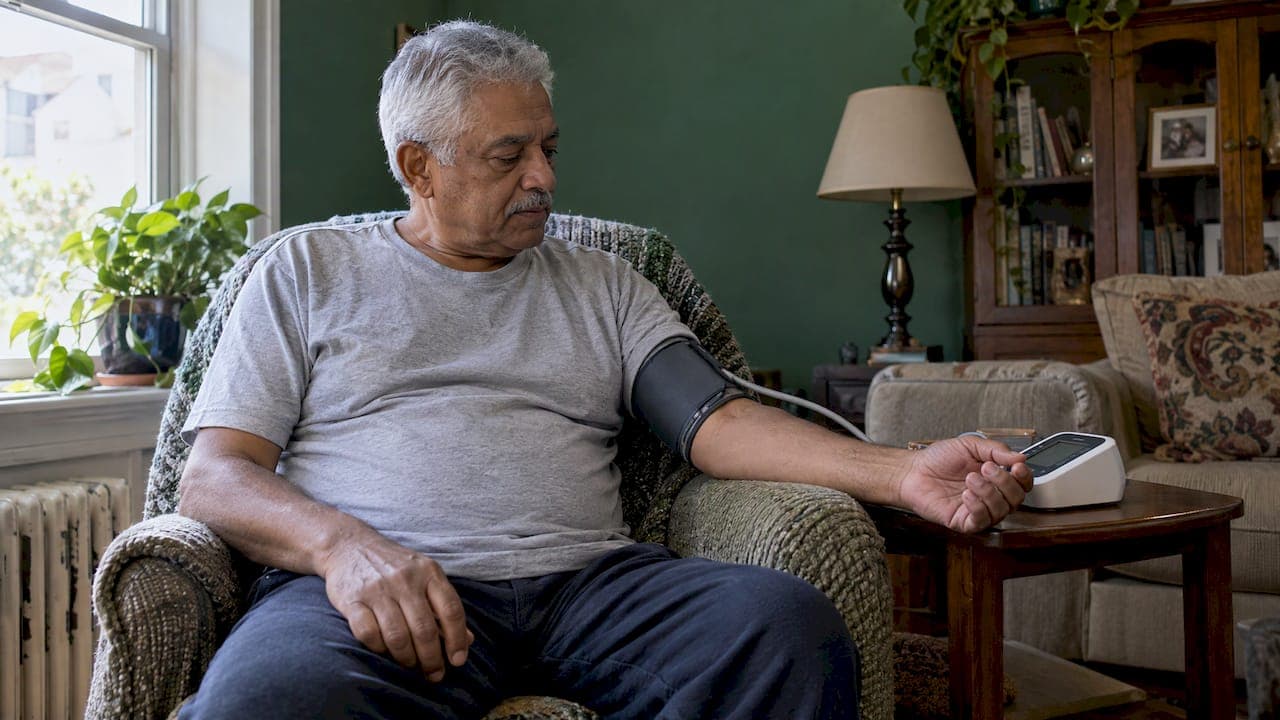
Home blood pressure monitoring means checking your own readings with an automatic upper arm cuff, in a calm and consistent routine, and sharing the results with your care team. Done well, it gives your doctor a far more complete picture than a single reading in an exam room. This guide covers which monitor to buy, the best time of day to measure, how many readings to take, how to keep a log, and which numbers mean you should call for help.
TL;DR
- Use an automatic, cuff-style, upper arm monitor. The American Heart Association does not recommend wrist or finger devices.
- Sit quietly for five minutes, feet flat, back supported, arm at heart level, cuff on bare skin. Do not talk during the reading.
- For decision-making, the usual pattern is two readings one minute apart in the morning and two in the evening, across about a week.
- Write every reading in a log or use your monitor's memory, and bring it to each appointment.
- A sudden reading above 180/120 mm Hg: wait a minute and retest. If it is still that high, contact a healthcare professional right away. With symptoms, call 911.
Table of Contents
- Why measure at home at all
- Choosing a home blood pressure monitor
- How to check your blood pressure at home
- The best time to take your blood pressure
- How often to check, and how many readings to take
- Keeping a home blood pressure log
- How accurate are home readings?
- When a reading is an emergency
- Our perspective on home monitoring
- Make your readings count at your next visit
- FAQ
- Sources
Why measure at home at all
A blood pressure reading in a clinic captures one moment. Blood pressure changes with the time of day, with stress, with what you ate and with how you slept. Readings taken at home, in your own chair, over several days, show your usual pattern.
This helps in a few specific ways. Home readings can show whether your treatment is working, according to the American Heart Association. They can also reveal whether nervousness in the doctor's office is pushing your numbers up. The CDC notes that being nervous about having your blood pressure taken can raise a reading, which is often called white coat syndrome. If that sounds like you, our article on confirming white coat hypertension at home in one week walks through the process.
Home monitoring is especially useful if you have been diagnosed with high blood pressure, if your medication was recently changed, or if your provider has asked you to track your numbers between visits. If you have never had your pressure checked in a while, start with a visit to your primary care provider, then build a home routine from there.

Choosing a home blood pressure monitor
The single most important choice is the type of device. The American Heart Association recommends an automatic, cuff-style, upper arm (biceps) monitor. Wrist and finger monitors are not recommended.
A few practical points when you shop:
- Pick a validated device. The AHA advises using a monitor that has been validated for your specific needs, such as use by older adults or during pregnancy. A validated model has been tested for accuracy against a clinical standard. Ask your provider or pharmacist if you are unsure which model fits.
- Get the right cuff size. A cuff that is too small or too large can distort readings. Measure your upper arm and check the size range printed on the cuff packaging. Many monitors come with a standard cuff only, and larger or smaller cuffs are often sold separately.
- Keep it simple. An automatic inflation device with a clear display and built-in memory is enough. Bluetooth and app syncing are convenient, but they do not make a reading more accurate.
- Bring it to your appointment. Taking your monitor to a visit lets your provider compare its readings with the office equipment, which is a good way to confirm it is accurate.
If you are comparing models, check that the cuff fits comfortably, that the display is easy to read without glasses, and that the monitor can store readings. Those features matter more than extras.
How to check your blood pressure at home
Technique matters. Small mistakes add up. According to the American Heart Association, a reading taken over clothing can be off by 5 to 50 points, so cuff placement is worth getting right.
Before you measure
A few minutes of preparation make the reading more trustworthy:
- Wait 30 minutes after eating, drinking, smoking, exercising or having alcohol or caffeine. The CDC says each of these can raise a reading. If you want to understand how your morning coffee fits in, this overview of caffeine and blood pressure is a helpful place to start.
- Empty your bladder. The CDC lists this as part of preparing to measure.
- Sit in a comfortable chair with your back supported for at least five minutes before you start.
During the reading
- Sit with your feet flat on the floor and your legs uncrossed.
- Rest your arm on a table or other flat surface so the cuff is at heart level.
- Place the cuff on bare skin, not over a sleeve. Roll up a loose sleeve rather than pushing it up tight, which can squeeze the arm.
- Stay still and quiet. The AHA advises against talking or using your phone during the measurement.
- Press the start button and wait for the monitor to finish.
After the reading
Write down both numbers right away: the top number (systolic) and the bottom number (diastolic), plus your pulse if your monitor shows it. If you are not sure what the numbers mean, our clear guide to blood pressure numbers explains them in plain language.
The best time to take your blood pressure
Blood pressure tends to be highest in the morning, falls through the day and is lowest during sleep, as the American Heart Association explains. That is why one reading at a random hour can mislead.
A simple routine that follows this guidance:
- Morning: Measure before breakfast and before you take any medicine, after you have been up a short while and have emptied your bladder.
- Evening: Measure again at about the same time each evening, before dinner or at least 30 minutes after.
Consistency matters more than the exact clock time. If you measure at 7 a.m. and 7 p.m. every day, your readings are comparable from one day to the next. If your provider gives you a different schedule, follow theirs. They know your history and your medications.
How often to check, and how many readings to take
Two questions come up constantly: how many times per sitting, and how many days.
Per sitting: Take two readings at least one minute apart. The 2017 ACC/AHA guideline recommends at least two readings one minute apart in the morning and in the evening, as described in a study published in the Journal of the American Heart Association. Record both. Your provider will usually average them.
Per week: The same publication describes the preferred approach as readings morning and evening for 7 days, with a minimum of 3 days. In that study, the average of two morning and two evening readings across the first week was very consistent with the average from the following week. A single week of careful readings can therefore be a reliable snapshot.
Ongoing: After that initial week, how often you check depends on your situation. Some people measure a few days a week, others once daily, and some only before appointments. Your provider may ask for a week of readings before each visit, or more frequent checks after a medication change. Ask for a schedule that fits your care plan, and do not check more often than advised. Repeated measuring all day can raise anxiety without adding useful information.
Here is a sample one-week plan:
| Day | Morning | Evening |
|---|---|---|
| 1 to 7 | 2 readings, 1 minute apart, before food and medicine | 2 readings, 1 minute apart, same time each evening |
| After day 7 | Add up and average, or share the log with your provider | Follow your provider's schedule |
Keeping a home blood pressure log
A log turns scattered numbers into something your provider can use. The AHA suggests recording your readings with a printable tracker or your monitor's memory and taking the results to your medical appointments.
A useful entry includes:
- Date and time
- Systolic and diastolic numbers for each reading
- Pulse, if your monitor shows it
- Whether you had taken your medication yet
- Anything unusual, such as poor sleep, a stressful morning, a missed meal, or feeling dizzy
Keep the log in one place: a notebook next to the monitor, a spreadsheet, or the monitor's own app. Do not throw out readings that look high or low. Write them all down, because your provider can often spot patterns you cannot, and a high number on a rough day is useful context.
Before a visit, glance at the week's numbers. If you see a clear pattern, such as higher readings in the morning, mention it. If you want to know how your readings are classified, our guide to hypertension stages and next steps gives a plain-language overview.
How accurate are home readings?
Home readings can be very reliable when your technique is consistent. The CDC says readings can be affected by nervousness, recent eating or drinking, smoking, alcohol, caffeine, exercise and how you sit. Each of those is something you can control with a simple routine.
Here are the common causes of a misleading number, and the fix for each:
| What throws a reading off | What to do instead |
|---|---|
| Cuff over clothing | Place it on bare skin |
| Talking or looking at your phone | Stay quiet and still |
| Recent coffee, exercise, smoking or alcohol | Wait 30 minutes first |
| Unsupported back or arm | Sit in a chair with back support and rest the arm at heart level |
| Rushing straight to the monitor | Sit for five minutes first |
| Wrong cuff size | Measure your arm and choose the right cuff |
One odd reading is not a diagnosis. Pay attention to the average over several days, and to the trend. If your home numbers differ a lot from your clinic readings, tell your provider and bring the monitor along so it can be checked.
When a reading is an emergency
Most home readings call for a note in your log and a conversation at your next visit. A few call for action now.
The American Heart Association says that if a reading is suddenly higher than 180/120 mm Hg, you should wait at least one minute and test again. If it is still very high, contact a healthcare professional immediately. If you also have symptoms, call 911.
Symptoms that should make you call 911 alongside a very high reading include chest pain, shortness of breath, back pain, numbness or weakness, vision changes, or difficulty speaking, as listed in the AHA guidance. Do not drive yourself to the hospital in that situation. Our article on when a high blood pressure reading is an emergency goes through what to do step by step.
If your readings are consistently higher than your provider's target but not at the emergency level, call the office during business hours rather than waiting for your next scheduled visit.
Our perspective on home monitoring
At Garden State Medical Group, we see home blood pressure monitoring as one of the most practical tools a patient can bring to a visit. A reading in our office is useful, but a week of careful readings from your own kitchen table tells us much more about how your body behaves in daily life.
Our approach combines primary care, cardiopulmonary services, on-site diagnostic testing and education programs under one roof in North Bergen and Secaucus. That means your home numbers do not sit in a drawer. We can review your log, talk through patterns, and, when it is appropriate, arrange testing such as an EKG or an echocardiogram without sending you across town.
We also believe monitoring should stay calm and manageable. The goal is not to check constantly. The goal is a clear routine, a log you can hand us, and a plan you understand. We design our programs around prevention, chronic condition management and patient education, so you know what your numbers mean and what to do next.
Garden State Medical Group
Make your readings count at your next visit
Home readings are most valuable when someone helps you interpret them. If you live in or near North Bergen or Secaucus, our primary care team can review your log, check your technique and your monitor, and build a plan with you. If your numbers suggest the heart or lungs need a closer look, our on-site diagnostics are available in the same practice.
Start with primary care at Garden State Medical Group to book a visit, or learn about our cardiopulmonary care services and diagnostic testing. For ongoing conditions such as hypertension, our chronic care management program supports regular check-ins between visits. We accept Medicare and Medicaid among other insurance plans, so call the office to confirm your coverage before you book.
For more on why tracking matters across your health, see our overview of what health monitoring is and why it matters. Food also plays a part, and our post on healthy food choices to help control your blood pressure is a practical next read.
FAQ
What is the best time to take blood pressure at home?
Morning and evening, at about the same times each day. Blood pressure tends to be highest in the morning, so measure before you eat or take medicine, then again in the evening. Following the same schedule makes your readings comparable, which matters more than the exact hour.
How many readings should I take each time?
Take two readings at least one minute apart, in the morning and in the evening. Write both down. Guidelines describe doing this for about seven days, with a minimum of three days, to get a reliable average for your provider to review.
Should I use a wrist monitor if an arm cuff is uncomfortable?
The American Heart Association recommends automatic, cuff-style upper arm monitors and does not recommend wrist or finger monitors. If the cuff is uncomfortable or does not fit, ask your provider about a different cuff size rather than switching to a wrist device.
Do I need to log every reading?
Yes, record every reading, including ones that seem off. You can use a notebook, a printable tracker or your monitor's memory. Bring the log to each appointment so your provider can see patterns over time.
What should I do if my reading is very high?
If a reading is suddenly above 180/120 mm Hg, wait at least one minute and test again. If it is still that high, contact a healthcare professional immediately. If you have symptoms such as chest pain, trouble breathing or vision changes, call 911.
Sources
- Home Blood Pressure Monitoring, American Heart Association
- Measuring Your Blood Pressure, CDC
- Monitoring blood pressure at home can be tricky, American Heart Association News
- Number of Measurements Needed to Obtain a Reliable Estimate of Home Blood Pressure, Journal of the American Heart Association
- Caffeine and blood pressure