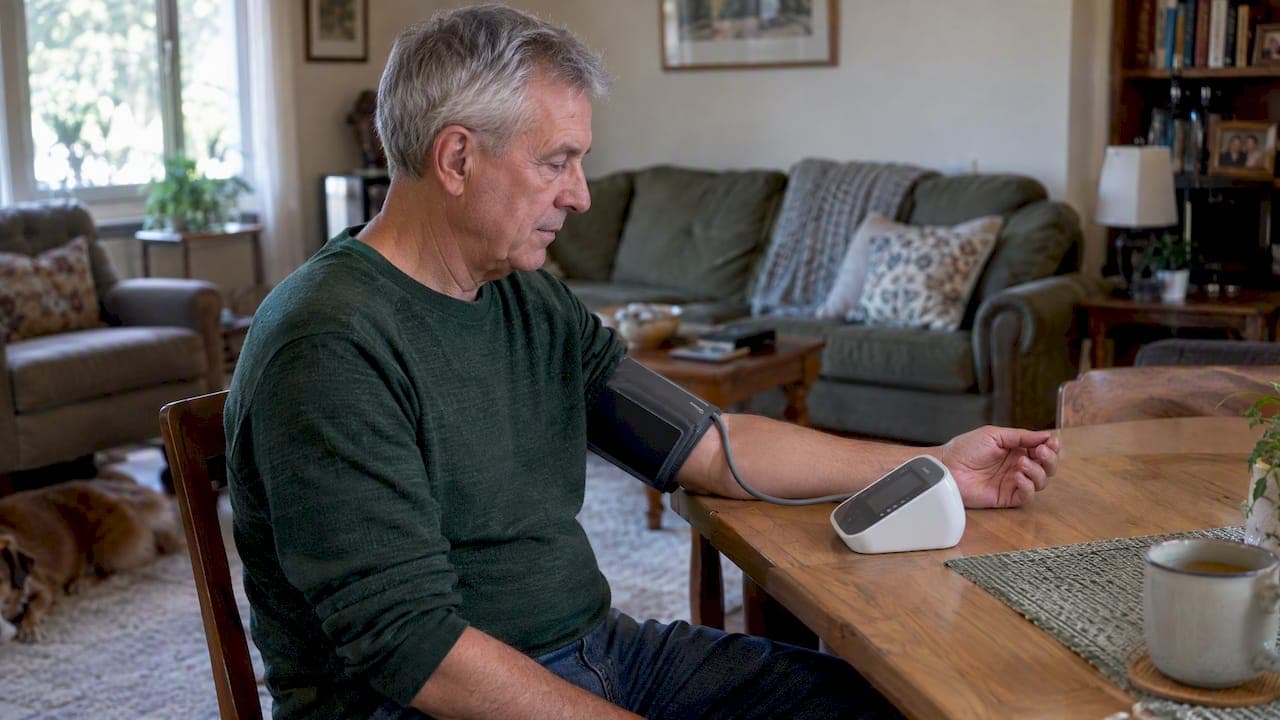
White coat hypertension means your blood pressure runs high in a medical office but stays normal at home or during a day of normal activity. The next step is to confirm it with out-of-office monitoring, either ambulatory blood pressure monitoring or a standardized week of home readings. We also recommend follow-up, because this pattern can progress to sustained hypertension over time.
TL;DR:
- White coat hypertension affects about 15% to 30% of people with elevated office readings, but estimates vary and the pattern can change over time.
- ABPM is the reference standard and captures nighttime pressure; validated home monitoring is a practical alternative, with 130/80 mmHg generally matching office thresholds.
- Take two home readings morning and evening for seven days, then average them; avoid caffeine, smoking, and exercise for 30 minutes beforehand.
- Check cuff fit: 52% of men and 38% of women with hypertension need a nonstandard size, and undersized cuffs can falsely raise readings.
- Medication is not automatic; clinicians may consider it for organ damage or high cardiovascular risk, while others receive periodic monitoring and lifestyle advice.
Table of Contents
- What is white coat hypertension, and how is it different from masked hypertension?
- How common is white coat hypertension, and who tends to get it?
- Does white coat hypertension raise your cardiovascular risk?
- How do clinicians confirm it: ABPM vs. home monitoring?
- How do you measure your blood pressure at home correctly?
- What should you do right after a high office reading?
- How often should you recheck, and when is treatment considered?
- What do the guidelines and studies say, in brief?
- How we approach elevated office readings
- How we can help with elevated blood pressure readings
- FAQ
- Sources
What is white coat hypertension, and how is it different from masked hypertension?
White coat hypertension (also called white coat syndrome) is a high blood pressure reading in a medical setting, 140/90 mmHg or above, paired with normal readings outside the office. Many clinicians also call it the white coat effect when a person already on treatment shows higher numbers at the office than at home. The two terms overlap, but the first describes a diagnosis in someone not yet treated, and the second describes a gap in someone who is.
It helps to see the full set of patterns side by side:
- Sustained hypertension: blood pressure is high both in the office and outside it.
- White coat hypertension: high in the office, normal outside.
- Masked hypertension: normal in the office, high outside. This is the mirror image, and it is easy to miss because the office number looks reassuring.
- Normotension: normal in both settings.
So why do the numbers differ? Situational anxiety is the best-known reason: the exam room, the white coat, the waiting. Other contributors include the observer effect (your body reacts when someone is watching), poor measuring technique, a wrong cuff size, talking during the reading, and ordinary moment-to-moment variability. Blood pressure changes with posture, bladder fullness, caffeine, pain and sleep.
Guidelines use slightly different numeric cutoffs, so check which one your clinician follows. For adults not on treatment, the 2025 AHA/ACC guidance recommends ruling out white coat hypertension with out-of-office monitoring when office pressure is 130/80 mmHg or higher but below 160/100 mmHg. If you want a refresher on what those numbers mean, our guide to understanding your blood pressure numbers walks through systolic and diastolic values in plain language.
How common is white coat hypertension, and who tends to get it?
Among people who get an elevated office reading, white coat hypertension is common. Estimates range from about 15% to 30% of those patients. That means a meaningful share of people told they have high blood pressure at one visit turn out to have normal readings in daily life.
The range is wide because studies differ in how they define the condition, which devices they use, how many office readings they take and which patients they enroll. A study that requires several visits with high readings will find a different share than one that looks at a single visit.
Certain profiles show up more often in the research, although the pattern is not a rule for any one person. White coat hypertension is reported more often in older adults, in women and in people who are not obese or who do not smoke. It also appears more often in people whose office readings are only mildly high rather than severely high. If you tend to feel nervous around medical care, or you notice your pulse jump when the cuff goes on, your odds of a white coat pattern may be higher.
One point surprises many patients: the pattern is not always stable. Some people have white coat hypertension at one visit and sustained hypertension later. Others return to normal readings across settings. European guidance on hypertensive phenotypes also points to variability and limited reproducibility, and recommends that diagnosis rest on repeated blood pressure measurements rather than a single snapshot.
For that reason we treat one high office reading as a question, not an answer. A single visit tells you your blood pressure in one stressful moment. The goal is to learn what it does across a normal week, which is why the confirmation steps later in this article matter so much.

Does white coat hypertension raise your cardiovascular risk?
The research gives a mixed but fairly consistent picture. White coat hypertension generally carries lower risk than sustained hypertension. The honest summary is that the evidence is not settled, and the answer depends on the person.
Experts emphasize that white coat hypertension is a clinical phenotype that warrants follow-up because it can transition into sustained hypertension. That sentence captures the practical meaning: it is not an emergency, and it is not something to ignore.
Several things shift your risk up or down:
- Other risk factors: diabetes, high cholesterol, smoking, a family history of heart disease and kidney problems all make a borderline pattern more worrying.
- Target-organ changes: signs that high pressure may already be affecting the heart, kidneys, eyes or blood vessels raise concern, even if home readings look fine.
- How high the office readings are: the further above the threshold, the more likely a true sustained problem is hiding underneath.
- Age and overall health: the same blood pressure pattern means different things in a healthy younger adult and in an older adult with other conditions.
Guidelines respond to this uncertainty with a middle path. They do not call for automatic medication, and they do not say to forget about it. They recommend periodic monitoring and decisions tailored to your overall cardiovascular risk. Our own Hypertension Stages guide explains how the blood pressure categories are defined and what usually follows from each.
If you have several of the risk factors above, mention them when you discuss your readings. Your clinician may weigh a mild white coat pattern very differently when it comes with diabetes or early kidney changes. Where those factors are absent, the usual plan is watchful monitoring, healthy habits and a repeat check on a schedule you agree on together.
How do clinicians confirm it: ABPM vs. home monitoring?
Two methods are used to see what your blood pressure does outside the office: ambulatory blood pressure monitoring (ABPM) and home blood pressure monitoring (HBPM). Professional statements describe ABPM as the reference standard, noting that it correlates more closely with cardiovascular outcomes than office readings do, and that HBPM is a validated, practical alternative when ABPM is not available or tolerated. Professional guidelines also stress that people should not rely on office readings alone.
ABPM uses a small cuff worn on your upper arm connected to a portable monitor. It takes readings automatically through the day and night for 24 hours. It gives a daytime average, a nighttime average and a picture of how your pressure rises and dips with your daily rhythm. It is particularly useful for spotting nighttime hypertension and for diagnosing masked hypertension. It is typically done at clinics that specialize in hypertension or cardiology, and you wear the device while you go about your day, which can disrupt sleep for some people.
HBPM means you measure at home with your own validated device, following a set schedule. It is easier to access, less costly and well suited to repeated checks over months or years. Its limits are that it depends on your technique and your device, and it cannot show nighttime readings in the way ABPM does.
Here is how the two compare, using the threshold that guidance links to each method:
| Feature | ABPM | HBPM |
|---|---|---|
| What it measures | Automatic readings over 24 hours, day and night | Your own readings, morning and evening, over about a week |
| Best for | Nighttime pressure, daily patterns, masked hypertension | Routine confirmation and long-term tracking |
| Where it happens | Worn during normal daily activity | At home with a validated upper-arm device |
| Guideline threshold | Separate cutoffs for 24-hour, daytime and sleep averages | 130/80 mmHg or higher generally matches the office threshold |
A home average of 130/80 mmHg or above generally aligns with office-based diagnostic thresholds. ABPM reports use their own 24-hour, awake and sleep cutoffs, and your clinician will tell you which ones apply to your report. The pattern that points to white coat hypertension is a high office reading alongside out-of-office averages that fall below those thresholds.
On access and coverage, Medicare covers ABPM for suspected white coat hypertension in some situations, and insurers often ask for prior authorization. Coverage varies by plan, so ask your insurer and your clinician's office before scheduling. If ABPM is not available or not covered, a well-done week of home monitoring is a sound next step.
How do you measure your blood pressure at home correctly?
Home readings are only useful if they follow a standard method. One or two random readings do not settle anything. The standardized HBPM protocol calls for duplicate readings twice daily, morning and evening, for a full week, with the results averaged for clinical decisions. Some guidelines suggest setting aside early readings, since people may be tenser while learning the routine. Follow whichever approach your clinician prefers and ask if you are unsure.
Follow these steps each time you measure:
- Avoid triggers first. Skip caffeine, smoking and exercise for at least 30 minutes before you measure, and use the bathroom beforehand.
- Sit quietly before measuring. Sit in a chair with your back supported, feet flat on the floor and legs uncrossed. Do not talk or look at a screen.
- Position your arm. Rest your bare upper arm on a table so the cuff sits at heart level. Do not measure over clothing, and roll up sleeves loosely so they do not squeeze your arm.
- Take two readings. Wait briefly between them, and write both down right away.
- Repeat morning and evening. Measure in the morning before medication or breakfast, and again in the evening, for seven days.
- Average the results. Bring your log to your appointment, or add the numbers and divide as your clinician instructs.
Pro Tip: Measure at the same times each day and keep your log in one place, such as a notebook next to the monitor, so you never have to reconstruct readings from memory.
Choose a validated device. Only devices independently validated for accuracy should be used for medical decisions. Choose an upper-arm model rather than a wrist or finger monitor, and check validatebp.org for your model, since manufacturers can change model numbers. A device that looks right on the shelf may not have been tested.
Get the cuff size right. Cuff size is one of the most common sources of error. The same research reports that 52% of men and 38% of women with hypertension need a cuff other than the standard adult size, and a wrong size is a primary cause of inaccurate readings. To size yours, measure around the middle of your upper arm with a flexible tape, then match that number to the cuff range printed on the package. A cuff that is too small reads falsely high, which could make a white coat pattern look like sustained hypertension.

What should you do right after a high office reading?
A high number at the doctor's office can be unsettling, but a clear plan helps. Work through these steps in order:
- Ask for a repeat reading and write down both values. A second measurement after a quiet rest is often lower. Ask whether the first number was taken with an automated office device that records several readings while you sit alone, since that method tends to reduce the white coat effect.
- Check the setup. Confirm that the cuff fit your arm, that your back and feet were supported and that you had not just walked in from the parking lot or been talking. If anything was off, say so.
- Start standardized home monitoring. Follow the one-week protocol described above, or ask your clinician whether ABPM makes sense for you. Keep a written log with the date, time and both readings for each session.
- Bring your log to follow-up. Ask what threshold your clinician is using, whether your averages look normal and whether any further testing is needed, such as blood work or a heart evaluation.
- Know the warning signs. A very high reading with chest pain, shortness of breath, severe headache, confusion, weakness, trouble speaking or vision changes could signal a medical emergency. Seek emergency medical care immediately.
Avoid the two opposite mistakes: panicking and starting a medication on your own, or shrugging it off and never checking again. Confirmation with good home or ambulatory data is the point of this whole process, and it takes the time needed to complete the monitoring plan.
How often should you recheck, and when is treatment considered?
If you are diagnosed with white coat hypertension and are not on medication, a common approach is to repeat out-of-office monitoring periodically. That might mean repeat ABPM or another period of home readings, and sooner if your weight, health or risk factors change. Your clinician can adjust that schedule to your situation.
Lifestyle changes are the first-line way to lower risk, whether or not your pressure is confirmed to be high:
- Weight: even modest weight loss can lower blood pressure.
- Sodium: cutting back on salty and processed foods helps.
- Physical activity: regular movement, such as brisk walking on most days, supports healthy pressure.
- Alcohol: keep intake moderate.
- Stress: slow breathing, good sleep and relaxation habits can also take the edge off stressful office visits.
On medication, evidence that antihypertensive drugs help in isolated white coat hypertension is limited. Treatment may be considered when there is target-organ damage or high overall cardiovascular risk. The choice is a shared decision between you and your clinician. For a broader view, see our overview of hypertension management.
What do the guidelines and studies say, in brief?
Across the major sources, the same themes repeat. Guidance from the American Heart Association and the American College of Cardiology, along with other professional groups, supports out-of-office monitoring to confirm a hypertension diagnosis. A scientific statement on blood pressure measurement notes that self-measured monitoring is recommended for diagnosis and management, is linked with better control when paired with other supports, and is cost-effective compared with office-only monitoring.
White coat hypertension is common, its long-term risk is mixed, and the best way to sort it out is to measure blood pressure outside the office. ABPM is the reference standard, and standardized home monitoring is a validated, practical alternative.
How we approach elevated office readings
At Garden State Medical Group, we start with the question your office number raises: what is your blood pressure in real life? We support standardized home monitoring and can arrange diagnostic testing through our cardiopulmonary and diagnostic services when your situation calls for more.
Please bring your home log to your appointment, with dates, times and both readings from each session. Come with specific questions, such as which threshold applies to you, how long to keep monitoring and whether ABPM is a good fit. We also offer educational resources to help you keep up good monitoring habits between visits.
— Garden State Medical Group
How we can help with elevated blood pressure readings
If a high reading at the doctor's office has you wondering what it means, we are ready to help you find out. Primary Care is the best starting point for review of your readings and guidance on home monitoring. Cardiopulmonary Care supports heart-focused evaluation when you need a closer look, and Radiology & Diagnostic Testing covers on-site testing and referrals.
- Book a visit to review your readings and create a monitoring plan.
- Ask about diagnostic testing if your numbers need a closer look.
- Schedule follow-up so we can track your progress over time.
Call or book online with our North Bergen and Secaucus offices today, and bring your blood pressure log with you.
This article is general information, not a substitute for advice from a qualified doctor. Consult a qualified healthcare professional about your own circumstances before acting on anything here.
FAQ
How do you get rid of white coat hypertension?
Many people lower their office readings by practicing slow breathing and sitting quietly before measurement and asking for a repeat reading. Healthy habits such as regular activity, less sodium and a healthy weight support overall blood pressure. Because the pattern can progress, keep up periodic monitoring with your clinician.
How serious is white coat hypertension?
It is usually less serious than sustained hypertension, but it is not something to ignore. Experts say it warrants follow-up because it can progress to sustained hypertension. Your other risk factors, such as diabetes or kidney problems, shape how closely you should be watched.
How high does blood pressure go with white coat syndrome?
Office readings in white coat hypertension are typically at or above 140/90 mmHg, while readings outside the office stay in the normal range. The size of the gap varies from person to person. Only out-of-office monitoring can show which pattern you have.
Does cold weather change blood pressure readings?
Blood pressure can run somewhat higher in cold months, since cold narrows blood vessels. That is why a single reading in any season is not enough to define your pattern. Standardized monitoring over a full week gives a more reliable picture, and a number such as 140/90 should be reviewed with your clinician.