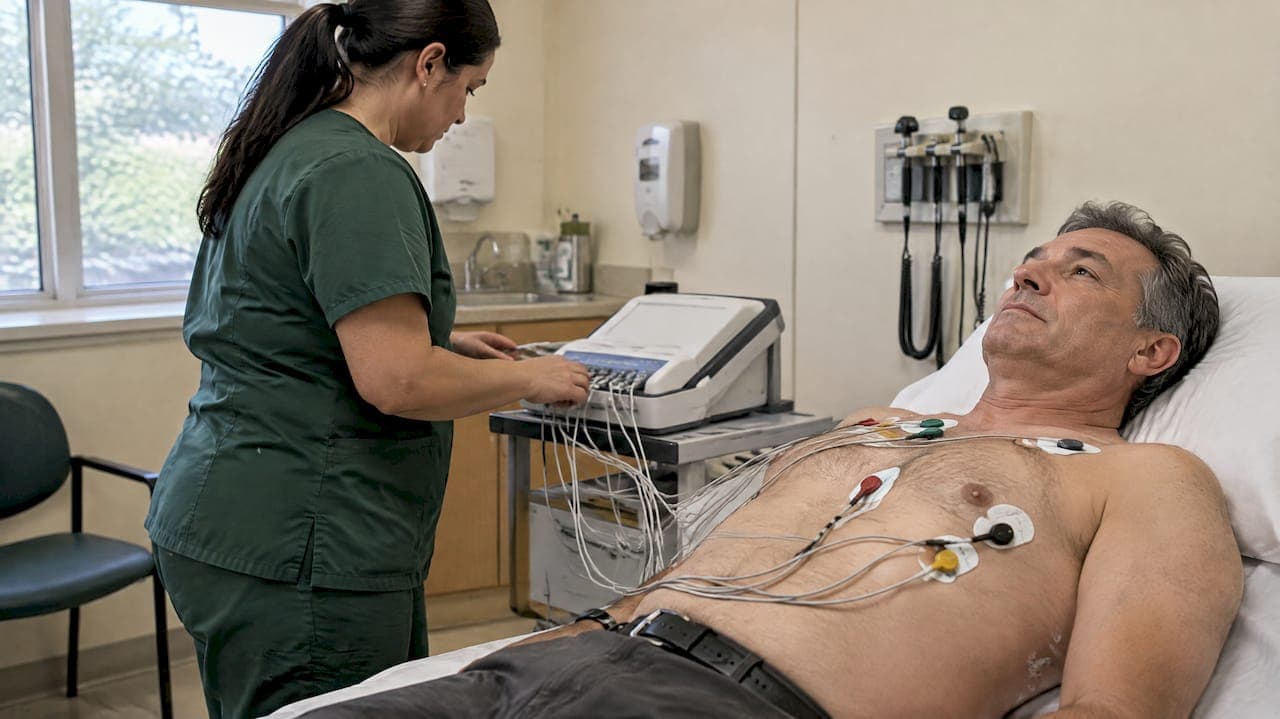
An electrocardiogram test, often called an ECG or EKG, is a quick, painless test that records your heart's electrical activity without sending any electricity into your body. Most resting ECGs take only a few minutes from start to finish, and the recording itself often lasts about 10 seconds. Once it's done, your provider reviews the results and talks with you about what they mean.
TL;DR:
- Resting ECGs are quick, lasting about 10 seconds, and are primarily used to monitor heart rhythm, rate, and detect past heart attacks or irregularities.
- The test's accuracy depends on proper preparation, such as wearing loose clothing, avoiding lotions, and staying still during recording, with longer procedures needed for stress tests or Holter monitors.
- Normal results do not rule out heart disease, and interpretation must consider symptoms and medical history, not just the ECG reading alone.
- Routine ECG screening in asymptomatic, low-risk adults is generally not recommended unless specific occupational or exercise requirements exist.
- The test is safe, involves no radiation, and the most common side effect is short-term skin irritation from electrode adhesive.
Table of Contents
- What an electrocardiogram records and the main test types
- Why your doctor might order an ECG and what it can't tell you
- How to prepare for your ECG: a practical checklist
- What to expect during your appointment, step by step
- How your provider reads the results and what comes next
- How safe is an ECG, and who really needs one?
- How we handle ECG testing and patient support
- A clinician's note on what matters most
- Ready to schedule your ECG or ask us a question?
- FAQ
- Sources
What an electrocardiogram records and the main test types
Your heart beats because of electrical signals that spread through its chambers in a set pattern. During an electrocardiogram test, small electrode patches placed on your chest, arms, and legs pick up these signals and translate them into a wave pattern made of three parts: the P wave, the QRS complex, and the T wave. Each one reflects a different stage of your heartbeat.
There are a few versions of this test, depending on what your provider needs to see:
- A resting 12 lead ECG captures your heart's activity while you lie still, usually in a clinic or hospital room.
- An exercise or stress test tracks your heart while you walk on a treadmill or pedal a stationary bike.
- A Holter or ambulatory monitor records your heart continuously over a day or more as you go about your routine.
A trained technician or nurse usually runs the test, and a physician interprets the results afterward.
Why your doctor might order an ECG and what it can't tell you
Providers order an electrocardiogram test for many reasons: chest pain, heart palpitations, fainting spells, clearance before surgery, or checking how well a medication or pacemaker is working. The test gives a snapshot of your heart rate, rhythm, and electrical pattern, which can reveal signs of a past or current heart attack, an enlarged heart chamber, or an irregular rhythm.
That said, an ECG has real limits. A normal result does not rule out heart disease, and interpretation always depends on your symptoms and medical history, not the numbers alone.
- Chest pain, palpitations, or unexplained fainting are common reasons for testing.
- Pre-surgery clearance and medication monitoring are routine, non-emergency uses.
- Pacemaker or implanted device checks rely on ECG tracings to confirm proper function.
A normal resting adult heart rate falls between 60 and 100 beats per minute, and your provider uses that range as one piece of a larger picture, not a stand-alone diagnosis.
How to prepare for your ECG: a practical checklist
A little preparation helps your technician get a clean, accurate reading on the first try.
- Wear a loose, two-piece outfit so your chest is easy to access, and leave jewelry and watches at home.
- Bring a photo ID, your insurance card, and a current list of your medications.
- Skip lotions, oils, or creams on your chest the day of the test, since they can block electrode contact.
- Mention any blood thinners, antiarrhythmic drugs, or insulin you take, and follow your provider's instructions about timing.
- If you're having a stress test, avoid heavy exercise or large amounts of caffeine beforehand unless your provider says otherwise.
Your technician may need to clip or shave small patches of chest hair so the electrodes stick properly and record a clear signal.
Pro Tip: Keep warm and stay as still as possible during the recording. Shivering or fidgeting can create electrical noise that blurs the reading.
What to expect during your appointment, step by step

Once you're checked in, a technician attaches around 10 small electrode patches to your chest, arms, and legs, connected by thin wires called leads. For a standard resting ECG, the actual recording takes about 10 seconds, while the full visit, including setup and removal, runs roughly 10 to 20 minutes.
A stress test takes longer. You'll walk or pedal at increasing intensity while your heart rhythm, blood pressure, and symptoms are monitored throughout, and the whole appointment can take up to about 60 minutes.
- Resting ECG: brief setup, seconds-long recording, quick removal.
- Stress ECG: exercise protocol with continuous monitoring, longer total visit.
- Holter monitor: a small device worn for a day or more, with instructions on keeping it dry and logging symptoms.
None of these tests should hurt. You might feel a brief tug when the electrode patches are removed, similar to pulling off a bandage.
How your provider reads the results and what comes next
Your provider looks at a few key things on your ECG tracing: your heart rate, whether the rhythm is regular, and the shape and timing of the P wave, QRS complex, and T wave. A heart rate within 60 to 100 beats per minute at rest is typically considered normal, though athletes and people on certain medications can run lower without any problem.
When something looks off, the next step depends on the pattern. Here's how that often plays out:
- An irregular, rapid pattern suggesting atrial fibrillation often leads to a cardiology referral or a Holter monitor for a longer look.
- Changes suggesting reduced blood flow to the heart muscle may prompt blood tests, imaging, or a stress test with imaging.
- For patients with pacemakers, abnormal readings can trigger a device interrogation to confirm it's working correctly.
A normal ECG is reassuring, but it does not guarantee your heart is free of disease. Since routine ECG screening shows limited benefit in people without symptoms, your provider weighs your results alongside your symptoms, risk factors, and history before deciding whether more testing is needed.
How safe is an ECG, and who really needs one?
An electrocardiogram test carries very little risk. It does not use radiation or send any electrical current into your body, and the most common side effect is mild skin irritation from the adhesive electrode pads, which usually fades quickly.
Where the evidence gets more nuanced is screening. For adults without symptoms and at low cardiovascular risk, routine resting or exercise ECG screening has not been shown to improve outcomes, according to evidence reviews on the topic. Some exceptions exist, such as certain occupational requirements or before starting a particularly intense exercise program.
- No radiation and no electrical current pass through your body during the test.
- Mild, short-lived skin irritation is the most common side effect.
- Routine screening in low-risk, symptom-free adults generally isn't recommended, so talk with your provider about your personal risk factors first.
If you're unsure whether screening makes sense for you, our adult screening guide walks through what's typically recommended by age and risk level.
How we handle ECG testing and patient support
We run electrocardiogram testing on site as part of our diagnostics and EKG services, alongside cardiopulmonary care for patients who need follow-up after an abnormal finding. When an ECG points toward a structural issue, we can also coordinate an echocardiogram to get a closer look at how your heart is pumping.
Before your visit, please bring a couple of things:
- Your current medication list, including dosages and timing.
- Your insurance card, so we can confirm coverage and any copay details before the appointment.
Billing questions can typically be addressed ahead of time if you'd like to know what to expect before your appointment.
A clinician's note on what matters most
An ECG is a simple, low-risk test, but its real value comes from pairing the tracing with your symptoms and history, not reading it in isolation. The most useful thing you can do is bring a current medication list and describe your symptoms clearly, including when they happen and what makes them better or worse.
— Garden State Medical Group
Ready to schedule your ECG or ask us a question?
We offer electrocardiogram testing and broader cardiopulmonary care for patients who need follow-up monitoring or treatment after a test.
- Visit our diagnostics page to see the full range of on-site testing we offer, including ECG, echocardiogram, and stress testing.
- Bring your insurance card and medication list to your visit, and check your coverage with us beforehand if you have questions.
If wearable heart-rate tracking has you curious about the difference between fitness data and a diagnostic test, Repbeats has a helpful look at how consumer heart-rate monitoring works, though it serves a very different purpose than a clinical ECG.
This article is general information, not a substitute for advice from a qualified doctor. Consult a qualified healthcare professional about your own circumstances before acting on anything here.
FAQ
What should you not do before an electrocardiogram?
Avoid applying lotions, oils, or creams to your chest, since they can interfere with electrode contact and reduce signal quality. If you're having a stress test, your provider may also ask you to skip heavy exercise or large amounts of caffeine beforehand.
What are three reasons a person would get an ECG?
Common reasons include chest pain or palpitations, clearance before a surgery, and monitoring how well a medication or pacemaker is working. Providers also order one when a patient has fainted without a clear cause.
Is there a difference between an ECG and an EKG?
No, ECG and EKG refer to the same test. Both names describe the recording of your heart's electrical activity, and the terms are used interchangeably in clinics and hospitals.
How long does an electrocardiogram usually take?
A standard resting ECG appointment typically runs about 10 to 20 minutes from setup to removal, though the actual recording lasts only about 10 seconds. A stress test takes longer, often up to about 60 minutes total.
Sources
- Electrocardiogram: MedlinePlus — Lab Tests
- Electrocardiogram (EKG or ECG Test) — Cleveland Clinic
- Electrocardiogram (ECG or EKG) — American Heart Association
- Screening for Cardiovascular Disease Risk With Electrocardiography: An Evidence review (PubMed)