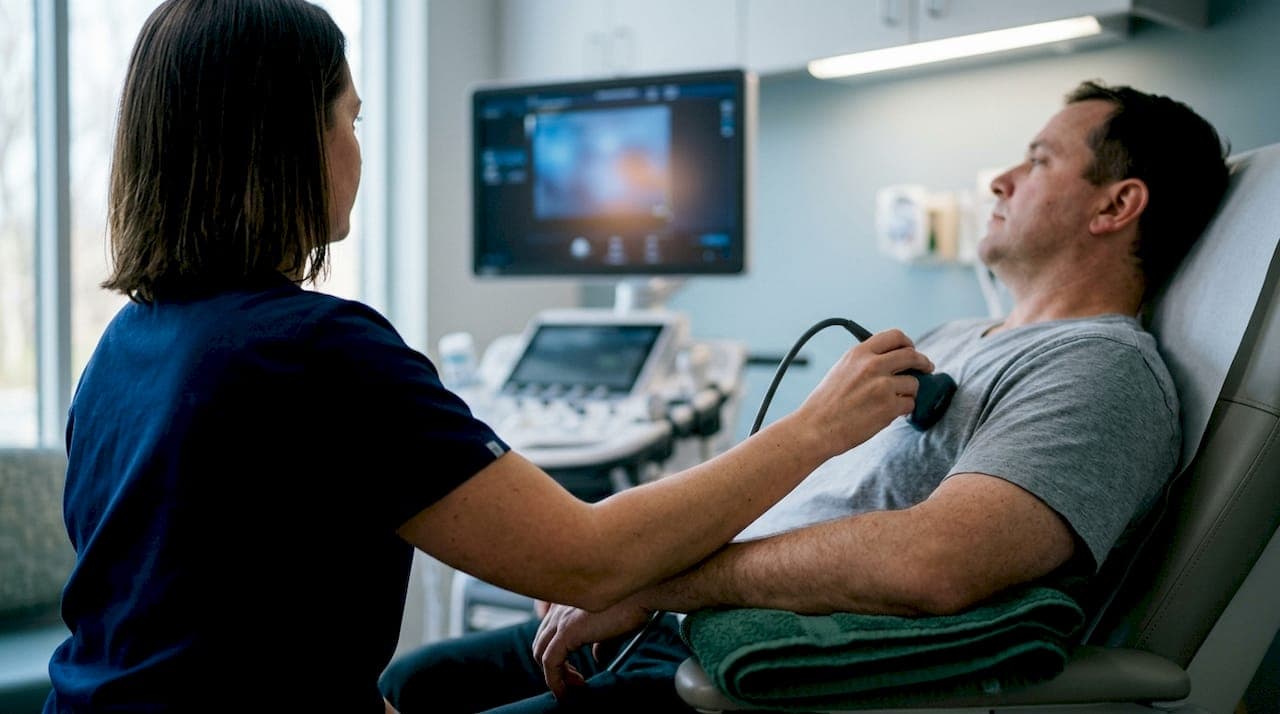
An echocardiogram is an ultrasound test that shows how your heart's chambers, valves, and muscle are working, and for most people it means a painless 30 to 60 minute transthoracic scan with no special preparation. If your doctor orders the transesophageal version instead, you will need to fast beforehand and arrange a ride home. Either way, knowing which test you're having tells you exactly how to prepare.
TL;DR:
- A transesophageal echocardiogram provides clearer images but requires sedation and fasting, necessitating arrangements for transportation afterward.
- Stress echocardiograms may involve exercise or medication to reveal issues only present under exertion, with pharmacologic stress causing temporary side effects like flushing or nausea.
- An echocardiogram typically takes 30 to 60 minutes for the standard TTE and up to 90 minutes if sedation and prep are included for TEE.
- Results focus on ejection fraction, chamber size, valve function, and blood flow, guiding potential medication adjustments or further testing if abnormalities are detected.
- Proper preparation includes bringing identification, medication information, and depending on the test, fasting or exercise-ready clothing, with clear communication essential during the procedure.
Table of Contents
- How an echocardiogram works and why doctors order it
- Which type of echocardiogram will you have?
- Getting ready for your echocardiogram
- What actually happens during the test
- Is an echocardiogram safe? Risks to know about
- Understanding your results and what comes next
- What to expect from a stress echocardiogram specifically
- What to expect when you book an echocardiogram with Garden State Medical Group
- A note on communication during your test
- How to schedule an echocardiogram at Garden State Medical Group
- Sources
- FAQ
How an echocardiogram works and why doctors order it
An echocardiogram uses sound waves, not radiation, to build a moving picture of your heart. A handheld device called a transducer sends these sound waves into your chest and picks up the echoes as they bounce off your heart's walls, valves, and chambers. A related feature called Doppler tracks the speed and direction of blood as it moves through your heart, which helps your doctor spot leaky or narrowed valves.
Together, these tools let your doctor see and measure things a stethoscope or blood test cannot catch. According to Mayo Clinic, the images reveal chamber size, how forcefully your heart pumps, whether valves are opening and closing properly, and whether blood is flowing in the direction it should.
Your doctor might order an echocardiogram if you're dealing with:
- Shortness of breath that doesn't have an obvious cause.
- A heart murmur or unusual sound picked up during a physical exam.
- Chest pain that needs a closer look at heart structure.
- Ongoing monitoring for a heart condition you already have.
- Evaluation before certain surgeries, when your surgical team wants a clearer picture of your heart function.
An echocardiogram and an EKG are often confused, but they measure different things. An EKG records your heart's electrical activity, while an echo shows its physical structure and how well it pumps. Many patients need both, and Mayo Clinic notes that the two tests give complementary information rather than duplicate results.
Which type of echocardiogram will you have?
Not every echocardiogram looks the same, and the type your doctor orders depends on what they need to see.
- Transthoracic echocardiogram (TTE): This is the standard test. A sonographer moves the transducer across your chest from the outside, and it's completely noninvasive. Image quality can be limited by obesity, lung disease, or chest wall shape, which sometimes leads a doctor to recommend a contrast agent or a different type of scan for a clearer view, according to CMS coverage guidance.
- Transesophageal echocardiogram (TEE): A thin, flexible probe is guided down your esophagus, which sits directly behind your heart. Because the probe is so much closer to the heart than skin and ribcage allow, TEE produces sharper images, particularly of valves and the heart's back wall. It requires sedation and throat numbing, which makes it more involved than a standard TTE.
- Stress echocardiogram: Images are taken before and after your heart is stressed, either through exercise or medication, to see how it performs under exertion. This shows problems that a resting echo can miss, particularly reduced blood flow that only appears when the heart works harder.
- Fetal, 3D, and contrast echo: Fetal echocardiography checks an unborn baby's heart structure, while 3D and contrast techniques add detail for complex valve or chamber assessments when standard imaging isn't sufficient.
Your doctor picks the type based on your symptoms, your body, and what specific question they're trying to answer.
Getting ready for your echocardiogram
Preparation depends heavily on which type of echo you're having, so check with your provider about your specific test.
Every echo visit goes more smoothly if you bring a few basics:
- Photo ID and your insurance card.
- A current list of medications and dosages.
- Comfortable, loose-fitting clothing that allows easy access to your chest.
- A written list of questions for your care team.
For a standard TTE, there's typically nothing else to do. You show up, change into a gown if asked, and the test begins.
TEE is different. Most providers require you to avoid food and drink for several hours beforehand, similar to fasting instructions before minor procedures, since sedation and throat numbing carry aspiration risk if your stomach isn't empty. You'll need someone to drive you home afterward, and you should tell your care team in advance about any history of esophageal problems, since that affects whether TEE is safe for you, as NCBI's procedural overview explains.
If you're having a stress echo, wear clothing and shoes suited to walking or light jogging on a treadmill. Your doctor may ask you to hold certain heart medications, such as beta blockers, on the day of the test, but only stop a medication if you're specifically instructed to.
It's also worth confirming with your insurer that the test is covered, since Medicare and other insurers require documented medical necessity rather than routine screening.
Pro Tip: Write your questions down the night before. Once you're in the room, it's easy to forget what you meant to ask.
For a deeper walkthrough of what to pack and how to plan your day, our preparation checklist covers the details specific to each echo type.
What actually happens during the test
Once you arrive, you'll check in, sign a consent form, and change into a gown. Small sticker electrodes are placed on your chest to record a simultaneous EKG tracing, which helps the sonographer time the images to your heartbeat.
For a TTE, the sonographer applies gel to your chest and moves the transducer to several positions, sometimes asking you to shift onto your left side or hold your breath briefly so the images stay sharp. The gel can feel cool at first, and the probe pressure is firm but shouldn't hurt, according to Mayo Clinic.
A TEE involves more steps. A nurse places an IV line, numbs your throat with a spray, and gives you a mild sedative so the probe insertion is tolerable. Once the probe is positioned in your esophagus, images are captured while your oxygen levels and vital signs are monitored throughout. You'll stay in recovery until the sedative wears off enough for you to leave safely, which adds time to the visit.
Stress echo starts with baseline images at rest. You then either exercise on a treadmill or stationary bike, or receive a medication that mimics the effects of exercise, while your heart rate and blood pressure are tracked. A second set of images is taken right after peak exertion to compare against the baseline.
Total time varies by test. According to MedlinePlus, a standard TTE takes about 30 to 60 minutes, while TEE can run up to 90 minutes once you count prep and recovery.

Is an echocardiogram safe? Risks to know about
A standard TTE carries minimal risk. There's no radiation involved, and the only discomfort most people report is mild pressure from the transducer against the chest.
TEE involves more to consider, since it uses sedation and a probe placed in the esophagus. Throat soreness afterward is common, and serious esophageal injury is rare but possible, which is why disclosing any esophageal history beforehand matters. If contrast dye is used during any type of echo, staff will screen you for allergies first, since reactions, though uncommon, can occur.
After a TEE especially, call your care team if you develop a fever, severe throat pain, unusual bleeding, chest pain, or shortness of breath.
Understanding your results and what comes next
A cardiologist interprets your echocardiogram images, typically within a few days, though your ordering provider will let you know the expected timeline for your specific case.
Your report will likely include a few key measurements:
- Ejection fraction (EF): the percentage of blood your left ventricle pumps out with each beat, a core marker of pumping strength.
- Chamber sizes: whether any part of your heart is enlarged.
- Valve function: whether valves are narrowed (stenosis) or leaking (regurgitation).
- Doppler findings: blood flow patterns and estimated pressures within the heart.
A normal EF generally falls in a healthy range, while a lower number can point toward weakened heart muscle that may need further evaluation. Your doctor will explain what your specific numbers mean for you, since normal ranges and their clinical significance depend on your overall health picture.
Depending on what the echo shows, your provider might adjust your medications, schedule a follow-up scan to monitor a known issue, refer you to a cardiologist, or recommend a procedure. In some cases, particularly when TTE images are hard to interpret, your doctor may order a complementary scan such as a cardiac MRI or CT for additional detail.
What to expect from a stress echocardiogram specifically
If you're exercising, the active portion typically lasts 5 to 15 minutes depending on your fitness level and age, with the treadmill or bike gradually increasing in intensity.
If you can't exercise, medications like dobutamine or adenosine and dipyridamole simulate the heart's response to exertion instead. These can cause temporary flushing, a racing heartbeat, or mild nausea, and your medical team monitors your ECG and blood pressure closely throughout, ready to stop the test immediately if needed. Pharmacologic stress is generally chosen for patients with joint problems, breathing limitations, or other conditions that make exercise impractical.
What to expect when you book an echocardiogram with Garden State Medical Group
At Garden State Medical Group, echocardiograms are performed as part of our on-site radiology and diagnostic testing, alongside services like stress testing and EKG. Your study is performed by a trained cardiac sonographer and read by a cardiologist, keeping the imaging and interpretation connected within your care team.
Scheduling is handled directly through the North Bergen and Secaucus locations, and insurance coverage can be confirmed prior to your visit. If your echocardiogram points to a condition that needs ongoing management, our cardiopulmonary care team can follow up in person or through a telemedicine visit, so you're not left figuring out next steps alone. For background reading before your appointment, our article on understanding cardiac ultrasound covers the basics in plain language.
A note on communication during your test
The clearer you communicate with your sonographer, the better your images turn out. Speak up right away if you're short of breath, uncomfortable, or in pain, and mention any esophageal history before a TEE so your care team can plan accordingly. If you're sedated for any part of the test, line up a ride home before your appointment day arrives.
— Garden State Medical Group
How to schedule an echocardiogram at Garden State Medical Group
Getting an echocardiogram at Garden State Medical Group means your imaging, interpretation, and follow-up care happen within one connected team instead of being scattered across separate offices.
Our diagnostics team offers echocardiograms alongside other cardiac testing, including EKGs and stress tests, so your doctor can build a complete picture of your heart health in fewer visits. When you schedule, our staff will confirm what your insurance covers and let you know exactly what to bring.
- Bring your ID, insurance card, and current medication list to your visit.
- Ask our scheduling team whether your specific echo type requires fasting or a driver.
- Follow up with our cardiopulmonary care specialists if your results call for ongoing management.
To book your echocardiogram or review our full range of diagnostic testing, visit our diagnostics page or contact our North Bergen or Secaucus office directly to schedule.
This article is general information, not a substitute for advice from a qualified doctor. Consult a qualified healthcare professional about your own circumstances before acting on anything here.
Sources
- Echocardiogram - MedlinePlus Medical Encyclopedia
- Echocardiogram - Mayo Clinic
- LCD: Echocardiography (L37379) - CMS
FAQ
How long does an echocardiogram typically take?
A standard transthoracic echocardiogram usually takes 30 to 60 minutes. A transesophageal echocardiogram can take up to 90 minutes once you include prep time and sedation recovery.
Why would a doctor order an echocardiogram?
Doctors order echocardiograms to investigate symptoms like shortness of breath, chest pain, or an unusual heart murmur, or to monitor a known heart condition. The test shows chamber size, pumping strength, and valve function that other exams cannot capture.
Do you need someone to drive you home after an echocardiogram?
You only need a driver if you receive sedation, which typically applies to a transesophageal echocardiogram rather than the standard transthoracic version. Ask your care team in advance so you can arrange transportation if needed.
What shouldn't you do before an echocardiogram?
For a standard transthoracic echo, there's usually nothing special to avoid. Before a transesophageal echo, you should avoid eating or drinking for several hours beforehand, following your provider's specific fasting instructions.