
TL;DR:
- Holistic care treats the complete person by addressing physical, emotional, social, cultural, and spiritual health dimensions. It integrates evidence-based conventional treatments with complementary approaches to promote overall well-being and resilience. Patients are active partners in a personalized care process that emphasizes prevention, lifestyle, and root causes over symptom management alone.
Holistic care is defined as a coordinated approach to health that addresses the physical, psychological, social, cultural, and spiritual dimensions of a person, not just their presenting symptoms. The term "integrative medicine" is the recognized clinical standard for this model, and it appears in guidelines from the Merck Manual and major nursing institutions. According to a systematic review of evidence from 2022 to 2025, holistic patient care treats health as a balanced state across all these dimensions. Understanding what is holistic care means recognizing that your sleep, stress levels, relationships, and sense of purpose are just as relevant to your health as your blood pressure or cholesterol.
What is holistic care and what does it include?
Holistic care is a clinical and organizational model that treats the entire person rather than isolating one symptom or organ system. The Merck Manual defines health in this context as a balance between physical, emotional, and spiritual systems. That definition is fundamentally different from conventional medicine's standard, which frames health primarily as the absence of disease.
The core components of a whole-person care model include six distinct dimensions:
- Physical health: Medical treatment, nutrition, exercise, sleep quality, and management of chronic conditions.
- Mental health: Cognitive function, stress levels, mood, and psychological resilience.
- Emotional health: How you process feelings, manage relationships, and cope with life changes.
- Social health: Your support network, community connections, and access to resources.
- Cultural health: How your background, values, and beliefs shape your health decisions and experiences.
- Spiritual health: Your sense of meaning, purpose, and connection to something larger than yourself.
Each dimension influences the others directly. Chronic stress, for example, raises cortisol levels and disrupts sleep, which then weakens immune function and increases cardiovascular risk. No single dimension operates in isolation.
Pro Tip: Before your next medical appointment, write down one concern from each of these six areas. Bringing that list gives your provider a fuller picture and leads to a more productive visit.

How does holistic care differ from conventional medicine?
Conventional medicine defines health as the absence of disease and focuses on diagnosing and treating specific conditions. Integrative medicine, the clinical term for the holistic care approach, integrates evidence-based conventional treatments with complementary approaches to restore whole-person balance rather than only mask symptoms.
The most persistent misconception is that holistic care means rejecting conventional medicine in favor of alternative therapies alone. That is incorrect. A common pitfall in understanding holistic medicine is mistaking it for a rejection of conventional treatment. In practice, a patient managing Type 2 diabetes under a whole-person model receives standard medication and monitoring alongside nutritional counseling, stress management support, and guidance on sleep and physical activity.
The table below clarifies the key differences and overlaps between the two models.
| Feature | Conventional medicine | Holistic or integrative medicine |
|---|---|---|
| Definition of health | Absence of disease | Balance across physical, mental, and spiritual systems |
| Primary focus | Diagnosis and treatment of specific conditions | Whole-person wellness and root cause identification |
| Treatment tools | Pharmaceuticals, surgery, clinical procedures | Evidence-based conventional care plus complementary therapies |
| Patient role | Recipient of treatment | Active partner in care planning |
| Assessment scope | Symptoms and test results | Symptoms, lifestyle, relationships, culture, and spirituality |
| Goal | Resolve the presenting condition | Build long-term health resilience |
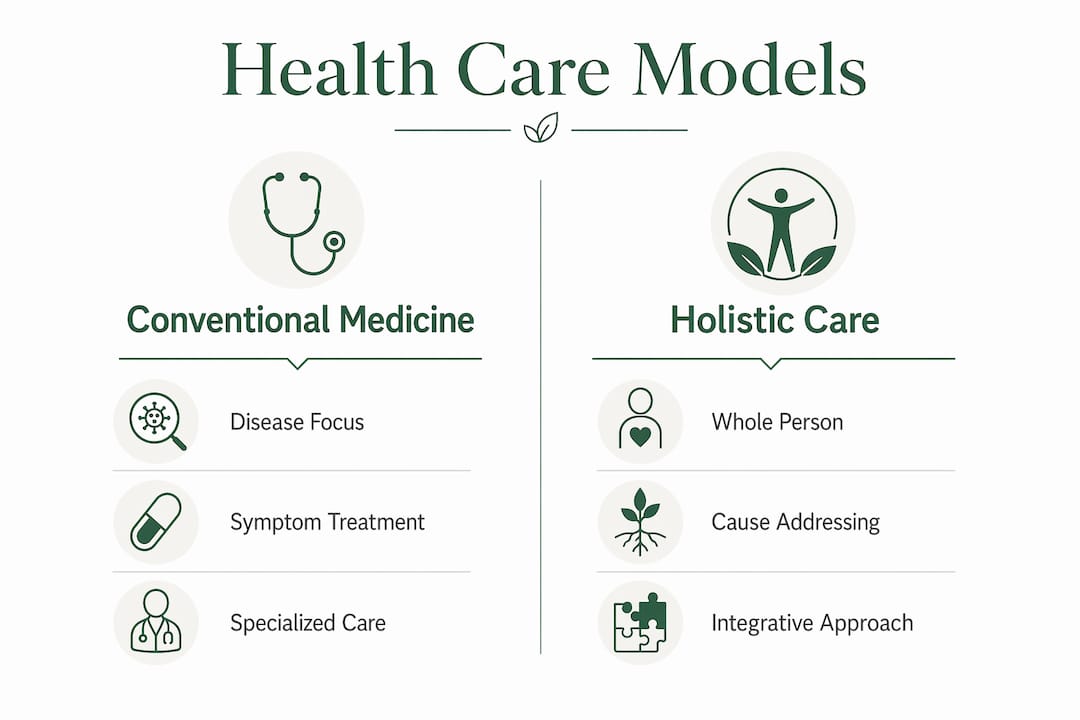
Understanding what integrated healthcare means for your care helps you ask better questions and make more informed decisions at every appointment.
Pro Tip: Ask your provider directly: "Are we addressing the cause or the symptom?" That one question opens the door to a more complete conversation about your health.
What does a holistic care assessment involve?
A holistic care assessment is significantly more thorough than a standard medical visit. According to St. Catherine University's nursing guidelines, a comprehensive holistic nursing assessment typically lasts 30–60 minutes and covers symptoms, lifestyle, stress, diet, social relationships, and cultural and spiritual needs. That duration reflects the depth of information required to build a truly personalized care plan.
Here is what you can expect during a typical assessment and plan development process:
- Symptom review: Your provider documents current physical complaints, medical history, medications, and test results.
- Lifestyle evaluation: Questions cover sleep patterns, physical activity, diet quality, alcohol or tobacco use, and daily routines.
- Mental and emotional screening: You discuss stress levels, mood, anxiety, and any history of mental health conditions.
- Social and cultural context: Your provider asks about your support system, living situation, work environment, and cultural or religious values that influence health decisions.
- Spiritual and purpose assessment: You may be asked about your sense of meaning, community involvement, or practices like meditation or prayer.
- Collaborative plan development: Based on all findings, you and your provider co-create a plan that may include medication, lifestyle changes, health education, referrals to specialists, and follow-up milestones.
The partnership model in holistic nursing places you as an active co-creator of your care plan, not a passive recipient. That shift in dynamic is one of the most meaningful differences patients report after their first integrative care visit.
Pro Tip: Bring a written summary of your sleep schedule, stress triggers, and any supplements you take. Providers often spend the first 10 minutes of a holistic assessment gathering exactly this information.
What are the benefits and challenges of holistic care?
The benefits of holistic healthcare are well-supported by recent clinical evidence. A 2026 systematic review found that whole-person care improves care coordination, patient experience, and health outcomes, particularly for patients managing multiple chronic conditions. That finding matters because multimorbidity is now the norm rather than the exception in primary care settings across the United States.
Key benefits of a whole-person care model:
- Improved care coordination across specialists and primary care providers.
- Better patient experience through personalized, respectful, and culturally sensitive care.
- Stronger disease prevention through lifestyle and environmental interventions.
- Greater patient empowerment and self-management skills.
- Long-term health resilience built through lifestyle and environmental adjustments rather than reactive symptom treatment.
Challenges that patients and providers face:
- Assessments are time-intensive and require more than a standard 15-minute appointment slot.
- Effective delivery requires interdisciplinary teams including physicians, nurses, social workers, and behavioral health specialists.
- Measuring outcomes across six health dimensions is more complex than tracking a single biomarker.
- Patients who expect a quick prescription may find the depth of questioning unfamiliar or unexpected.
The challenges are real, but they are structural rather than clinical. The evidence for better outcomes is consistent. Patients with diabetes, heart disease, and chronic pain who receive coordinated, whole-person care report higher satisfaction and better long-term adherence to treatment plans.
How does holistic care fit into today's healthcare system?
Rising multimorbidity is the primary driver pushing healthcare systems toward whole-person models. Interdisciplinary teams are now required to manage whole-person health in a coordinated way, because no single provider can address all six dimensions of health alone. A cardiologist manages your heart. A primary care physician coordinates your overall health. A behavioral health counselor addresses stress and mood. Together, they deliver something no single specialist can.
The patient as partner concept is central to how this model functions in practice. You are expected to show up prepared, engaged, and willing to reflect on your own habits and values. That level of participation is what separates a whole-person care visit from a routine checkup.
Coordinated care models like those described in multidisciplinary healthcare research show measurable improvements in outcomes for patients with complex needs. Programs built around personalized health plans that account for physical and emotional health consistently outperform single-dimension treatment approaches.
For patients managing ongoing conditions, chronic disease management strategies grounded in whole-person principles offer a practical path to better daily function and fewer hospitalizations. The key is finding a care team that treats your full health picture, not just the condition that brought you through the door.
Key Takeaways
Holistic care, or integrative medicine, produces better health outcomes by treating the whole person across physical, mental, emotional, social, cultural, and spiritual dimensions rather than addressing symptoms in isolation.
| Point | Details |
|---|---|
| Definition of holistic care | A coordinated approach addressing six health dimensions, not just physical symptoms. |
| Holistic vs. conventional medicine | Holistic care integrates conventional treatments with complementary therapies; it does not replace evidence-based medicine. |
| Assessment process | Expect a 30–60 minute visit covering lifestyle, stress, relationships, and cultural values alongside physical symptoms. |
| Core benefits | Improved care coordination, disease prevention, and patient empowerment, especially for those with chronic conditions. |
| Patient role | You are an active co-creator of your care plan, not a passive recipient of treatment. |
Why I think most people misunderstand what holistic care actually is
After years of working in healthcare communication, the single biggest misconception I encounter is that holistic care is a soft alternative to real medicine. People picture crystals and herbal teas. What they should picture is a 45-minute appointment where a provider asks about your job stress, your sleep, your relationships, and your sense of purpose, and then connects those answers directly to your blood sugar or your blood pressure.
The second surprise patients report is how much they learn about themselves during a holistic assessment. Most people have never been asked by a medical professional whether they feel a sense of meaning in their daily life. That question is not philosophical. It predicts health outcomes. Patients with a strong sense of purpose have lower rates of cardiovascular disease and better recovery from serious illness.
My practical advice: do not wait until you have a diagnosis to seek whole-person care. The model is most powerful as a prevention tool. Go in healthy, get a full picture of where your six health dimensions stand, and build a plan before a crisis forces one on you. That is the version of healthcare that actually keeps you well.
— Krunal
How Gardenstatemedicalgroup supports your whole-person health
Gardenstatemedicalgroup delivers care that goes well beyond treating isolated symptoms. The practice's primary care services are built around personalized, whole-person wellness, integrating physical health management with attention to lifestyle, prevention, and chronic condition support. For patients managing ongoing health challenges, the chronic care management program provides coordinated, team-based care designed to address the full scope of your health needs.
Located in North Bergen and Secaucus, New Jersey, Gardenstatemedicalgroup brings together physicians, specialists, and health program coordinators who work as a team to support your long-term wellness. Schedule an appointment today and take the first step toward care that treats all of you.
FAQ
What is the definition of holistic care?
Holistic care is a coordinated clinical approach that addresses the physical, psychological, social, cultural, and spiritual dimensions of a person's health. It treats the whole person rather than focusing only on a specific disease or symptom.
Is holistic care the same as alternative medicine?
No. Holistic or integrative medicine combines evidence-based conventional treatments with complementary approaches. It does not reject conventional medicine; it builds on it to address the full scope of a patient's health.
What happens during a holistic care assessment?
A holistic assessment typically lasts 30–60 minutes and covers physical symptoms, lifestyle habits, stress levels, sleep, social relationships, and cultural or spiritual values. The goal is to build a personalized care plan that reflects your complete health picture.
Who benefits most from a holistic care approach?
Patients managing multiple chronic conditions benefit most, since whole-person care improves coordination across providers and addresses the lifestyle and emotional factors that drive disease progression. Healthy individuals also benefit by using the model for prevention and resilience building.
How do I find a provider who practices holistic or integrative medicine?
Look for primary care practices that offer chronic care management, behavioral health integration, and personalized health programs. Practices with interdisciplinary teams, like Gardenstatemedicalgroup in New Jersey, are structured to deliver coordinated, whole-person care.