
TL;DR:
- Family medicine provides continuous, comprehensive care for patients of all ages, addressing physical, mental, and social health.
- It emphasizes long-term relationships, whole-person treatment, and coordination across generations and specialties.
Family medicine is a primary care specialty that provides continuous, comprehensive care regardless of a patient's age, sex, or condition. It is the only medical specialty designed to serve patients from birth through end of life, addressing physical, mental, and social health within the context of family and community. Recognized by the American Board of Family Medicine and the World Health Organization, this specialty uses the biopsychosocial model to treat the whole person, not just isolated symptoms. If you have ever wondered what is family medicine and how it differs from seeing a specialist, this guide gives you a clear, complete answer.
What is family medicine and what does it cover?
Family medicine is defined as a specialty focused on personal, comprehensive, and continuing care for individuals and families across all ages and conditions. The American Academy of Family Physicians describes it as the medical discipline that builds long-term relationships between a physician and patient, rather than treating single episodes of illness. That relationship is the foundation of everything the specialty does.
The scope is broader than most patients realize. A family physician manages preventive screenings, chronic diseases like diabetes and hypertension, acute illnesses, mental health concerns, and reproductive health, all within a single practice. The biopsychosocial model means your doctor considers biological factors, psychological stressors, and social circumstances together when making a diagnosis or treatment plan. That integrated view produces more accurate assessments than treating each problem in isolation.
Family medicine also covers a lifespan advantage that other specialties cannot replicate. Because your family physician sees you at age 8 and again at age 48, they recognize patterns across generations. Lifespan training gives family physicians a unique diagnostic edge when hereditary conditions are in play. That continuity is not available when you see a different specialist for every concern.
What do family medicine practitioners actually do?
Family medicine practitioners perform a wider range of services than most patients expect. Their daily work spans four core areas.

Preventive care includes annual wellness exams, vaccinations, cancer screenings, and cardiovascular risk assessments. Catching a problem early costs far less, in time and money, than treating an advanced condition.
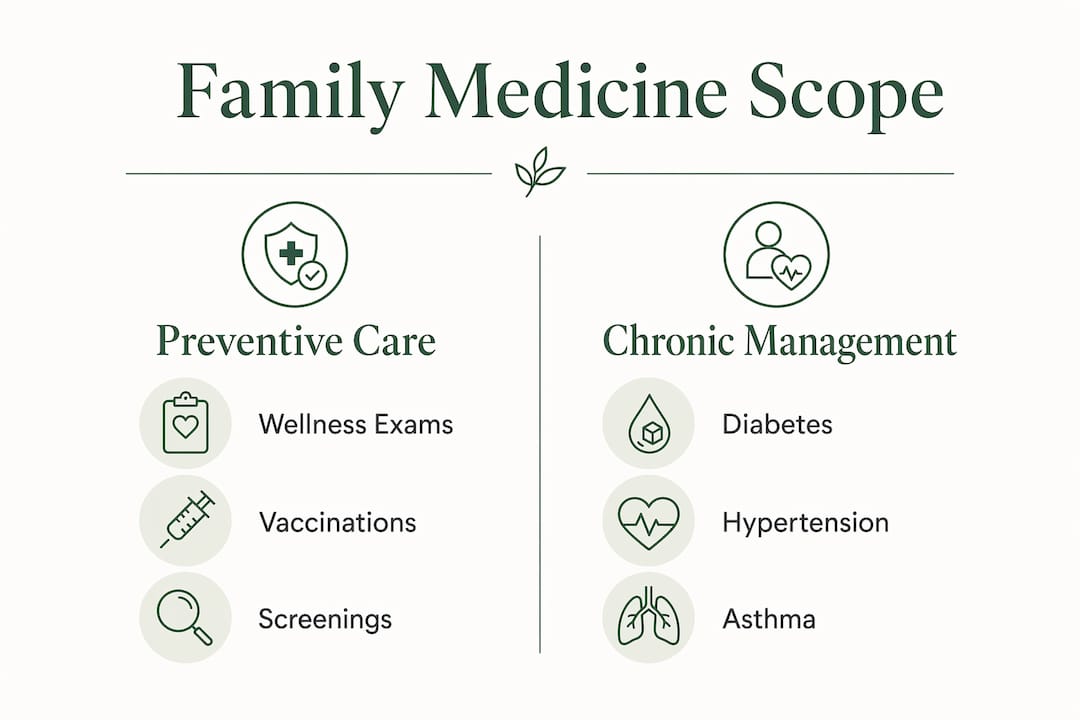
Chronic disease management covers conditions like type 2 diabetes, asthma, high blood pressure, and thyroid disorders. Your physician monitors lab trends over years, adjusts medications, and coordinates with specialists when needed. That longitudinal view prevents the gaps that occur when care is fragmented across multiple providers.
Acute illness treatment handles infections, injuries, and sudden symptoms. Many patients avoid urgent care visits entirely because their family doctor offers same-day appointments and extended hours, including evenings and Saturdays.
Office-based procedures are a part of family medicine that surprises many patients. Family physicians perform joint injections, skin biopsies, IUD placements, laceration repairs, and more. These procedures save you a specialist referral, a separate appointment, and often significant out-of-pocket cost.
Pro Tip: Before your next appointment, write down every medication you take, including supplements, and note when each symptom started. Physicians report that a prepared patient list cuts diagnostic time and reduces the chance of a missed interaction.
Family physicians also function as care coordinators. When you do need a cardiologist or orthopedic surgeon, your family doctor manages the referral, shares your full medical history, and follows up after the specialist visit. That coordination role is what the medical home model is built on, and most patients underestimate how much it protects them from duplicate testing and conflicting treatment plans.
How does family medicine differ from other specialties?
The clearest distinction is age range. Family medicine treats patients from newborns through older adults, while internal medicine focuses on adults only and pediatrics focuses on children only. A med-peds physician trains in both internal medicine and pediatrics but does not include prenatal care or reproductive health, which family medicine does.
The table below shows how the specialties compare across key dimensions.
| Dimension | Family medicine | Internal medicine | Pediatrics |
|---|---|---|---|
| Patient age range | All ages, birth to end of life | Adults only | Children and adolescents |
| Reproductive and prenatal care | Yes | Limited | No |
| Office procedures | Broad outpatient scope | Moderate | Limited |
| Mental health integration | Yes, built into care model | Varies | Varies |
| Longitudinal care focus | Core principle | Common | Common |
Internal medicine physicians go deeper into adult organ systems and complex multi-system disease. That depth is valuable for a 70-year-old with five chronic conditions requiring subspecialty coordination. Family medicine, by contrast, prioritizes breadth and continuity. The right choice depends on your life stage and health complexity, but for most people and families, a family physician serves as the most practical and cost-effective starting point.
Pro Tip: If you have children and aging parents in the same household, a single family physician can manage care for everyone. That shared context makes it easier to spot hereditary risks and coordinate care across generations.
Social determinants of health receive more structured attention in family medicine than in most other specialties. A family physician trained in the biopsychosocial model will ask about housing stability, food access, and work stress because those factors directly affect whether a treatment plan succeeds. That attention to context is a defining feature of the specialty, not an add-on.
Why does family medicine benefit patients and healthcare systems?
The benefits of family medicine extend beyond the individual patient. A review of 34 studies across the Americas found that integrating family physicians in primary care improves access, continuity, and diagnostic resource use across entire populations. That is a system-level finding, not just a patient satisfaction score.
For individual patients, the advantages are concrete.
-
Better chronic disease control. Continuous monitoring by one physician who knows your full history produces tighter control of conditions like diabetes and hypertension. Tighter control means fewer hospitalizations. You can read more about this in Gardenstatemedicalgroup's guide to managing chronic conditions through primary care.
-
Lower overall healthcare costs. Preventive care and early intervention cost less than emergency treatment. Family physicians reduce unnecessary specialist referrals and duplicate testing by serving as an informed central point of contact.
-
Stronger patient-physician trust. A long-term relationship with one physician increases the likelihood that you will share sensitive information, follow treatment plans, and return for follow-up care. Trust is not a soft benefit. It directly affects health outcomes.
-
Telemedicine and technology access. Modern family medicine now integrates electronic health records and telemedicine to deliver proactive, data-driven care. Patients can address minor concerns remotely, reducing unnecessary office visits while maintaining continuity.
-
Care coordination with specialists. When you need a referral, your family physician shares your complete history with the specialist and follows up afterward. That loop prevents the communication gaps that lead to medication errors and conflicting advice. Platforms like Carexroads illustrate how hospital-to-home transitions and specialist coordination are increasingly supported by structured care networks.
Whole-person care from a family physician also prevents disease more effectively than fragmented care. When your doctor knows your stress level, your family history, and your lifestyle habits, they can intervene before a risk factor becomes a diagnosis.
What should you expect at a family medicine visit?
A first visit with a family physician typically lasts 20–40 minutes. That time covers a full health history, a physical exam, a review of current medications, and a discussion of any active concerns. Subsequent visits are often shorter, but the depth of the relationship grows over time.
Preparation makes a measurable difference in what you get from each appointment. Bring a complete list of every medication and supplement you take, including dosages. Note when each symptom started and whether anything makes it better or worse. If you have records from previous providers, bring those too. Comprehensive medication lists and symptom timelines substantially improve diagnostic accuracy and reduce the chance of a missed drug interaction.
During the visit, you can expect your physician to address more than the presenting complaint. Family medicine visits often include brief mental health screening, preventive counseling, and a review of any overdue screenings. That breadth is intentional. The goal is to catch what you did not come in for, not just treat what you did.
Insurance coverage is broad in family medicine. Most practices accept Medicare, Medicaid, and major commercial plans. Many offer sliding fee scales for uninsured or underinsured patients. If you are getting your first primary care physician, confirming insurance acceptance before your first visit saves time and avoids billing surprises.
Pro Tip: Write down your top three concerns before the appointment and hand the list to your physician at the start of the visit. This helps your doctor prioritize and ensures nothing gets left out if time runs short.
Key Takeaways
Family medicine is the most complete form of primary care available because it combines lifespan coverage, procedural capability, and whole-person assessment under one physician relationship.
| Point | Details |
|---|---|
| Lifespan coverage | Family physicians treat patients from birth through end of life, unlike any other specialty. |
| Procedural breadth | Office procedures like joint injections and biopsies reduce specialist visits and patient costs. |
| Whole-person model | The biopsychosocial approach addresses biological, psychological, and social factors together. |
| System-level impact | Research across 34 studies confirms family medicine improves access and reduces fragmented care. |
| Visit preparation | Bringing medication lists and symptom timelines directly improves diagnostic accuracy and care quality. |
Family medicine in 2026: what I have learned from watching it evolve
By Krunal
The conversation about family medicine has shifted significantly over the past several years, and not always in the direction people expect. The specialty is not just about annual checkups and referrals. The most effective family physicians I have seen work are doing something much harder: they are holding the full picture of a person's health across decades, and that is genuinely difficult to replicate with any other model.
What strikes me most is how the safety-netting practice in family medicine gets almost no public attention. Safety-netting means your physician actively reassesses ambiguous symptoms over time, watching for signs that something minor might be developing into something serious. That ongoing vigilance is not built into a one-time specialist visit. It requires a continuous relationship.
The technology integration happening right now is real and meaningful. Electronic health records and telemedicine are not replacing the family physician. They are giving physicians better data to act on earlier. The practices that are doing this well are shifting from reactive care to proactive management, and their patients are showing up to the emergency room less often.
My honest view is that family medicine is undervalued precisely because it works quietly. When your family doctor catches a rising A1C at your annual visit and adjusts your diet plan before you need medication, that success is invisible. You never see the hospitalization that did not happen. That invisibility makes it easy to underestimate the specialty. Do not make that mistake. A strong relationship with a family physician is one of the most protective health decisions you can make.
— Krunal
Primary care at Gardenstatemedicalgroup
Gardenstatemedicalgroup provides comprehensive primary care at locations in North Bergen and Secaucus, New Jersey, with a team built around the same principles that define family medicine at its best.
The practice accepts Medicare, Medicaid, and most major insurance plans, and offers coordinated referrals to cardiopulmonary, radiology, and specialty services on site. Patients also have access to structured programs for diabetes prevention, bone health, and weight management, all managed within the same care team. If you are ready to establish care with a physician who knows your full history and coordinates everything in one place, Gardenstatemedicalgroup is ready to see you. Schedule your appointment online or call the office directly to get started.
FAQ
What is the family medicine definition in simple terms?
Family medicine is a primary care specialty that provides continuous, comprehensive healthcare to patients of all ages, addressing physical, mental, and social health within the context of family and community.
How is family medicine different from primary care?
Family medicine is a type of primary care. The term "primary care" describes the level of care, while family medicine describes the specialty. All family physicians provide primary care, but not all primary care physicians are family medicine specialists.
What conditions does a family doctor treat?
Family doctors treat a wide range, including chronic conditions like diabetes and hypertension, acute illnesses, mental health concerns, reproductive health issues, and skin conditions. They also perform preventive screenings and office procedures.
How long does a typical family medicine visit last?
Initial visits typically last 20–40 minutes and cover a full health history, physical exam, and medication review. Follow-up visits are usually shorter but build on the established relationship.
Do family medicine practitioners accept insurance?
Most family medicine practices accept Medicare, Medicaid, and major commercial insurance plans. Many also offer sliding fee scales for patients without insurance coverage.
Recommended
- Building a family health plan for lasting wellness
- 3 Benefits of Choosing Family Medicine for Your Health Care - What to Know | Garden State Medical Group | Garden State Medical Group
- 3 Good Reasons for Having in a Family Medicine Doctor | Garden State Medical Group | Garden State Medical Group
- What You Should Look For When Picking a Family Doctor | Garden State Medical Group | Garden State Medical Group