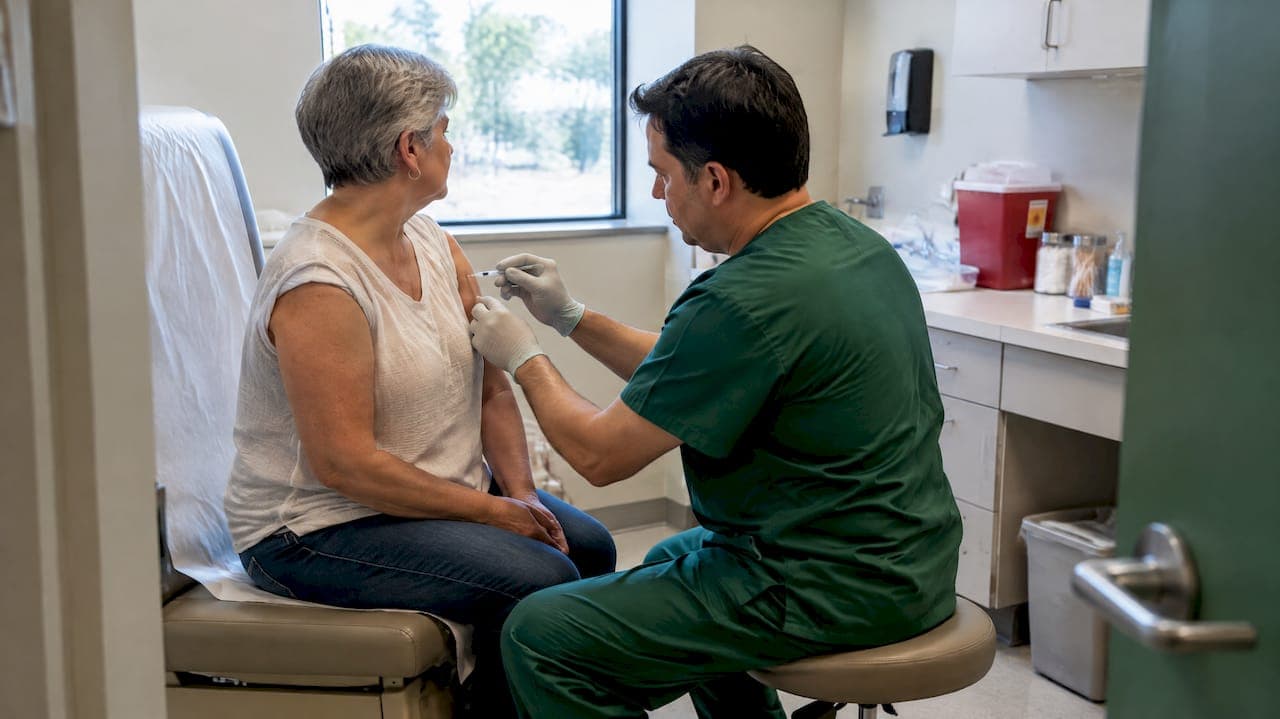
Most adults need an annual flu shot, an updated COVID-19 vaccine, a Tdap or Td booster at routine intervals, the recombinant zoster vaccine (Shingrix), recommended beginning around age 50, and pneumococcal vaccination starting around age 50 or earlier for adults with specific risk factors. Depending on your history, you may also need catch-up or initial doses of MMR, varicella, HPV, hepatitis A, or hepatitis B depending on individual risk and history. The CDC and ACIP publish the official recommendations each year, but your own schedule depends on your age, health conditions, and past vaccination records, so a conversation with your provider is the fastest way to find out exactly what you're missing.
TL;DR:
- Adults aged 50 and older should receive the recombinant zoster vaccine (Shingrix) and routine pneumococcal vaccines, especially if they have chronic conditions.
- COVID-19 vaccine updates are frequent, requiring current doses as circulating variants change, with most adults needing booster shots annually.
- Checking immunization records through state registries, providers, or pharmacies before vaccination helps prevent unnecessary repeat doses.
- Specific health conditions such as immunosuppression or pregnancy can alter vaccine timing and need personalized consultation with a healthcare provider.
- Many adults overlook the importance ofcatch-up dosing for vaccines like MMR, varicella, and HPV, which are crucial based on individual history and risk factors.
Table of Contents
- Age-based vaccine recommendations: 19 to 65 and older
- How health conditions, pregnancy, and occupation change your schedule
- What changed in the adult vaccine schedule for 2026
- How to check your records and actually get vaccinated
- Common vaccine timing mistakes adults make
- How Garden State Medical Group approaches vaccine reviews
- A clinician's view on staying current with vaccines
- Book a vaccine review at Garden State Medical Group
- FAQ
- Sources
Age-based vaccine recommendations: 19 to 65 and older
Your age is the first filter the CDC adult immunization schedule uses to sort out what you need. Think of it as a starting point, not the final word, since health conditions can add to or change this list.
Ages 19 to 26. This is the window for finishing HPV vaccination; catch-up is recommended generally through the mid-20s for most adults. You should also be caught up on MMR (two doses if you lack documented immunity), varicella (two doses if you've never had chickenpox or the vaccine), and the three-dose hepatitis B series if you missed it as a child. Annual flu and staying current on COVID-19 vaccination apply at every age band from here forward.
Ages 27 to 49. HPV catch-up is still possible in this range for some adults after a conversation with a provider about shared clinical decision-making, though it's no longer routinely recommended for everyone. Tdap or Td boosters are generally recommended every 10 years, and pregnant women need a Tdap dose during each pregnancy, as recommended regardless of timing of previous vaccination. Hepatitis A and B vaccines are recommended for adults with specific risk factors, including certain medical conditions, occupational exposures, or travel plans.
Ages 50 to 64. This is when the recombinant zoster vaccine (Shingrix) becomes routinely recommended, given as two doses spaced two to six months apart. Pneumococcal vaccination also enters the picture for adults with qualifying chronic conditions, even before the universal age threshold. If you haven't had a documented case of chickenpox or two varicella vaccine doses, that gap should be closed now rather than later.
Ages 65 and older. Pneumococcal vaccination is routinely recommended for all adults older than about 65 years, using PCV and PPSV23 products based on prior vaccination history, as detailed in the CDC schedule notes. Influenza vaccination is recommended every year, with preference for high-dose or adjuvanted formulations for older adults. RSV vaccination is recommended universally for adults 75 and older and for adults 60 to 74 years with specific risk conditions.
A few practical notes apply across every age group:
- If you're unsure whether you've had a vaccine, don't assume you need to start the series over; ask your provider about accepting self-reported history or using a single catch-up dose where appropriate.
- Recombinant zoster vaccination is recommended starting at age 50 regardless of self-reported chickenpox history, since prior infection doesn't rule out shingles risk.
- Pneumococcal vaccine choice and sequencing depend heavily on what you've already received, so bring any documentation you have to your appointment.
- COVID-19 vaccine recommendations are updated regularly to reflect circulating variants, requiring updated doses as advised.
For more detail on pneumococcal vaccine types and who specifically needs them, our guide to pneumonia vaccination for adults breaks down the differences between the available products.
How health conditions, pregnancy, and occupation change your schedule
Age alone doesn't tell the whole story. The CDC's condition-based recommendations exist because certain health situations raise the risk of severe disease, weaken the body's response to infection, or create reasons to delay or avoid a particular vaccine altogether. A clinician reviews these factors individually rather than applying a blanket rule.
A few examples show how this plays out in practice:
- Immunocompromised adults, including those on certain cancer treatments or immunosuppressive medications, often need an additional COVID-19 vaccine dose beyond the standard recommendation, along with closer attention to live vaccine restrictions.
- Adults without a spleen or with a damaged spleen face a higher risk of certain bacterial infections and typically need both pneumococcal and meningococcal vaccination on an accelerated or expanded schedule.
- Pregnant women need a Tdap dose during each pregnancy to pass some protection against whooping cough to the newborn, and flu vaccination is recommended during any trimester of flu season.
- Healthcare personnel face specific MMR and varicella immunity requirements tied to workplace exposure risk, and some roles require documented immunity rather than just vaccination history.
Contraindications and precautions are not the same thing, and the distinction matters for how your provider handles your visit. A contraindication, such as a documented severe allergic reaction to a vaccine component, means that vaccine should not be given. A precaution, such as a moderate acute illness at the time of your appointment, means your provider weighs the benefits and risks before deciding whether to proceed or reschedule. Either way, clear documentation in your medical record protects you from repeating an unnecessary risk assessment at every future visit, and it's worth asking your provider to note any reaction or condition explicitly rather than relying on memory. Our overview of chronic conditions in adults explains how ongoing health issues intersect with preventive care decisions like this one.
What changed in the adult vaccine schedule for 2026
The adult immunization schedule isn't static. Each year, the Advisory Committee on Immunization Practices reviews new evidence and adjusts recommendations, and a few recent changes have real practical weight for adults trying to stay current.
- COVID-19 dosing guidance was updated to reflect the latest circulating variants, meaning the vaccine you received last year is not automatically the "current" one this year; check with your provider about the most recent formulation.
- Pneumococcal vaccine options expanded with PCV20 and PCV21 added to the lineup alongside PPSV23, giving providers more flexibility in sequencing based on your prior vaccination history.
- RSV vaccination guidance now covers adults 75 and older universally, plus adults 60 to 74 with qualifying risk factors, and pregnant persons during a specific window of pregnancy to protect newborns.
- Influenza vaccine product preferences for adults 65 and older continue to favor high-dose or adjuvanted formulations over standard-dose vaccines.
For many adults, the practical next step after reviewing these updates is a single vaccine review appointment rather than separate visits for each shot, according to the CDC's consolidated adult schedule, which organizes recommendations by age and medical condition specifically so one visit can cover multiple gaps. If you're 65 or older, immunocompromised, or have an incomplete pneumococcal history, this year's updates are a good reason to check your status rather than assume last year's shot still covers you.
How to check your records and actually get vaccinated
Knowing what you need is only half the job. Finding out what you've already had, and then getting the rest, takes a bit of legwork, but it's manageable if you break it into steps.
- Check your state immunization information system (IIS). Most states maintain a registry that tracks vaccination records across providers and pharmacies, and you can often request access online or through your state health department.
- Contact past providers and pharmacies. If you've moved or changed doctors, your old clinic or pharmacy chain may still have records on file that didn't make it into a state registry.
- Gather what you have before your appointment. Bring any paper records, old insurance cards, or printouts, along with a list of known allergies and your current medications.
- Book a visit and bring your documentation. A primary care appointment is typically the most efficient setting for a full vaccine review, since your provider can cross-reference your history against the current schedule in one sitting.
- Ask about getting multiple vaccines at once. Simultaneous administration of eligible vaccines at the same visit is standard practice and reduces the number of trips you need to make.
Pharmacies, community health centers, and workplace clinics all administer vaccines, and each has tradeoffs. Pharmacies offer convenience and extended hours but limited ability to review your full medical history. Workplace clinics are efficient for routine shots like flu vaccine but rarely stock less common vaccines like RSV or zoster. A primary care visit gives you the most complete picture, since your provider has access to your full chart and can flag contraindications or precautions specific to your health.
Pro Tip: If you're traveling internationally or need documentation for work, ask your provider for a printed immunization record at the same visit rather than requesting it separately later.
If you're preparing for your next checkup, our checklist for annual health exams covers what else is worth reviewing at the same visit.
Common vaccine timing mistakes adults make
A handful of mix-ups come up again and again, and most are easy to fix once you know what to look for.
- Restarting a series from scratch. If you're missing documentation for one dose of a multi-dose series, ask your provider whether a single catch-up dose works instead of starting over.
- Assuming one COVID-19 vaccine covers you indefinitely. Guidance is updated seasonally, so last year's dose may not count as current this year.
- Skipping Tdap during a later pregnancy. Protection doesn't carry over between pregnancies, so each one calls for its own Tdap dose.
- Confusing the shingles vaccine age cutoff. Shingrix is recommended starting at 50, not 60, and prior chickenpox infection doesn't change that recommendation.
- Skipping annual flu vaccination because "I never get the flu." Flu vaccine effectiveness varies by season and by how well the vaccine matches circulating strains, but skipping it removes a layer of protection entirely.
Providers generally delay vaccination for an acute moderate-to-severe illness or a documented severe reaction to a prior dose, but a mild cold or seasonal allergies usually isn't a reason to reschedule. If your records are incomplete or lost, your provider can usually work from self-reported history for some vaccines while recommending a fresh dose for others where the risk of under-protection outweighs the risk of an extra shot. For a closer look at what to expect physically after one specific vaccine, our guide to shingles vaccine side effects walks through a typical two to three day recovery window.
How Garden State Medical Group approaches vaccine reviews
When you come in for a vaccine review, we start by looking at what you already have on record and what's missing, cross-referencing your history against the current CDC/ACIP schedule. From there, our providers assess whether any health conditions, medications, or prior reactions should change your plan, documenting contraindications and precautions clearly so future visits don't require repeating that work.
We administer eligible vaccines at the same visit whenever appropriate, which means fewer trips back and forth for routine boosters and catch-up doses. Our primary care team also looks at vaccination as one piece of a broader preventive care picture, connecting it to the chronic disease management programs we run for certain chronic conditions, since several of those conditions directly affect which vaccines you need and when.
If you want background reading before your visit, our preventive screening guide pairs well with a vaccine review, since both are typically handled at the same annual visit. We also stock professional-grade supplements for patients working on broader health goals alongside their vaccination plan, though that's a separate conversation from what's medically indicated for immunization.

A clinician's view on staying current with vaccines
Vaccination is one of the few areas of preventive care where a short visit now meaningfully lowers your risk of a serious illness later. We see this most clearly in older patients managing chronic conditions, where a bout of flu or pneumonia can set back months of otherwise stable health. The adult schedule isn't complicated once you know your age band and health history, but it does require someone to actually check it rather than assume it's handled.
Our honest recommendation: bring up your vaccination status at your next visit, even if it's not the reason you booked the appointment. It takes a few minutes to review and can close gaps you didn't know existed.
— Garden State Medical Group
Book a vaccine review at Garden State Medical Group
If you're not sure what you're missing, the simplest path forward is a single primary care visit where we review your history and handle any catch-up or routine vaccines in one sitting, rather than you trying to piece together old records on your own.
We accept most major insurance plans along with Medicare and Medicaid, and our team can confirm coverage details before your visit. Schedule a primary care appointment with us to get your vaccine status reviewed and any recommended doses administered the same day.
This article is general information, not a substitute for advice from a qualified doctor. Consult a qualified healthcare professional about your own circumstances before acting on anything here.
FAQ
What is the recommended MMR vaccine schedule for adults?
Most adults need either documented evidence of two MMR doses or other proof of immunity, such as a prior lab-confirmed case. Adults without documentation, particularly healthcare personnel without immunity evidence, should get one or two doses depending on risk factors, per the CDC adult schedule.
How often do adults need a tetanus booster?
Adults need a Tdap or Td booster at routine intervals as part of routine care. Pregnant women need a Tdap dose during each pregnancy regardless of their last booster date, since protection doesn't transfer between pregnancies.
When should adults get the shingles vaccine?
The recombinant zoster vaccine (Shingrix) is recommended starting at age 50, given as two doses spaced two to six months apart. This applies even if you don't remember having chickenpox, since the recommendation is based on age rather than confirmed prior infection.
How do I know if I need a pneumococcal or RSV vaccine?
Pneumococcal vaccination is routinely recommended at 50 or older, or earlier if you have certain chronic conditions, with product choice depending on your prior vaccine history, as outlined in the CDC schedule notes. RSV vaccination is recommended for adults 75 and older and for those 60 to 74 with qualifying risk factors; a provider visit is the most reliable way to confirm which applies to you.
What are 7 types of vaccines commonly recommended for adults?
Commonly recommended adult vaccines include influenza, updated COVID-19 vaccine, Tdap or Td, recombinant zoster (shingles), pneumococcal, MMR, and HPV, with hepatitis A, hepatitis B, varicella, and RSV also recommended for specific ages or risk groups. Your exact list depends on your age, health history, and prior vaccination records.