
TL;DR:
- Medical groups are legally organized entities of multiple physicians providing coordinated outpatient care.
- They improve chronic disease management through team-based, integrated care, reducing hospitalizations.
- Ownership type impacts care quality, autonomy, and resource access, influencing your healthcare experience.
Choosing a healthcare provider in North Bergen or Secaucus can feel overwhelming. There are solo practices, hospital clinics, urgent care centers, and medical groups, and the differences between them are not always clear. Yet the type of provider you choose directly shapes your care experience, especially if you manage a chronic condition like diabetes, heart disease, or high blood pressure. Medical groups, in particular, play a central role in how primary and specialty care is delivered in our community. This article breaks down exactly what a medical group is, how it operates, and what the latest trends mean for you as a patient.
Table of Contents
- What is a medical group?
- How do medical groups operate?
- Legal standards and membership: what sets medical groups apart?
- Trends in ownership and the future of medical groups
- A fresh perspective: what most guides miss about medical groups
- Connect with medical group care in your community
- Frequently asked questions
Key Takeaways
| Point | Details |
|---|---|
| Medical group defined | A medical group is a legally recognized team of physicians working together to deliver patient care. |
| Coordinated care advantage | Patients benefit from team-based, coordinated services, especially for chronic health needs. |
| Strict legal standards | Federal rules set clear requirements for what counts as a medical group, impacting organization and care. |
| Ownership matters | The ownership and affiliation of a medical group impact autonomy, available services, and patient experience. |
| Local access | Residents of North Bergen and Secaucus can find specialized primary care and chronic illness support at local medical groups. |
What is a medical group?
The term "medical group" gets used loosely, but it has a precise legal meaning. Under federal Stark Law, a medical group is a single legal entity made up of two or more physicians organized as a partnership, professional corporation, foundation, or similar structure. This is not just a branding choice. The legal structure determines how physicians are compensated, how services are billed, and what patient protections apply.
A medical group is a single legal entity of two or more physicians, as defined by Stark Law, organized to deliver coordinated healthcare services.
For patients in North Bergen and Secaucus, this distinction matters because it affects the continuity and quality of care you receive. A true medical group is not simply a building where several independent doctors happen to share office space. The physicians are part of the same organization, which means your records, referrals, and care plans can be shared and coordinated across providers.
Common misconceptions are worth addressing here. Many people assume that all group practices operate the same way, or that a medical group is just a smaller version of a hospital. Neither is accurate. A hospital is a separate institution with inpatient facilities, surgical suites, and emergency departments. A medical group focuses on outpatient care, meaning you come in for appointments, diagnostics, and follow-ups without being admitted overnight.
Here is what typically defines a qualifying medical group:
- Two or more licensed physicians sharing a single legal entity
- A defined organizational structure (partnership, corporation, or equivalent)
- Shared overhead costs and administrative systems
- Coordinated clinical services across the group's providers
- Compliance with federal Stark Law billing and referral rules
When you explore medical group programs in your area, knowing these criteria helps you ask the right questions and understand what kind of care structure you are entering.
How do medical groups operate?
Now that you know what a medical group is, let's look at how these organizations actually work to serve patients. On a day-to-day basis, a medical group brings together multiple physicians, nurse practitioners, physician assistants, and clinical support staff under one organizational roof. Each provider may have a defined specialty, but they work as a team to manage patient care.

Medical groups deliver ambulatory healthcare through physician teams and staff across primary care and specialty areas. This means your care is not siloed. If your primary care doctor identifies a cardiac concern, a cardiologist within the same group can be looped in quickly, with full access to your records.
Team-based care is especially valuable for patients managing chronic conditions. Research on physician-led team-based care shows that coordinated teams improve patient outcomes, reduce unnecessary hospitalizations, and support better long-term disease management. For someone managing Type 2 diabetes alongside hypertension, having a care team that communicates internally is not a convenience. It is a clinical advantage.
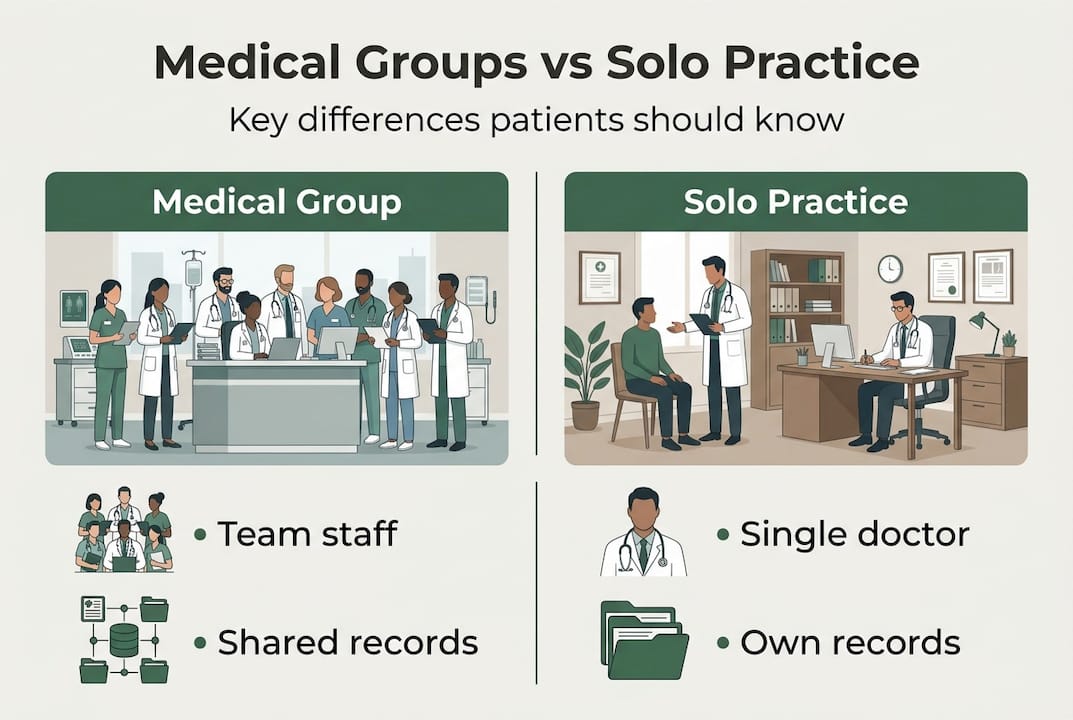
Here is how medical groups compare to solo practices:
| Feature | Medical group | Solo practice |
|---|---|---|
| Number of providers | Multiple physicians and staff | One physician |
| Care coordination | Structured, team-based | Dependent on individual |
| Specialist access | Often in-house or closely affiliated | Requires external referral |
| After-hours coverage | Typically covered by group | Limited or unavailable |
| Chronic care management | Systematic programs available | Varies by provider |
| Diagnostic services | Often on-site | Usually referred out |
The team-based care impact on avoidable hospitalizations is well documented, and it is one of the clearest reasons why patients with ongoing health needs benefit from choosing a group practice over a solo provider.
Pro Tip: If you have a complex health history or manage more than one chronic condition, ask any prospective provider how their team communicates internally. A group that uses shared electronic health records and regular care team meetings will serve you far better than one where providers work in isolation.
You can review the medical group specialties available locally to understand what a fully integrated group looks like in practice. The range of services, from primary care to cardiopulmonary diagnostics, reflects the kind of coordinated model that benefits patients most.
Legal standards and membership: what sets medical groups apart?
While day-to-day operations focus on care, there are strict legal standards behind the scenes that shape how medical groups are organized. Under Stark Law, strict criteria must be met for a practice to qualify as a group, including rules about the range of services offered, the percentage of patient encounters handled by group members, how overhead is shared, and how physician compensation is structured.
Here are the key requirements a practice must satisfy to qualify as a medical group under Stark Law:
- The group must consist of two or more physicians legally organized as a single entity.
- Each physician must provide substantially all of their professional services through the group.
- At least 75% of total patient care services must be provided through the group entity.
- Overhead expenses must be shared across the group, not divided by individual physician.
- Physician compensation cannot be based directly on the volume or value of referrals made within the group.
- The group must offer a range of services that reflects the combined practice of its members.
Membership in a medical group also has a specific legal definition. Physicians who are employees or direct partners of the group qualify as members. Independent contractors, even if they regularly see patients at the same location, do not count as group members under Stark Law. This matters because it affects billing, accountability, and the legal protections that apply to your care.
| Stark Law requirement | What it means for patients |
|---|---|
| Single legal entity | Unified accountability for your care |
| Service range requirement | Access to multiple types of care in one place |
| Encounter percentage rule | Your doctor is genuinely part of the group |
| No referral-based pay | Referrals are clinically driven, not financially motivated |
| Shared overhead | Stable, organized practice environment |
Understanding group versus independent practices is especially useful when you are comparing providers in North Bergen or Secaucus. The edge cases in group definitions can be nuanced, but the practical takeaway is straightforward: a qualifying medical group offers more structural accountability and coordinated care than a loosely affiliated collection of independent providers.
Trends in ownership and the future of medical groups
Beyond regulations, the structure and ownership of medical groups are rapidly evolving, and here is what that means for you. One of the most significant shifts in American healthcare over the past decade is the steady decline of privately owned physician practices. Private physician-owned practices declined from 60.1% in 2012 to just 42.2% in 2024, with groups growing larger and more diversified in scope.
At the same time, operating costs are rising sharply. The AMGA 2025 survey found that the median operating expense ratio for medical groups reached 151%, with physician compensation rising even as revenue growth remained flat. These financial pressures are pushing more groups toward hospital affiliation or acquisition by larger health systems.
For patients, this shift has real implications. Hospital-affiliated groups often have greater access to diagnostic technology, specialists, and after-hours services. However, some patients report that larger systems can feel less personal, with longer wait times and less continuity with a single provider.
Here are key considerations when choosing between different types of medical groups:
- Independent private group: Often more personalized, but may have fewer resources or specialists on-site
- Hospital-affiliated group: Greater access to advanced diagnostics and specialists, though sometimes less flexible
- Health system-owned group: Broad network and integrated records, but physician autonomy may be more limited
- Multispecialty group: Covers a wide range of conditions under one roof, ideal for patients with complex needs
Looking ahead, the trend points toward larger, more integrated medical groups that emphasize value-based care, meaning providers are rewarded for keeping patients healthy rather than simply seeing more of them. For patients managing chronic conditions, this model aligns incentives in your favor. Understanding the reasons for group care helps you make a more informed choice when selecting a provider in your area.
A fresh perspective: what most guides miss about medical groups
With these trends and definitions in mind, it is time for a more candid viewpoint on what truly sets medical groups apart. Most patient guides focus on logistics, location, insurance acceptance, and hours. What they rarely address is how ownership structure quietly shapes the care you receive.
A privately owned group and a hospital-owned group may look identical on the surface. Same building, same white coats, same appointment process. But the incentives driving clinical decisions can differ significantly. In a physician-owned group, doctors often have more autonomy to spend time with complex patients. In a health-system-owned group, productivity targets may push toward shorter visits.
This is not a criticism of any one model. It is a call for patients to ask better questions. When you are managing a chronic condition, the operational model of your medical group matters as much as the credentials of your individual doctor. Look for groups that offer transparent care coordination, clear communication between providers, and programs built around your long-term health, not just episodic visits.
Reviewing ownership and practice models before you commit to a provider is one of the most underrated steps in choosing quality care.
Connect with medical group care in your community
If you are ready to take action or want support, here is how you can benefit from local medical group expertise. Residents of North Bergen and Secaucus have access to a fully integrated medical group that brings primary care, specialty services, and chronic disease management together in one place.

At Garden State Medical Group, our team-based approach means your care is coordinated, not fragmented. Whether you are looking for a primary care provider or need support managing a chronic condition like diabetes or heart disease, we offer structured programs designed around your needs. Explore our primary care services or browse our chronic care programs to find the right fit. We accept a wide range of insurance plans and serve patients across both North Bergen and Secaucus. Contact us today to schedule an appointment and experience what coordinated, community-based care looks like.
Frequently asked questions
What distinguishes a medical group from a hospital?
A medical group is a team of physicians providing ambulatory, outpatient care, while a hospital delivers both inpatient and outpatient care and may employ or affiliate with medical groups. The two serve different but often complementary roles in your overall healthcare.
How does joining a medical group benefit patients with chronic conditions?
Medical groups use team-based, coordinated care that is proven to improve outcomes and simplify the management of chronic illnesses. Having multiple providers sharing your records and care plan reduces gaps and prevents conflicting treatments.
Can I choose my own doctor within a medical group?
Yes, most medical groups allow you to select a primary care doctor and, where needed, a specialist from within their network of physicians. Availability depends on the group's structure and which insurance plans they accept.
Are medical groups covered by insurance?
Most medical groups accept a broad range of insurance plans, but you should always confirm your specific plan's network status before scheduling an appointment to avoid unexpected out-of-pocket costs.
Recommended
- 6 Important Things Every Doctor Wishes Their Patients Knew | Garden State Medical Group | Garden State Medical Group
- 4 Facts You Need to Know About Internal Medicine Doctors | Garden State Medical Group | Garden State Medical Group
- Our Guide on Making the Most of Your Medical Check-Up - What to Ask & Expect | Garden State Medical Group | Garden State Medical Group
- Why Should People Continue Tracking Their Medical History? | Garden State Medical Group | Garden State Medical Group
- court approved programs | glendora recovery center