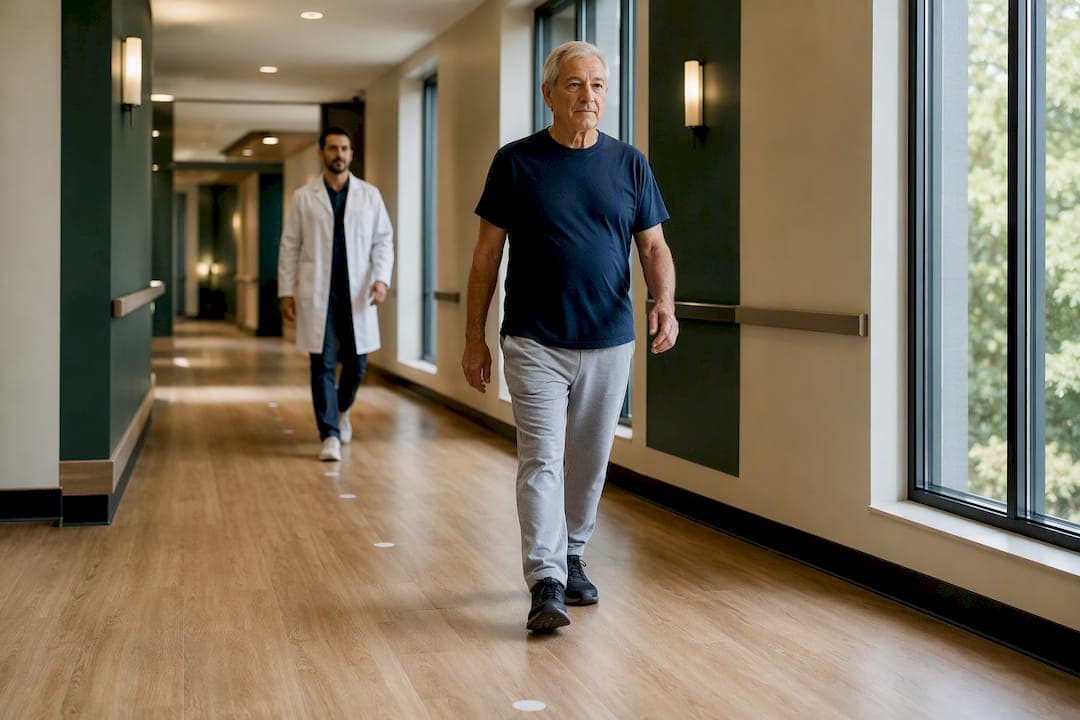
The six minute walk test (6MWT) measures how far a person can walk in six minutes on a flat, measured course, producing the six-minute walk distance (6MWD). Clinicians use that single number as an integrated snapshot of heart, lung, and muscle function together, ordering it to track disease progression, set oxygen prescriptions, and gauge surgical risk. It's generally safe for most patients, though certain heart conditions call for postponing it.
TL;DR:
- The 6MWT should be performed on a flat, at least 30-meter corridor with standardized equipment, staff training, and scripted instructions to ensure accurate, reproducible results.
- Patients with recent unstable heart conditions or severe respiratory failure should defer the test, while those with controlled chronic conditions generally benefit from it for functional assessment.
- Two tests on the same day, spaced with adequate rest, are recommended to account for learning effects and variability, with actual course length and protocol strictly documented.
- Continuous pulse oximetry and monitoring for symptoms like chest pain or severe dyspnea are critical for safety during the test, with immediate cessation if alarming signs appear.
- Post-test interpretation relies on comparing the distance to reference values, tracking changes of around 30 meters as a meaningful improvement, and integrating physiologic data for accurate clinical decisions.
Table of Contents
- What Equipment and Staffing Does a Proper 6MWT Require?
- Who Should Get a 6MWT, and Who Shouldn't?
- How Do You Perform the Six Minute Walk Test Correctly?
- What Should You Watch for While the Test Is Running?
- How Do You Interpret 6MWT Results?
- How Does the 6MWT Change Clinical Decisions?
- Should You Repeat the Test, and How Does Track Length Change Results?
- How Should You Prepare for a 6MWT?
- Where Can You Get a Standardized 6MWT Done Right?
- What the 6MWT Can and Can't Tell You
- Ready to Schedule Your Six Minute Walk Test?
- Sources
- FAQ
What Equipment and Staffing Does a Proper 6MWT Require?
Running a compliant 6MWT doesn't take much hardware, but every piece on the list earns its place. Skip one and you lose the ability to catch a problem early or trust the number you record.
A pulse oximeter tracks oxygen saturation continuously, which matters most for patients with known lung or heart disease where a sharp drop can happen without obvious symptoms. A stopwatch or count-down timer keeps the six minutes exact. Cones or markers at each turnaround point define the track, and a chair placed along the course lets a patient sit immediately if dizziness or chest discomfort hits. A blood pressure cuff and the Borg scale (or a modified 0 to 10 version) round out the kit, letting staff document exertion and breathlessness at standardized intervals.
- Pulse oximeter (finger probe, ideally with a numeric display staff can glance at while walking alongside)
- Stopwatch or countdown timer with an audible alert
- Two cones marking the turnaround points of the course
- A chair positioned partway down the track for emergency rest
- Blood pressure cuff for pretest and post-test readings
- Borg scale card for rating dyspnea and fatigue
The course itself should be a straight, flat, enclosed corridor, ideally at least 30 meters long, per the ATS/ERS technical standard. Shorter corridors work when space is limited, but every extra turnaround adds variability, since patients lose momentum each time they pivot.
In most outpatient settings, a trained medical assistant, respiratory therapist, or nurse can administer the test once they've learned the scripted protocol and stop criteria. The person running it needs enough training to recognize warning signs quickly, not just to hold a stopwatch.
Pro Tip: Mark your 30-meter course permanently with floor tape or small painted dots rather than remeasuring with a tape measure every time. Small measurement drift between sessions is one of the most common, and most avoidable, sources of inconsistent 6MWD results.
Who Should Get a 6MWT, and Who Shouldn't?
The 6MWT fits a wide range of chronic conditions precisely because it measures function rather than a single organ system. It's a standard tool for pulmonary function monitoring in COPD, interstitial lung disease (ILD), and pulmonary arterial hypertension (PAH), and it's just as useful in heart failure, pre-operative risk assessment, pulmonary rehab program planning, and post-COVID recovery evaluation.
Common indications include:
- Chronic obstructive pulmonary disease (COPD), to track functional decline or response to therapy
- Interstitial lung disease, where distance and oxygen desaturation both carry prognostic weight
- Pulmonary arterial hypertension, where 6MWD is a recognized trial and monitoring endpoint
- Heart failure, to assess functional class and response to treatment adjustments
- Pre-operative evaluation before major thoracic or abdominal surgery
- Pulmonary rehabilitation intake and outcome measurement
- Post-COVID-19 recovery clinics assessing lingering exercise limitation
Not every patient is a safe candidate on a given day. The StatPearls reference on the 6MWT lists acute coronary syndrome, meaning unstable angina or a myocardial infarction within the past 30 days, as an absolute contraindication. Uncontrolled heart failure, acute respiratory failure, and recent syncope also warrant deferral until the patient is stabilized.
Relative contraindications require more clinical judgment rather than an automatic stop. Severe uncontrolled hypertension, a resting heart rate above 120 beats per minute, active infection with fever, or significant cognitive or orthopedic limitations that prevent independent ambulation all deserve a second look before proceeding.
Before starting, staff should check resting blood pressure, heart rate, oxygen saturation, and confirm the patient hasn't eaten a heavy meal or exercised vigorously in the past hour or two. A quick review of current medications, especially inhalers and heart medications, rounds out the pretest screen.
How Do You Perform the Six Minute Walk Test Correctly?
Reproducibility is the whole point of a standardized protocol. Two clinics running the same 6MWT should get comparable numbers on the same patient, and that only happens when the script, the timing, and the course stay consistent.
- Rest the patient for 10 minutes in a chair near the starting point. Record baseline blood pressure, heart rate, oxygen saturation, and Borg dyspnea score during this window.
- Explain the test using the standardized phrasing: "The object of this test is to walk as far as possible for 6 minutes. You will walk back and forth in this hallway. Six minutes is a long time to walk, so you will be exerting yourself. You will probably get out of breath or exhausted. You are permitted to slow down, to stop, and to rest as necessary."
- Start the stopwatch and begin timing the moment the patient starts walking; the staff member walks behind or beside, never in front, to avoid pacing them.
- Give scripted encouragement at exactly 1-minute intervals ("You are doing well. You have 5 minutes to go.") and continue through the 5-minute and 4-minute marks. No other coaching or cheerleading is permitted.
- Tell the patient with 15 seconds left to stop where they are when you call time.
- Call "Stop" at exactly six minutes and mark the patient's final position with a cone or floor marker.
- Record total laps completed and measure the remaining partial distance to the final marker; multiply completed laps by course length and add the partial distance for total 6MWD.
- Document any stops, their number and approximate duration, and the lowest (nadir) oxygen saturation recorded during the walk, not just the ending value.
- Take immediate post-test vitals: heart rate, blood pressure, oxygen saturation, and a final Borg score, and repeat oxygen saturation checks for a few minutes afterward if the patient desaturated.
Why scripting matters: Unstandardized encouragement can meaningfully inflate the distance walked, according to the ATS/ERS technical standard, which is why the exact 1-minute phrases are non-negotiable rather than a suggestion.
A course shorter than 30 meters is workable when hallway space runs short, but every clinic should note the actual length used on the report, since a 20-meter or 10-meter track with more turns tends to produce a shorter distance than a longer straightaway would for the same patient.
What Should You Watch for While the Test Is Running?
Monitoring during the walk is where the 6MWT earns its safety reputation, and where corners get cut most often when clinics are busy.
Continuous pulse oximetry is the single most useful real-time signal. A sharp drop in saturation, or a reading falling into a range that concerns the supervising clinician, should prompt staff to slow the pace, encourage a pause, or stop the test outright depending on how the patient looks and feels. The number matters less than the trend and the patient's appearance.
Certain symptoms mandate immediate cessation regardless of oximetry readings:
- Chest pain or pressure suggestive of cardiac origin
- Severe or intolerable dyspnea
- Leg cramps severe enough to prevent walking
- Staggering, dizziness, or near-syncope
- Diaphoresis with a pale or ashen appearance
- Patient request to stop
If a patient pauses but wants to continue, the stopwatch keeps running. Note the pause, its duration, and the saturation at that moment, then let the patient resume at their own pace once ready. That's normal and expected. It isn't a failed test.
Keep the patient seated and monitored for several minutes after the six minutes end, checking that vitals and saturation return toward baseline. If a patient doesn't recover promptly, or shows ongoing chest pain, altered mental status, or persistent hypoxemia, escalate immediately per your clinic's emergency protocol rather than waiting to see if it resolves.

How Do You Interpret 6MWT Results?
A raw distance number means little without context. Interpretation depends on comparing the patient's 6MWD against reference values, tracking change over time against a clinically meaningful threshold, and reading the accompanying physiologic data alongside the distance itself.
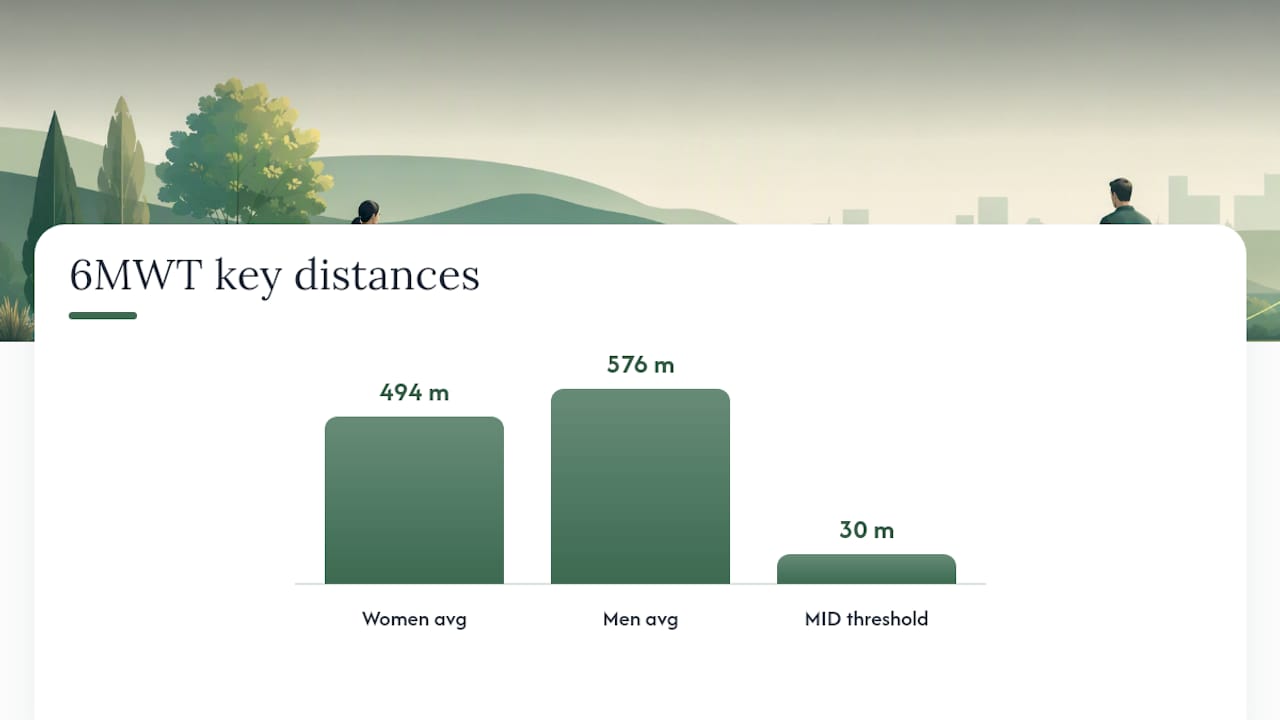
Healthy adults typically cover a distance on the order of several hundred meters in six minutes, though this range varies considerably depending on age, sex, height, and weight. Reference equations commonly cite averages around 494 meters for women and 576 meters for men, according to the StatPearls entry on the 6MWT, but any percent-predicted figure reported to a patient or in a chart should always name which reference equation generated it, since different equations can shift the predicted value meaningfully.
| Metric | What it tells you | Practical note |
|---|---|---|
| 6MWD (raw distance) | Overall functional exercise capacity | Compare to reference equation, not a fixed universal number |
| Percent predicted | Distance relative to expected value for age, sex, height, weight | Always state the reference equation used in the report |
| Change from baseline | Response to treatment, rehab, or disease progression | A change of about 30 meters is a commonly cited estimate for the minimal clinically important difference (MID) in chronic respiratory disease, though MID values vary by specific condition and study. |
| SpO2 nadir | Lowest oxygen saturation during the walk, not just end-of-test | More clinically relevant than the ending saturation alone |
| Borg score change | Perceived exertion and dyspnea before versus after | Helps distinguish cardiac versus pulmonary limitation |
That roughly 30-meter MID, drawn from the ATS/ERS technical standard, is the threshold most clinicians use to decide whether a change between two tests reflects a real clinical shift rather than day-to-day variability. It varies somewhat by condition, so a 25-meter improvement in one disease might carry different weight than the same change in another, but 30 meters remains the widely cited anchor point across chronic respiratory disease.
Heart rate response and Borg score trends add texture the distance alone can't. A patient who walks farther but reports a much higher Borg score, or whose heart rate climbs disproportionately, may be pushing through worsening cardiac strain rather than genuinely improving.
How Does the 6MWT Change Clinical Decisions?
The number on the page only matters if it changes what happens next, and in practice it changes quite a bit.
In COPD, ILD, and PAH, serial 6MWT results measure whether pulmonary rehabilitation or a new medication is actually working. A stable or improving distance over months supports staying the course; a declining trend, especially one that crosses the 30-meter MID, often triggers a treatment review or additional testing.
- Confirming whether supplemental oxygen is needed during activity, and documenting the saturation drop that justifies an oxygen prescription for insurance and reimbursement purposes
- Flagging pre-operative risk before major thoracic or abdominal surgery, where a markedly reduced distance can prompt further cardiopulmonary workup before clearing a patient for surgery
- Establishing a functional baseline for referral to pulmonary rehab or a structured chronic condition management program
- Assessing lingering exercise limitation in post-COVID-19 recovery clinics, where a reduced 6MWD despite normal resting oxygen levels often points toward exertional desaturation worth investigating further
The clinical review on 6MWT use in outpatient practices notes that oxygen-prescribing workflows built around 6MWT results carry specific coding and documentation requirements, which is one reason a standardized, well-documented protocol matters as much for billing accuracy as for clinical accuracy.
Should You Repeat the Test, and How Does Track Length Change Results?
Patients tend to walk farther the second time they take the 6MWT, purely from familiarity with the course and pacing, not from any real physiologic improvement. That's the learning effect, and it's well documented enough that guidelines build around it rather than ignoring it.
- Perform two tests on the same day when you need to measure a true change, using the better of the two as the baseline
- Allow adequate rest between tests to reduce carryover fatigue before repeating the walk
- A shorter track, 20 meters or 10 meters instead of 30, tends to produce a shorter distance for the same patient because more turnarounds slow momentum
- Always note the exact course length used so future comparisons account for it rather than assuming every 6MWT used the same setup
- Reserve incremental or endurance shuttle walk tests, or full cardiopulmonary exercise testing (CPET), for cases needing a peak oxygen uptake measurement or a more controlled, externally paced protocol
Pro Tip: If a patient's second test comes back meaningfully better than the first, don't assume the treatment worked. Check whether the improvement exceeds the roughly 30-meter MID and whether the same course length and time of day were used before crediting a therapy change.
How Should You Prepare for a 6MWT?
A little preparation goes a long way toward getting a distance that actually reflects how the patient functions day to day, rather than one thrown off by a rushed morning or the wrong shoes.
- Wear comfortable, well-fitting walking shoes and loose clothing that won't restrict movement.
- Take usual medications as scheduled, including inhalers, unless your clinician specifically instructs otherwise before the appointment.
- Avoid a heavy meal or vigorous exercise in the one to two hours before the test.
- Bring any walking aids you normally use, such as a cane or walker, and bring your portable oxygen equipment if you use supplemental oxygen at home.
- Expect to rest for about 10 minutes before starting, and know that you're allowed to slow down or pause during the walk if you need to.
- Ask your clinician when to expect results and how they'll be communicated, whether that's during the same visit or at a scheduled follow-up.
None of this requires special training on your part. The goal is simply to walk the way you normally would on your best ordinary day, not to perform above your baseline.
Where Can You Get a Standardized 6MWT Done Right?
Garden State Medical Group runs 6MWT evaluations as part of its onsite cardiopulmonary care services in North Bergen and Secaucus, pairing the walk test with pulmonary function testing and radiology under one roof rather than sending patients between separate facilities for each piece.
Staff follow the scripted ATS/ERS protocol, meaning the encouragement, timing, and course measurement stay consistent from one visit to the next, which is exactly what makes serial testing meaningful for tracking a patient's COPD, heart failure, or post-COVID recovery over months rather than guessing whether a change is real. Results feed directly into the practice's broader chronic disease management programs, so a reduced 6MWD doesn't just sit in a chart. It becomes the starting point for a pulmonary rehab referral, an oxygen prescription conversation, or a closer look with additional diagnostics when the number warrants it.
What the 6MWT Can and Can't Tell You
The 6MWT earns its place in clinical practice because it's cheap, fast, and needs no special equipment beyond a hallway and a pulse oximeter. Few tests give you that much information about real-world function for that little cost or setup time.
Its limitation is exactly what makes it useful: it's integrated, not diagnostic. A reduced distance tells you something is limiting function without telling you whether that something is the heart, the lungs, or deconditioned muscle. When you need to isolate the mechanism, peak oxygen uptake, or a specific cardiac response, a stress test or full cardiopulmonary exercise test fills that gap better than a walk test ever will.
Treat the 6MWD as a starting conversation, not a final verdict, and talk through what a specific number means for your situation with your clinician rather than comparing it against a generic online chart.
— Garden State Medical Group
Ready to Schedule Your Six Minute Walk Test?
Garden State Medical Group offers something most standalone imaging centers and pulmonary labs can't: a 6MWT result that connects directly to a physician who already has your chart, your medications, and your history in front of them, instead of a printout you have to carry to a separate follow-up appointment.
Booking is straightforward. Schedule a cardiopulmonary care visit, and bring your usual medications list, walking shoes, and any oxygen equipment or walking aids you use day to day. If you're already managing a chronic lung or heart condition, ask about pairing the walk test with a pulmonary function test during the same visit so your care team gets a fuller picture in one appointment rather than two. Call the North Bergen or Secaucus office, or request an appointment online, to get a testing date on the calendar.
Sources
- Six-Minute Walk Test - StatPearls - NCBI Bookshelf
- The 6-Minute Walk Test: Indications and Guidelines for Use in Outpatient Practices (clinical review)
This article is general information, not a substitute for advice from a qualified doctor. Consult a qualified healthcare professional about your own circumstances before acting on anything here.
FAQ
What Is a Good 6MWT Distance?
A "good" distance depends heavily on age, sex, height, and weight, since healthy adults commonly cover somewhere between 400 and 700 meters. Your result matters most compared against your own reference equation and past tests, not a single universal number.
Is 500 Meters Good for a Six Minute Walk Test?
Healthy adults typically cover several hundred meters in six minutes, though the exact value varies considerably depending on age and sex-specific reference equations. A clinician needs your percent-predicted value, calculated from your specific reference equation, to say whether your distance is reassuring or concerning.
How Far Should a 70 Year Old Walk in Six Minutes?
Expected distance drops with age, so an older adult's reference value will sit lower than a younger adult's, though exact figures depend on the specific reference equation, sex, and height used. Ask your clinician for your percent-predicted result rather than comparing raw distance to a younger adult's range.
What Counts as a Meaningful Change Between Two Tests?
A change of roughly 30 meters is the minimal clinically important difference commonly used in chronic respiratory disease, meaning smaller shifts may simply reflect normal day-to-day variability. Anything below that threshold is harder to interpret as a genuine improvement or decline.
Can Garden State Medical Group Perform a 6MWT and Follow-Up Care in One Place?
Yes. Garden State Medical Group offers onsite cardiopulmonary care, pulmonary function testing, and radiology together in North Bergen and Secaucus, so a 6MWT result connects directly to a follow-up plan rather than a separate referral.