
Why diagnostic testing sits at the center of clinical care
Diagnostic testing is the foundation on which most clinical decisions rest. Approximately 70% of major medical decisions regarding admission, treatment, and discharge depend on diagnostic test results, yet diagnostics account for only 3–5% of total healthcare budgets. That gap between influence and cost makes testing one of the highest-value activities in medicine.
The core functions of diagnostic testing in clinical care include:
- Disease identification: Confirming or ruling out a suspected condition based on objective evidence
- Case management: Guiding treatment selection, dosing, and care planning
- Treatment monitoring: Tracking how a patient responds to therapy over time
- Prognosis support: Estimating disease course and likely outcomes
- Public health surveillance: Collecting population-level data to inform outbreak response and prevention programs
No test result should stand alone. Integrating findings with the patient's history, physical examination, and clinical context is what converts raw data into a meaningful diagnosis. A positive lab value in a low-risk patient carries very different weight than the same result in someone with multiple risk factors.
What are the main categories of diagnostic tests?
Diagnostic tests fall into six primary categories, each designed to reduce uncertainty in a specific domain of clinical evaluation.
Body fluid analysis covers blood tests, urinalysis, cerebrospinal fluid analysis, and cultures. These are the most frequently ordered tests in clinical practice. A complete blood count (CBC) is among the most frequently ordered tests in hospital settings, with serum electrolytes being the single most commonly ordered analyte.
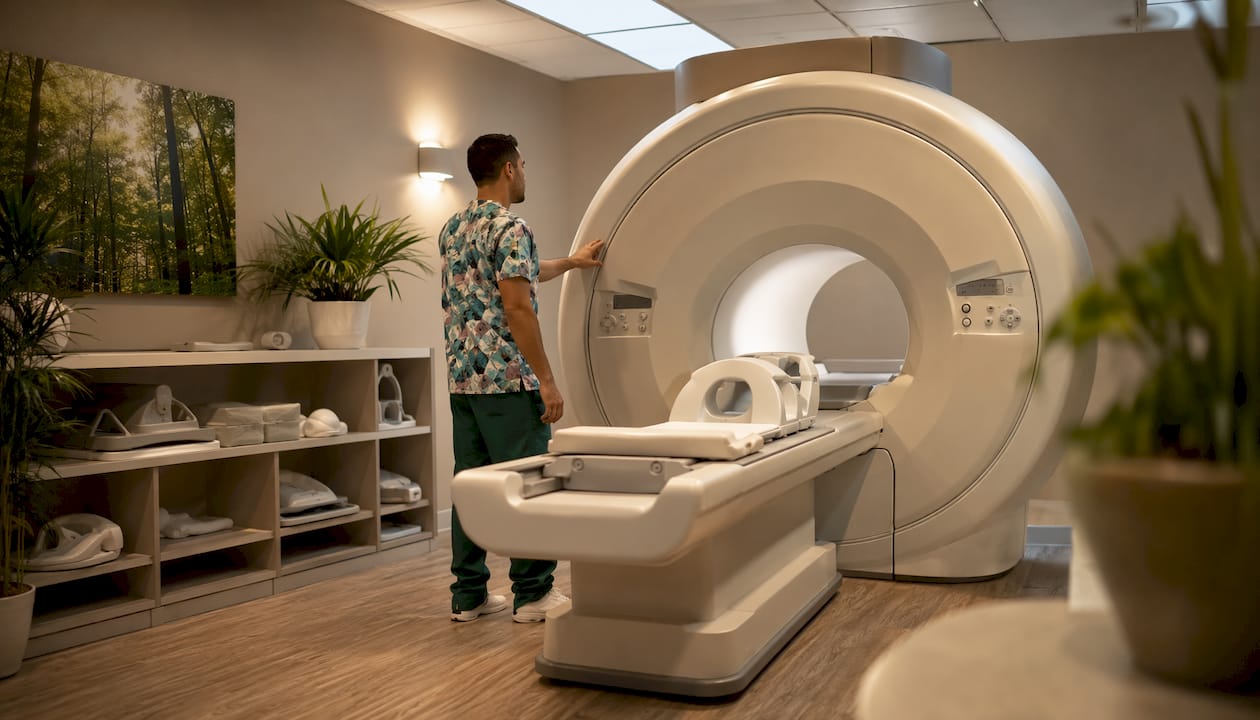
Medical imaging includes X-rays, CT scans, MRI scans, ultrasound, mammography, and PET scans. Imaging provides structural and functional information that fluid analysis cannot, making it indispensable for evaluating masses, fractures, vascular disease, and organ anatomy. The role of medical imaging in both diagnosis and ongoing monitoring has expanded considerably as technology has advanced.
Endoscopy allows direct visualization of internal structures, including the gastrointestinal tract via colonoscopy or gastroscopy. It combines diagnostic and therapeutic capability in a single procedure.
Body function measurement captures physiological performance rather than anatomy. An electrocardiogram (ECG) records cardiac electrical activity; spirometry measures lung function. These tests are particularly valuable for cardiopulmonary conditions where structural imaging alone does not tell the full story.
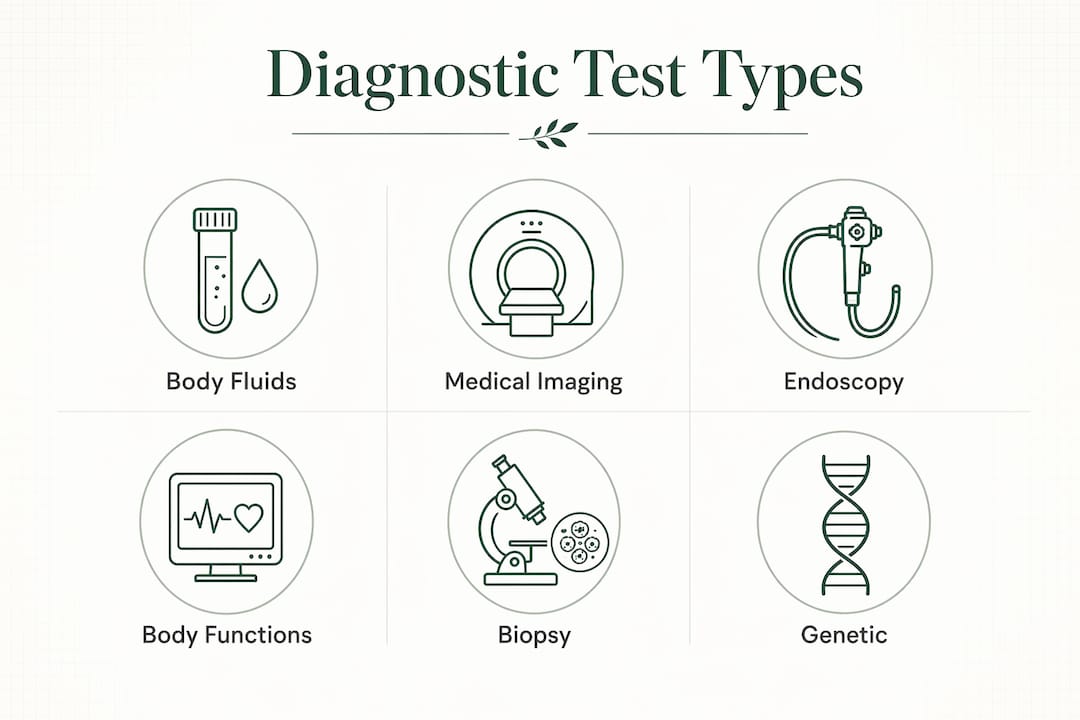
Biopsies involve removing tissue for histological examination. They remain the definitive standard for diagnosing most cancers and many inflammatory conditions.
Genetic testing analyzes DNA or RNA to identify inherited mutations, chromosomal abnormalities, or pathogen genotypes. Panels like BRCA1/BRCA2 testing or pharmacogenomic profiles increasingly shape both diagnosis and treatment selection.
| Category | Examples | Invasiveness | Typical Indications |
|---|---|---|---|
| Body fluid analysis | CBC, urinalysis, cultures | Low | Infection, anemia, metabolic disorders |
| Medical imaging | CT, MRI, X-ray, ultrasound | Low to moderate | Structural abnormalities, masses, fractures |
| Endoscopy | Colonoscopy, gastroscopy | Moderate | GI disease, cancer screening, biopsy access |
| Body function measurement | ECG, spirometry, EEG | Low | Cardiac, pulmonary, neurological conditions |
| Biopsy | Core needle, excisional | Moderate to high | Cancer diagnosis, inflammatory disease |
| Genetic testing | BRCA panels, pharmacogenomics | Low (blood/saliva) | Hereditary conditions, treatment planning |
How diagnostic tests directly affect patient outcomes
Early and accurate diagnosis is the clearest benefit of well-ordered testing. Catching type 2 diabetes through a fasting glucose or HbA1c before symptoms appear, for instance, opens a window for lifestyle intervention that can delay or prevent complications entirely. The same principle applies across conditions from thyroid disease to early-stage cancers.
The clinical roles of diagnostic testing extend well beyond initial diagnosis:
- Confirming a diagnosis when clinical findings are ambiguous or when multiple conditions share overlapping symptoms
- Staging disease to determine severity and guide treatment intensity, as with cancer staging or chronic kidney disease classification
- Monitoring treatment response through serial measurements, such as tracking HbA1c every three months in a patient managing diabetes
- Detecting complications early, before they become clinically apparent
- Guiding medication decisions, including dosing adjustments based on drug levels or organ function markers
The benefits of diagnostic assessments also depend on whether the test is being used for screening or diagnosis. Screening asymptomatic individuals carries a distinct risk-benefit profile. Screening tests require careful selection based on disease prevalence and the availability of effective treatment, because false positives in healthy populations can cause real harm through unnecessary follow-up procedures, anxiety, and expense.
Every testing decision involves weighing potential benefit against potential harm. A test that imposes radiation exposure, procedural risk, or significant cost is only justified when the result will meaningfully change what you do for the patient.
Principles and challenges in appropriate test use
The most persistent problem in diagnostic testing is not inaccuracy. It is overuse. Research shows that 40–60% of diagnostic tests ordered in clinical practice may be unnecessary, and 72% of patients subjected to excessive testing experience no clinical benefit or are actively harmed by the results.
40–60% of diagnostic tests may be unnecessary, and 72% of patients experience no clinical benefit from overtesting.
Diagnostic stewardship is the framework that addresses this problem directly. It means ordering tests based on a specific clinical hypothesis, considering the pre-test probability of disease, and asking one clear question before every order: will this result change what I do for this patient? If the answer is no, the test should not be ordered. Clinicians who order tests "just in case" without a clear hypothesis often generate confusion rather than clarity, because unexpected abnormal values trigger further testing that may never resolve into a useful answer.
Pre-test probability is central to interpreting results correctly. Testing a patient with a low probability of disease increases the likelihood that a positive result is a false positive. False-positive results expose healthy patients to unnecessary procedures, emotional distress, and financial burden, while false negatives in high-probability patients can delay treatment that was clearly needed.
Most errors in diagnostic testing occur in the pre-analytical phase, before the sample even reaches the analyzer. Improper specimen collection, labeling errors, transport delays, and inadequate patient preparation all degrade result accuracy. Controlling these variables is as important as choosing the right test.
Best practices for appropriate test utilization:
- Order tests tied to a specific diagnostic question, not as a general screen
- Assess pre-test probability before interpreting any result
- Avoid repeat testing unless the patient's condition has changed or new information is expected
- Review whether results will alter management before ordering
- Communicate critical values promptly to the treating team
- Reassess the necessity and frequency of monitoring tests regularly
Pro Tip: Before ordering any test, ask yourself: "If this result comes back abnormal, what will I do differently?" If your management plan stays the same regardless, reconsider whether the test is warranted.
Diagnostic testing in the United States: guidelines, oversight, and team-based care
In the United States, diagnostic testing operates within a structured regulatory and clinical framework. The Food and Drug Administration (FDA) oversees the approval and clearance of diagnostic devices and in vitro tests. The Clinical Laboratory Improvement Amendments (CLIA) set federal standards for laboratory quality, personnel qualifications, and proficiency testing. Together, these frameworks establish a baseline of reliability that clinicians depend on when interpreting results.
Clinical guidelines from organizations like the United States Preventive Services Task Force (USPSTF), established in 1984, shape how and when screening and diagnostic tests are applied across populations. The Choosing Wisely campaign, led by the American Board of Internal Medicine, promotes judicious test use by encouraging clinicians and patients to question tests that offer little benefit relative to their cost or risk. Studies based on clinical guideline recommendations show that 25–30% of repeat testing is unnecessary, a figure that underscores why adherence to evidence-based protocols matters.
Optimizing diagnostic procedures is not a solo effort. Physicians, advanced practitioners, nurses, laboratory scientists, and pharmacists all play a role in ensuring that the right test is ordered, collected correctly, interpreted in context, and acted upon promptly. Interprofessional coordination reduces redundant testing, catches pre-analytical errors before they affect results, and ensures that critical findings reach the right clinician at the right time.
Gardenstatemedicalgroup integrates this team-based approach across its North Bergen and Secaucus locations. The practice combines primary care, cardiopulmonary care, and radiology under one roof, allowing clinicians to coordinate test ordering, imaging interpretation, and follow-up care without the delays that come from fragmented referral networks. That coordination directly supports the kind of diagnostic accuracy that clinical guidelines call for.
Pro Tip: When reviewing a patient's test results, always cross-reference findings with the clinical picture. A result that does not fit the presentation warrants a conversation with the ordering clinician or the lab, not an automatic treatment change.
How to interpret diagnostic test results accurately
Every test result carries a probability, not a certainty. Understanding sensitivity and specificity is the starting point for accurate interpretation. Sensitivity is the true positive rate: a highly sensitive test rarely misses disease. Specificity is the true negative rate: a highly specific test rarely flags healthy patients as sick. No test scores perfectly on both, and the tradeoff between them shapes how results should be read.
Sensitivity and specificity are properties of the test itself, but predictive value depends on the population being tested. A positive result from a highly specific test in a high-prevalence population is far more meaningful than the same result in a low-prevalence group. This is why pre-test probability shapes clinical value so directly: the same test, the same result, and a different patient population can lead to opposite clinical conclusions.
Reference ranges also require careful handling. Laboratory reference intervals are typically derived from healthy populations and represent the middle 95% of values. That means 5% of healthy patients will fall outside the normal range on any given test by chance alone. A single mildly abnormal value in an otherwise well patient often warrants repeat testing or clinical correlation rather than immediate intervention.
Results must always be interpreted alongside the full clinical picture. Unrelated conditions can alter test accuracy in ways that are not always obvious. The rapid plasma reagin (RPR) test for syphilis, for example, produces a higher false-positive rate in patients with rheumatologic disease, which means the same result carries different weight depending on the patient's underlying conditions.
How test results integrate with clinical decision-making
Diagnostic testing and clinical reasoning work together, not in sequence. The decision to order a test is itself a clinical act, shaped by the differential diagnosis already forming in the clinician's mind. Results then update that differential, either narrowing it toward a single diagnosis or prompting a revised hypothesis and additional evaluation.
Tests should be ordered only when results will directly impact management. When the pre-test probability is already above the treatment threshold, meaning the clinician is confident enough to treat, further testing adds cost and delay without changing the plan. When probability is below the no-test threshold, the likelihood of disease is low enough that a negative result would not change management either. Testing is most valuable in the zone of uncertainty between those two thresholds.

Patient management decisions that flow from test results include initiating or adjusting therapy, referring to a specialist, scheduling follow-up imaging, or reassuring a patient that no further workup is needed. Each of these actions carries its own risk-benefit calculation. A clinician who improves patient outcomes through deliberate test ordering avoids both the harm of missed diagnoses and the harm of unnecessary intervention.
Communication of results is the final, often underappreciated step. Critical values, unexpected findings, and results that change a diagnosis need to reach the treating team promptly and clearly. Delays in result communication are a recognized source of patient harm, particularly in inpatient settings where management decisions happen quickly.
What emerging technologies are changing diagnostic testing
Molecular diagnostics represent the most significant shift in testing capability over the past decade. Polymerase chain reaction (PCR) assays can detect pathogen DNA or RNA with high sensitivity, enabling rapid identification of infections like SARS-CoV-2, influenza, and respiratory syncytial virus (RSV) from a single nasopharyngeal swab. Next-generation sequencing (NGS) goes further, profiling entire tumor genomes to identify targetable mutations for precision oncology.
Point-of-care testing (POCT) brings laboratory-quality results to the bedside, the clinic, and even the patient's home. Portable analyzers can now deliver troponin, glucose, INR, and influenza results within minutes, compressing the time between clinical suspicion and confirmed diagnosis. In emergency settings, that speed directly affects triage decisions and time-sensitive treatments like thrombolytics for stroke or antibiotics for sepsis.
Artificial intelligence is beginning to assist with image interpretation in radiology and pathology. Algorithms trained on large datasets can flag abnormalities in chest X-rays, retinal photographs, and dermatology images with accuracy that matches or approaches that of specialists in specific, well-defined tasks. These tools are designed to support clinician judgment, not replace it, and their integration into clinical workflows is still evolving under FDA oversight.
Liquid biopsies detect circulating tumor DNA (ctDNA) in blood, offering a less invasive alternative to tissue biopsy for cancer detection and treatment monitoring. Wearable biosensors continuously track physiological parameters like heart rate, oxygen saturation, and glucose levels, generating longitudinal data that episodic clinic visits cannot capture. The primary care and radiology and diagnostic testing services at Gardenstatemedicalgroup incorporate current diagnostic technologies to support accurate, timely clinical evaluation for patients across its New Jersey locations.
For patients managing chronic conditions, a primary care checklist that integrates routine diagnostic monitoring can help ensure that key tests are ordered at the right intervals and that results are reviewed systematically.
Gardenstatemedicalgroup offers radiology and diagnostic testing services at its North Bergen and Secaucus locations, supported by an interprofessional team that coordinates imaging, laboratory evaluation, and clinical follow-up. Whether you need a routine workup or a more specialized evaluation, the practice's primary care team is available to guide appropriate test selection and help you understand what your results mean for your health.

Key Takeaways
Diagnostic testing drives approximately 70% of major clinical decisions while consuming only 3–5% of healthcare budgets, making appropriate test selection and interpretation among the highest-value skills in clinical practice.
| Point | Details |
|---|---|
| Testing drives most decisions | Approximately 70% of major medical decisions depend on diagnostic results, yet diagnostics use only 3–5% of healthcare budgets. |
| Overtesting is widespread | 40–60% of tests may be unnecessary, and 72% of patients experience no clinical benefit from excessive testing. |
| Pre-test probability matters | Testing low-risk patients increases false positives; always assess disease likelihood before ordering. |
| Pre-analytical errors dominate | Most testing inaccuracies originate in specimen collection and transport, not in the analyzer itself. |
| Results require clinical context | Sensitivity, specificity, and reference ranges only yield accurate conclusions when interpreted alongside the full clinical picture. |
FAQ
What is the role of diagnostic testing in clinical care?
Diagnostic testing identifies disease, guides treatment decisions, monitors therapy, and supports prognosis. Test results influence approximately 70% of major clinical decisions regarding admission, treatment, and discharge.
What is the objective of a diagnostic test?
The primary objective is to reduce clinical uncertainty enough to support a specific management decision. A test should only be ordered when its result will directly change what is done for the patient.
What is the main purpose of a diagnostic assessment?
A diagnostic assessment gathers objective evidence to confirm or rule out a suspected condition, stage disease severity, or monitor treatment response, always interpreted alongside the patient's history and physical findings.
How does pre-test probability affect diagnostic test results?
Pre-test probability determines how likely a positive result reflects true disease. Testing patients with a low probability of disease increases the chance of false positives, which can lead to unnecessary follow-up procedures and patient harm.
What is diagnostic stewardship?
Diagnostic stewardship is the practice of ordering tests based on a specific clinical hypothesis, considering pre-test probability, and confirming that results will change patient management before proceeding. It reduces unnecessary testing and the harms that follow from it.