
Yes, hearing loss is linked to a higher risk of dementia, and research increasingly suggests that treating it may lower that risk for some people. A large cohort of 573,088 people found a 7% higher dementia risk tied to hearing loss, and the effect grows with severity. The takeaway for you: hearing loss is not just an inconvenience. It is one of the few dementia risk factors you can actually screen for and treat.
TL;DR:
- Using hearing aids consistently and with proper fit may reduce dementia risk, especially if worn all waking hours, though definitive proof is still pending.
- Hearing loss increases dementia risk by around 7% overall, with severity amplifying the risk up to nearly five times in some cases.
- Hearing assessments should be done with calibrated tests in a clinical environment, especially if symptoms like asking for repetitions or difficulty in noisy places occur.
- Treating hearing loss offers low risk and potential cognitive benefits, making early intervention and proper use essential.
- Protecting cardiovascular health and staying socially active are critical steps that support both hearing and brain health.
Table of Contents
- What Major Studies Say About Hearing Loss and Dementia
- Why Might Hearing Loss Affect Your Brain?
- Do Hearing Aids Actually Lower Dementia Risk?
- Online Hearing Tests vs. a Real Evaluation: What's the Difference?
- Your Prevention and Management Checklist
- A Coordinated Approach to Hearing and Cognitive Health
- Ready to Talk About Your Hearing and Memory Together?
- Sources
- FAQ
What Major Studies Say About Hearing Loss and Dementia
The strength of the connection depends heavily on which study you look at, and that variation matters more than any single number.
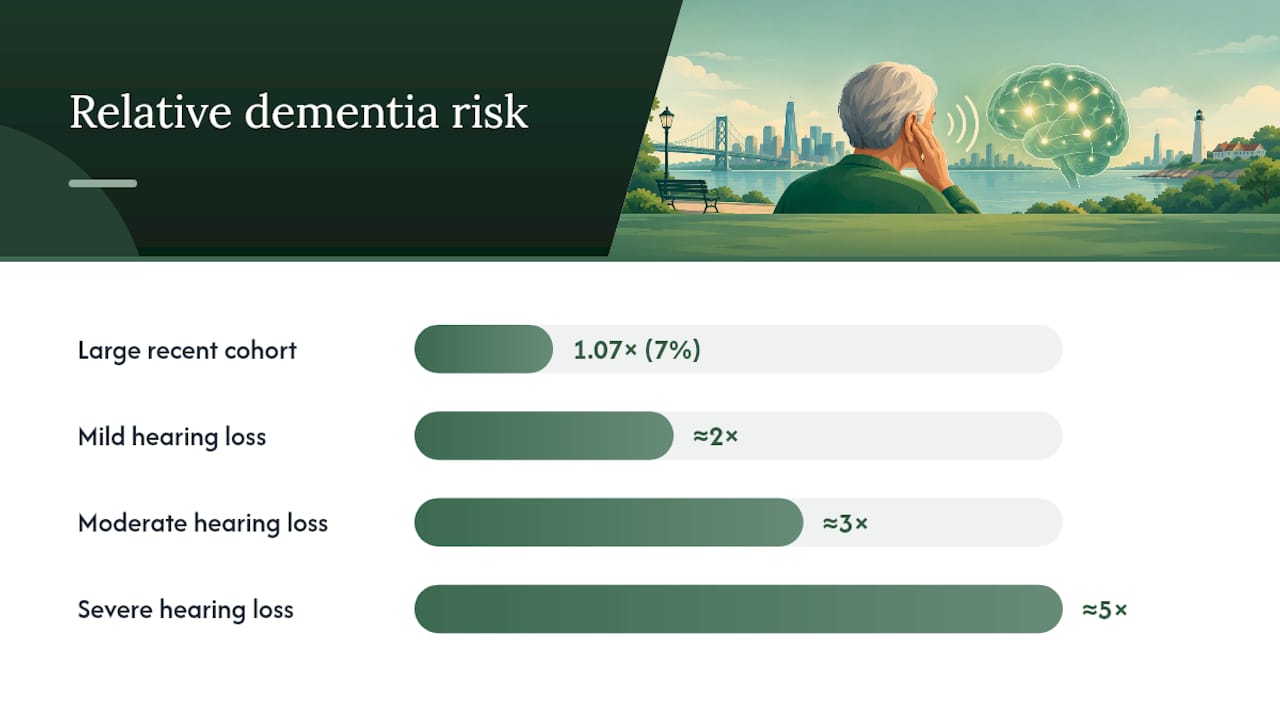
The largest and most recent cohort, covering over half a million adults, found hearing loss carried a 7% higher relative risk of dementia (hazard ratio 1.07). Within that same group, people who had hearing loss but skipped hearing aids showed noticeably higher risk than those who used them consistently, with risk differences observed between the groups.
Older, smaller cohorts paint a starker picture. Longitudinal work summarized in a recent meta-analysis found risk scaling with severity:
- Mild hearing loss: close to double the dementia risk in some cohorts
- Moderate hearing loss: roughly triple the risk
- Severe hearing loss: nearly five times the risk in the most affected groups
The number that gets cited most in public health circles comes from the Lancet Commission, which estimated that hearing loss accounts for about 8% of dementia cases worldwide, assuming the relationship is causal. That "assuming" matters. This is a population-attributable fraction, a statistical estimate of how much dementia risk might shrink if hearing loss were eliminated entirely, not proof that hearing loss directly causes dementia in any one person.
Why do the numbers swing so widely between studies? Cohort design, how hearing loss is measured (self-report versus audiometry), and how long researchers followed participants all shape the result. Observational studies also can't fully rule out reverse causation. Early, undiagnosed cognitive decline can itself make people less attentive to sound, which would inflate the apparent link.
Why Might Hearing Loss Affect Your Brain?
Researchers point to a few overlapping explanations, and none of them requires hearing loss to directly damage brain tissue.
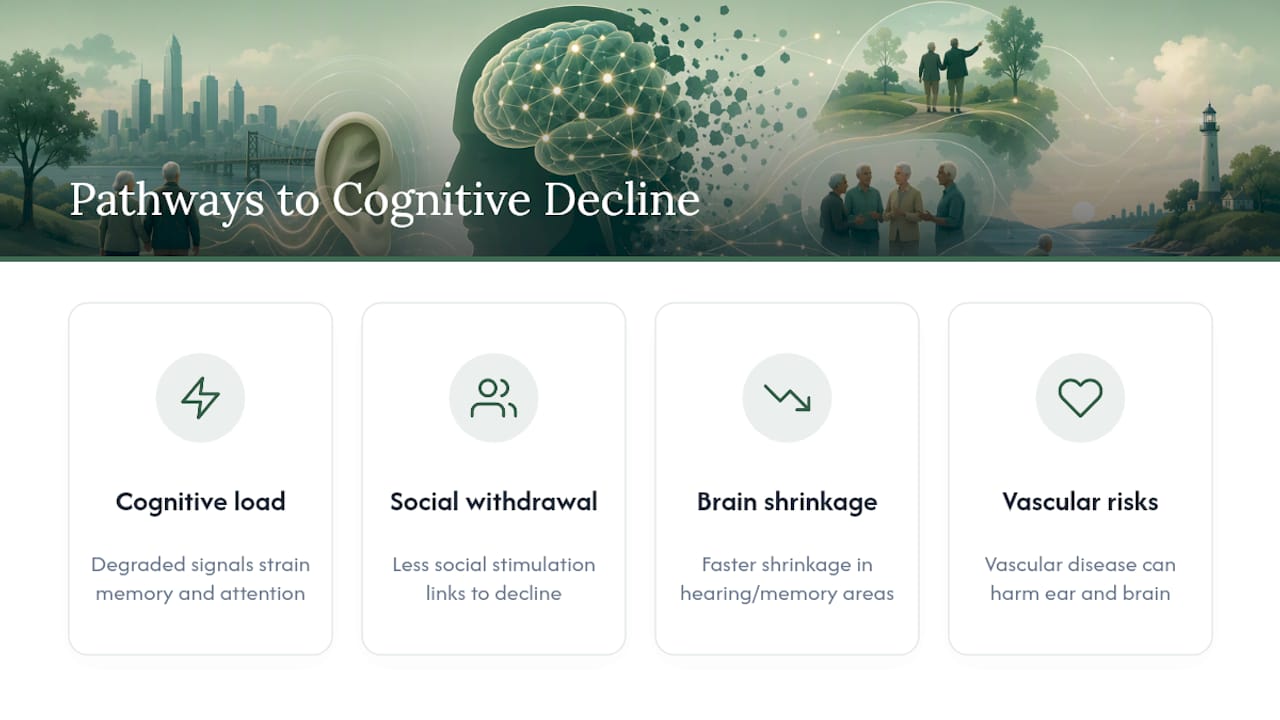
The cognitive load hypothesis is the leading one. When your ears send the brain a degraded signal, your brain has to work harder to fill in gaps, straining working memory and attention. Picture trying to follow a conversation in a loud restaurant for eight hours a day, every day. That constant strain pulls mental resources away from memory formation and other cognitive tasks.
Social withdrawal is the second pathway. Straining to hear is exhausting, so people with untreated hearing loss often start skipping conversations, gatherings, and calls. Less social and mental stimulation is independently linked to cognitive decline.
Some evidence also points to structural brain changes, including faster shrinkage in areas tied to hearing and memory. And shared risk factors, especially vascular disease, can damage both the inner ear and the brain at the same time, making hearing loss a marker of a broader problem rather than its sole cause. Expert commentary on these mechanisms frames hearing loss as a genuinely modifiable target, not just a symptom to track.
Do Hearing Aids Actually Lower Dementia Risk?
The honest answer is: probably, for some people, but the proof isn't airtight yet.
Observational data leans encouraging. In the same large cohort mentioned above, hearing-aid users showed meaningfully lower dementia risk than nonusers with equivalent hearing loss. A JAMA Otolaryngology analysis reached a similar conclusion, but flagged an important caveat: people who seek out and stick with hearing aids may already be healthier, wealthier, or more socially engaged than those who don't, which muddies any causal claim.
Randomized trial evidence, the gold standard for proving cause and effect, is still catching up. Clinicaltrials are actively testing whether treating hearing loss changes cognitive trajectories, but definitive long-term results aren't in yet.
Here's what you can act on today, regardless of how the trials turn out:
- Hearing aids carry minimal medical risk, so there's little downside to trying them if you have hearing loss.
- Benefit depends heavily on consistent daily use and a proper fitting, not just owning a device.
- Give yourself an adjustment period. Your brain needs time to relearn how to process amplified sound.
Pro Tip: Wearing your hearing aids only at appointments or big events won't give your brain the consistent input it needs. Aim for all waking hours, the way you'd wear glasses.
Online Hearing Tests vs. a Real Evaluation: What's the Difference?
Online hearing screenings are a decent first flag, but they aren't a diagnosis. Most take under 15 minutes and use whatever speakers or headphones you have on hand, which introduces plenty of room for error. A clinical evaluation is a different level of precision. Audiologists use calibrated equipment in a sound-treated booth, running tests like pure-tone audiometry, speech audiometry, and sometimes tympanometry to check how your middle ear is functioning.
You don't need a referral to justify getting checked. Watch for these signs:
- Frequently asking people to repeat themselves, especially in group settings
- Turning the TV or phone volume up louder than family members prefer
- Struggling to follow conversations in noisy restaurants or family gatherings
- Feeling unusually tired after socializing, a sign your brain is overworking to compensate
Bring a list of your current medications and any family history of hearing or memory issues to your first appointment. That context helps your clinician plan treatment rather than just confirm a diagnosis.
Your Prevention and Management Checklist
Protecting your hearing and supporting your cognition go hand in hand, and the steps overlap more than most people expect.
- Get tested. Don't wait for symptoms to become disruptive before scheduling a hearing evaluation.
- Treat what's found. Hearing aids or cochlear implants, when indicated, are the standard next step.
- Commit to consistent use. Adherence and proper fitting matter more than the device itself.
- Stay socially and mentally active. Conversation, hobbies, and community involvement keep cognitive pathways engaged.
- Manage cardiovascular health. Blood pressure, blood sugar, and regular exercise protect both your ears and your brain.
Pro Tip: Treat hearing care and memory care as one coordinated plan, not two separate errands. The same vascular risks that affect your hearing often affect your cognition.
A Coordinated Approach to Hearing and Cognitive Health
Garden State Medical Group sees hearing concerns as part of a bigger cognitive-health picture. Our Memory and Cognition Care Program works alongside primary care and diagnostic testing, so a hearing concern doesn't sit in isolation. If you're worried about your memory or your hearing, that conversation belongs in one visit, not two separate ones.
— Garden State Medical Group
Ready to Talk About Your Hearing and Memory Together?
Most patients don't realize hearing concerns and memory concerns can, and should, be evaluated at the same visit. Garden State Medical Group takes that combined approach seriously, connecting primary care with cognitive follow-up and diagnostic testing under one roof in North Bergen and Secaucus.
Your first step is simple: schedule a visit with our primary care team, describe what you're noticing, whether it's trouble following conversations or occasional memory lapses, and let your provider coordinate the right referrals from there. If cognitive changes are part of the picture, our Memory and Cognition Care Program picks up where that first conversation leaves off, and our on-site radiology and diagnostic testing means you're not shuttled across town for basic imaging. Call your local office or request an appointment online to get started.
Sources
- Hearing Loss, Hearing Aid Use, and Risk of Dementia in Older Adults (cohort study)
- JAMA Otolaryngology cohort analysis and discussion of hearing-aid use and dementia risk
This article is general information, not a substitute for advice from a qualified doctor. Consult a qualified healthcare professional about your own circumstances before acting on anything here.
FAQ
What Are the Early Warning Signs of Dementia?
Common early signs include memory lapses that disrupt daily life, difficulty planning or solving problems, confusion about time or place, and withdrawal from social activities. Since untreated hearing loss can mimic some of these symptoms, particularly social withdrawal and apparent confusion in conversation, a hearing evaluation is a reasonable first step before assuming cognitive decline.
Is Hearing Loss Common in People With Dementia?
Yes, hearing loss and dementia frequently occur together, and studies find people with dementia have notably higher rates of untreated hearing impairment than the general older population. This overlap is part of why the Lancet Commission flagged hearing loss as a major modifiable dementia risk factor.
What Are the Daily Effects of Untreated Hearing Loss?
Beyond dementia risk, untreated hearing loss is linked to higher rates of depression, social isolation, and workplace difficulties. It also increases mental fatigue, since your brain has to work harder throughout the day just to follow ordinary conversation.
What Are the Signs of Sudden Hearing Loss?
Sudden hearing loss shows up as a rapid drop in hearing, often in one ear, sometimes with ringing (tinnitus) or a feeling of fullness in the ear. This is different from the gradual, age-related decline discussed above and needs prompt medical attention, ideally within 72 hours, since early treatment improves recovery odds.
Can Treating Hearing Loss Actually Prevent Dementia?
No study has proven that hearing aids prevent dementia outright, but observational data consistently shows lower dementia risk among consistent hearing-aid users compared to nonusers with similar hearing loss. Randomized trials are underway to test this more rigorously, and in the meantime, treating hearing loss carries real quality-of-life benefits with minimal risk.