Yes, flu season has started in Secaucus and across New Jersey. The state's most recent respiratory report, for the week ending November 7, 2026, shows influenza activity rising and higher than at this point last year. The practical answer for you is simple: get your flu vaccine if you have not yet, know whether you are in a higher-risk group, and call your primary care provider early if symptoms start. Early contact matters because flu antiviral drugs work best when started within two days of getting sick.
This guide explains what the latest reports say, when flu usually peaks here, who needs to be most careful, which vaccine fits which age, and how to decide when to get care. It is written for adults, families and older residents in Secaucus and North Bergen.
TL;DR
- New Jersey's report for the week ending November 7, 2026 shows flu activity rising and higher than at the same time last year, with the heaviest hospital burden among adults 65 and older.
- Flu in New Jersey typically peaks between December and February, and cases can occur as late as May, so a vaccine given now still protects you.
- Adults 65 and older, people with asthma, diabetes, or heart and lung disease, young children and pregnant women are at higher risk of serious complications.
- The state recommends a yearly flu vaccine for everyone 6 months and older, and a high-dose vaccine for adults 65 and older when possible.
- If you are higher risk and develop flu symptoms, call your provider the same day. Antivirals work best within 2 days.
Table of Contents
- What the latest reports show for Secaucus and New Jersey
- When flu season starts and peaks in New Jersey
- Who is at higher risk of serious flu complications
- Which flu vaccine fits you
- Everyday steps that lower your risk
- When to call your provider
- Insurance and cost questions
- Care for flu season close to home
- Our perspective on flu season
- FAQ
- Sources
What the latest reports show for Secaucus and New Jersey
There is no separate flu report for Secaucus. Hudson County residents are covered by the state's surveillance, which the New Jersey Department of Health (NJDOH) publishes weekly in its respiratory illness report.
In the report for the week ending November 7, 2026, NJDOH said seasonal influenza activity continued to rise and was higher than levels seen at this time last year. Case counts, emergency department visits, outpatient visits, test positivity and influenza-associated hospitalizations were all increasing. The highest hospitalization burden was among adults 65 and older.
That trend started quietly. In its October 14, 2026 release, NJDOH described activity as still low but already higher than the year before. In a few weeks it moved from low to clearly rising, which is the usual pattern as people spend more time indoors.
The national picture
The CDC's FluView report for Week 45, ending November 14, 2026, gives the national view. Of 613 influenza viruses reported by public health laboratories, 608 were influenza A and 5 were influenza B. Among 365 influenza A viruses that were subtyped, 352 (96.4%) were A(H1N1)pdm09 and 12 (3.3%) were A(H3N2).
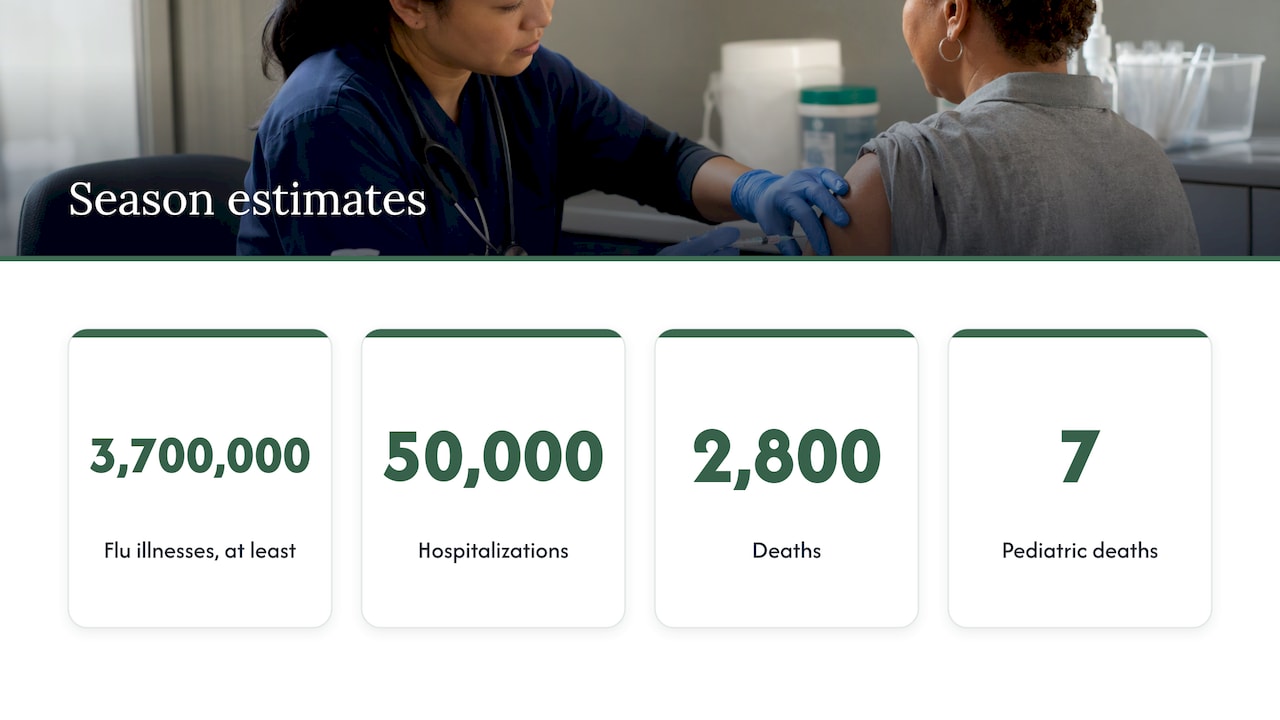
The same report estimates at least 3,700,000 flu illnesses, 50,000 hospitalizations and 2,800 deaths so far this season, with seven pediatric deaths reported to date. The CDC's preliminary severity classification is low across all age groups. It also cautions that an early rise in activity does not necessarily mean a higher peak or a more severe season.
These numbers change every week. NJDOH and the CDC update their reports weekly, so check their pages for the latest week rather than relying on any single figure, including the ones here.
How to read a flu activity report
A few details help you avoid misreading the numbers:
- Activity level is not severity. NJDOH's surveillance FAQ explains that activity levels describe how widespread flu is across the state's five regions, not how severe the illness is.
- Counts are not exact. The same FAQ notes that not everyone who has flu gets tested, so reported counts understate real illness, and they cannot be compared year to year because new laboratories are added over time.
- Trends matter more than a single number. "Rising and higher than last year" tells you more than any one count.
When flu season starts and peaks in New Jersey
NJDOH says flu season in New Jersey typically begins in late fall, runs through winter into early spring, usually peaks between December and February, and can produce cases as late as May.
The CDC's flu season page gives the national history. Over 40 seasons, from 1982-83 through 2021-22, February was the most common peak month (17 seasons), followed by December (7 seasons), January (6) and March (6). Activity often begins to climb in October.
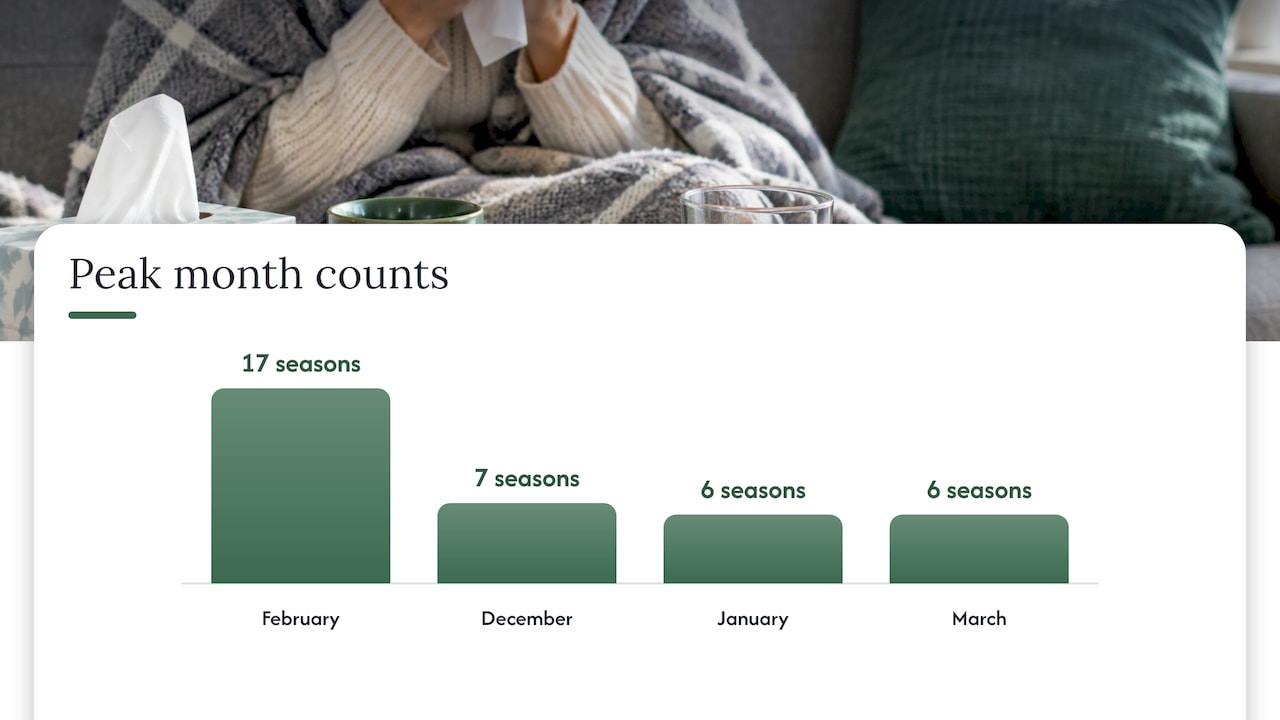
For you, this means two things. First, with the state's current numbers rising in November, the heaviest weeks are likely still ahead. Second, it is not too late to be vaccinated. The CDC recommends getting vaccinated ideally by the end of October, but the season lasts well past that, and protection is worth having through the winter peak and into spring.
Who is at higher risk of serious flu complications
Most healthy adults recover from flu at home. Some people are more likely to develop serious complications such as pneumonia or a worsening of an existing condition. The CDC lists these groups as higher risk:
- Adults 65 and older
- People with chronic conditions such as asthma, diabetes, or heart and lung disease
- Pregnant women
- Young children
This matches what New Jersey is seeing this season, with adults 65 and older carrying the highest hospitalization burden so far. If you or a family member fits one of these groups, treat flu season as a time to plan ahead: get vaccinated, know who you will call if you get sick, and keep your usual medications and appointments on schedule.
Chronic conditions are where a regular care team makes the biggest difference. Someone with diabetes, for example, needs blood sugar monitoring during an illness, and someone with COPD or asthma needs a plan for breathing symptoms. Those are conversations to have before you are sick, not during the worst day of fever.
Which flu vaccine fits you
The CDC recommends a flu vaccine every season for everyone 6 months and older. New Jersey's recommendation is the same. In its September 29, 2026 executive directive, NJDOH recommended an annual flu vaccine for everyone 6 months and older, including children, adults 19 and older, pregnant patients, immunocompromised individuals and healthcare personnel.
Adults 65 and older
Older adults make up the group with the highest hospitalization burden this season, and the recommendation is more specific for them. The CDC preferentially recommends Fluzone High-Dose, Flublok recombinant or Fluad adjuvanted vaccine for adults 65 and older. If none of those is available, any age-appropriate flu vaccine is acceptable. NJDOH's directive likewise says adults 65 and older should receive a high-dose vaccine when possible.
The American Academy of Family Physicians' 2026-2027 guidance adds that Moderna's mFlusiva (mRNA-1010), approved by the FDA in August 2026, is among the preferentially recommended enhanced vaccines for this age group, alongside high-dose, adjuvanted and recombinant products.
Pregnancy and weakened immune systems
NJDOH advises that pregnant and immunocompromised patients should avoid the nasal spray formulation and receive an injected vaccine instead. If either applies to you, mention it when you schedule so the right product is ready.
Children
NJDOH notes that the Vaccines for Children program provides no-cost vaccines to eligible children through age 18, and that 317-funded programs exist for uninsured adults. Ask about eligibility when you call to book.
What is in this year's vaccine
You do not need to choose strains, but it helps to know the vaccine is matched to what is circulating. For 2026-2027, egg-based vaccines contain an A/Missouri/11/2025 (H1N1)pdm09-like virus, an A/Darwin/1454/2025 (H3N2)-like virus and a B/Tokyo/EIS13-175/2025 (B/Victoria)-like virus, according to the AAFP guidance. Cell-based and recombinant vaccines use closely related strains. Since the great majority of subtyped viruses reported nationally so far are H1N1, that component is the one in play this season.
One visit for several vaccines
NJDOH and Governor Sherrill's October release encouraged residents to get flu, COVID-19 and RSV vaccines at the same visit when eligible. Our guide to updating your adult vaccine schedule in one visit explains how to line up what you need. Adults 65 and older may also want to read about the pneumonia vaccine for adults, since pneumonia is one of the complications flu can lead to.
Everyday steps that lower your risk
The vaccine is the first step, and the CDC lists several habits that add to it. According to the CDC's prevention guidance, these include:
- Washing your hands often.
- Covering coughs and sneezes.
- Avoiding close contact with sick people.
- Avoiding touching your eyes, nose and mouth.
- Improving indoor air quality, for example by bringing in fresh air or using filtration.
- Staying home while sick, until your symptoms are improving overall and you have had no fever for at least 24 hours without fever-reducing medication.
Masks are an optional extra layer, particularly useful if you are in a crowded indoor space or caring for someone who is high risk.
In Secaucus, where many people commute through Secaucus Junction and work in offices, warehouses and shared spaces, staying home when sick is the habit that matters most for everyone around you, and it is the one people skip most often. Plan ahead: tell your employer early, and ask your provider about a telemedicine visit so you can be seen without sitting in a waiting room or travelling while feverish.
If you use your voice for work, such as teaching, calling, presenting or singing, winter illness can strain it. These preventative vocal health steps cover day-to-day throat care that fits alongside the flu precautions above.
When to call your provider
The CDC advises that flu antiviral drugs work best when started within 2 days of getting sick, but they can still help if started later, especially in people at higher risk or who are very sick. People at higher risk who have flu symptoms should call their health care provider early.
That translates into a simple rule:
- If you are 65 or older, pregnant, or have asthma, diabetes, heart disease or lung disease: call on the first day of fever, cough, body aches or sudden fatigue. Do not wait to see if it passes.
- If you are otherwise healthy: rest at home, drink fluids and call if symptoms are severe, last longer than expected, or improve and then return worse.
- If someone has trouble breathing, chest pain, confusion or cannot keep fluids down: call 911 or go to an emergency room.
A fever and cough that keep getting worse, or breathlessness that appears after you seemed to be recovering, can point to pneumonia or bronchitis rather than flu alone. Our article on pneumonia vs. bronchitis explains the differences and how care works in New Jersey.
Chronic conditions during flu season
If you manage a long-term condition, the weeks of peak flu are the time to confirm your plan. That means having enough of your regular medications, knowing which symptoms should trigger a call, and keeping follow-up visits. People with lung or heart conditions can talk with their provider about whether a recent pulmonary function test, EKG or other diagnostic is due, so that any change in how you feel can be compared against a recent baseline.
Insurance and cost questions
Coverage is one reason people delay care. If you are not sure what your plan covers for vaccines or visits, our New Jersey health insurance coverage guide walks through practical tips. Medicare and Medicaid beneficiaries should bring their cards to the visit, and anyone who is uninsured can ask about the state programs for adults and children described above.
Care for flu season close to home
Garden State Medical Group provides primary care for adults and families at our Secaucus office and in North Bergen. Our primary care team can review your vaccine history, talk through which flu vaccine fits your age and health, and help you decide what to do if symptoms begin. We also offer telemedicine visits, and we accept Medicare and Medicaid.
If you live with a lung or heart condition, our cardiopulmonary care services and on-site diagnostic testing are available in the same practice, and our chronic disease programs support people managing diabetes, heart, lung and bone health.
To book a visit, start from our home page.
Our perspective on flu season
Flu season is predictable in its timing and unpredictable in how it hits each person. That is why we focus on preparation rather than reaction.
At Garden State Medical Group, we bring primary care, cardiopulmonary care, on-site diagnostics and chronic disease programs together under one roof for the communities of North Bergen and Secaucus. For a patient with diabetes, heart disease or lung disease, that matters in November. The same team that follows your condition throughout the year can look at your vaccine history, your medications and your risk, and give you one plan for the winter.
We believe prevention works best when it is explained clearly. A yearly flu vaccine, a plan for who to call, and a clear sense of what symptoms need attention are small steps that make a hard week much easier. Our approach combines integrative and functional medicine with education, so you understand what is happening and what to do next, not only what to take.
If you are 65 or older, have a chronic condition, or are caring for family members who do, we encourage you to talk with us before you get sick.
Garden State Medical Group
FAQ
Is it flu season in Secaucus right now?
Yes. New Jersey's report for the week ending November 7, 2026 showed influenza activity rising and higher than at the same point last year. Flu typically peaks in the state between December and February, so activity may keep climbing.
Which month is worst for flu?
Over 40 seasons through 2021-22, February was the most common peak month nationally, followed by December, then January and March. Any single season can differ, and flu cases can still occur as late as May.
Is it too late to get a flu shot?
No. The CDC suggests getting vaccinated ideally by the end of October, but flu season runs through winter and into spring, so a vaccine given now still helps. Adults 65 and older should ask for a high-dose, adjuvanted or recombinant vaccine when possible.
How long should I stay home with the flu?
The CDC advises staying home until your symptoms are improving overall and you have had no fever for at least 24 hours without taking fever-reducing medication. If you are higher risk, call your provider early, because antivirals work best when started within 2 days.
Sources
- NJDOH Respiratory Illness Surveillance Report, week ending November 7, 2026
- CDC Weekly US Influenza Surveillance Report, Week 45, 2026
- CDC: Flu Season
- NJDOH: Influenza (Flu)
- NJDOH: Influenza surveillance FAQs
- CDC: Preventing Seasonal Flu
- CDC: Who Needs a Flu Vaccine
- NJDOH executive directive, September 29, 2026
- NJDOH news release, October 14, 2026
- AAFP 2026-2027 immunization recommendations